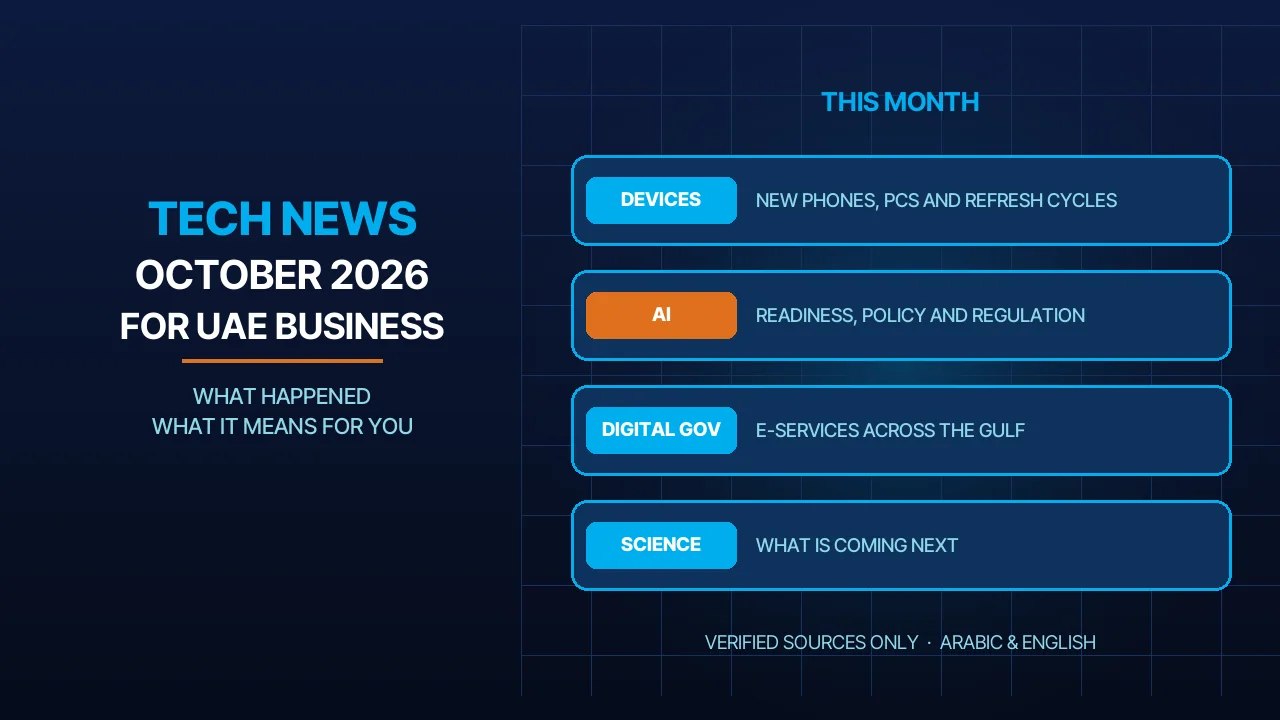
We publish this digest once a month because technology news arrives faster than any manager can read it, and most of it does not need a decision. This month we checked every item against the vendor’s own announcement or the official record before including it, and dropped what we could not confirm. The themes for October 2026: a full round of new phones and PCs from Apple, Google, Samsung, Huawei and Microsoft; AI companies rehearsing for a bad day; digital government in Qatar and an energy-and-technology week in Riyadh; and a timekeeping result from China that will matter to navigation long before it matters to your office.
Quick Answer
Apple shipped iPhone 18 Pro and iPhone 18 Pro Max and announced iPhone Duo, its first foldable, with iOS 27 and a beta of Siri AI; Google released the Pixel 11 family on Tensor G6; Samsung released Galaxy Z Fold8 Ultra, Fold8 and Flip8; Huawei launched HUAWEI Mate XT 2 and HUAWEI WATCH GT 7; and Microsoft opened pre-orders for Surface Laptop Ultra under a “hybrid intelligence” plan for Windows. AI executives are reportedly rehearsing for a major incident. Qatar’s Ministry of Justice launched a new Official Gazette website and the Al Meezan legal portal. Riyadh is hosting the 25th WPC Energy Congress. And a Tsinghua team published a working thorium-229 nuclear clock in Nature.
New phones and PCs: a refresh cycle lands all at once
Apple announced iPhone 18 Pro and iPhone 18 Pro Max on 9 September, with pre-orders from 12 September and availability from 18 September. The headline changes are a 48MP Fusion Main camera with variable aperture, the A20 Pro chip, and Apple Reference Image, which signs sensor data so a photo can be checked for edits later. Both run iOS 27, which was released as a free update on 14 September, and give access to Siri AI, a new version of Siri that is rolling out in beta. The same day Apple introduced iPhone Duo, the first foldable iPhone: a 7.6-inch inner display, a 5.4-inch outer display, Touch ID in the side button, an IP68 rating, with pre-orders from 16 October and availability from 23 October.
Google unveiled Pixel 11, Pixel 11 Pro and Pixel 11 Pro XL on 12 August, built on the Google Tensor G6 chip running the latest Gemini Nano model, with all three on shelves from 20 August. Pixel 11 Pro Fold followed on the same schedule. Samsung announced Galaxy Z Fold8 Ultra, Galaxy Z Fold8 and Galaxy Z Flip8 at Galaxy Unpacked in London on 22 July; Fold8 weighs 201 g, runs the Snapdragon 8 Elite Gen 5 Mobile Platform for Galaxy with a 4,800 mAh battery, and Flip8 turns its FlexWindow into an AI-native cover interface.
Huawei held its HarmonyOS 7 and HUAWEI Mate XT 2 launch event on 7 September; Huawei describes the Mate XT 2 as a tri-fold phone, the first with its logical-fold τ chip, running HarmonyOS 7. Its Munich event on 2 September brought HUAWEI WATCH GT 7 to global markets, with up to 21 days of battery.
Microsoft’s news is about Windows as much as hardware. On 7 October it set out “hybrid intelligence”: AI agents that run on the PC when they can and in the cloud when they should, with Microsoft Execution Containers now generally available on Windows so an organisation can control what an agent may access and see which agent did what. The same day it opened pre-orders for Surface Laptop Ultra, built around the NVIDIA RTX Spark Superchip with up to 128 GB of unified memory, pitched at developers and AI builders. For ordinary office work the relevant devices are the June ones: the 13-inch Surface Pro and the 13.8-inch and 15-inch Surface Laptop on Snapdragon X2, on sale from 16 June with Surface for Business from 14 July.
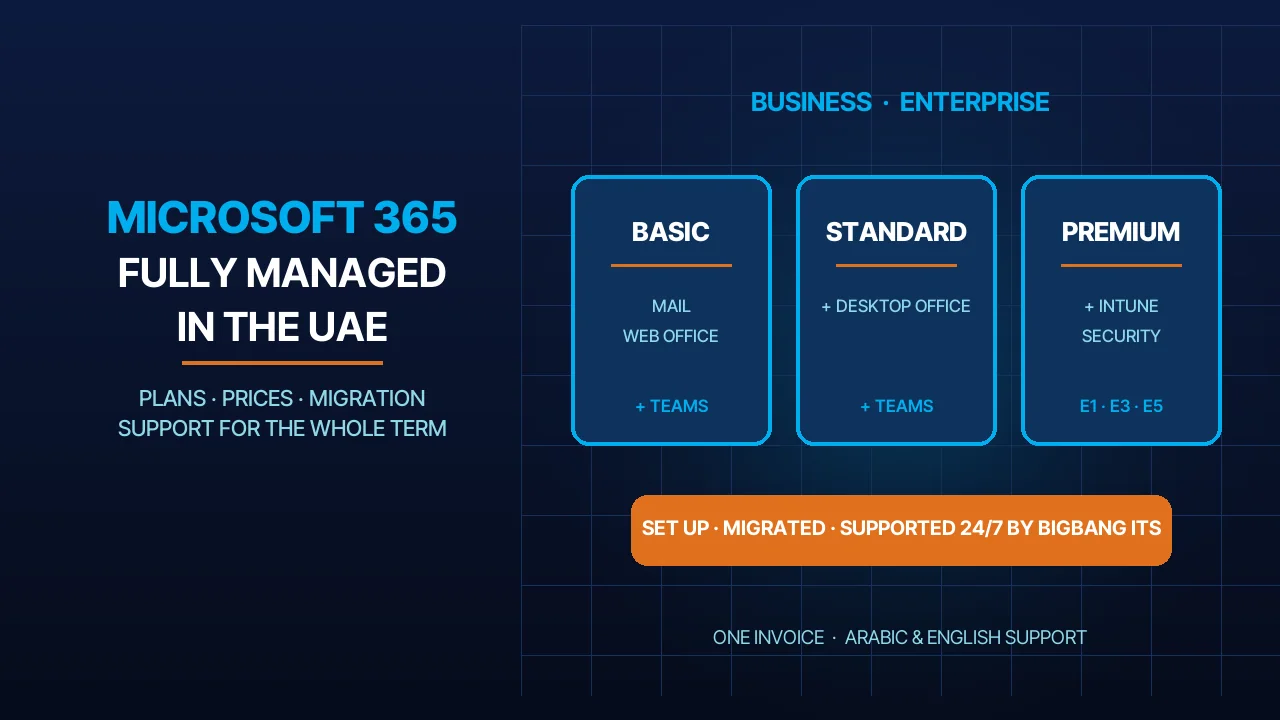
What it means for your business: The devices are not the decision; the policy is. Every one of these phones ships with an on-device assistant that reads screens, messages and files, and Windows now assumes agents will run on the PC itself. Before the next batch of staff handsets arrives, we would decide which assistants are allowed on company data, enrol the devices in mobile device management, and turn on two-factor authentication everywhere. If your team runs on Microsoft 365, the Surface for Business line and Execution Containers are the pieces to evaluate together; our Microsoft 365 service covers the licensing and the device policy in one plan.
AI companies rehearse for a bad day
According to an Axios report published on 9 October and summarised by Decrypt, executives at Anthropic, OpenAI and other AI companies are privately war-gaming the public and political fallout of a catastrophic AI event, most likely a large cyberattack on finance, internet access, power or water. Many industry insiders quoted in the report expect a major incident within 6 to 12 months. OpenAI said its preparedness exercises cover a range of scenarios that are not treated as inevitable; Anthropic declined to comment. The planning includes red-teaming worst cases and briefing legislators. Gizmodo notes the report came just over a week after major AI companies signed a voluntary, non-binding set of safety standards at the White House. We could not reach the original Axios page, so we cite the two outlets that reproduce its claims.
What it means for your business: You do not need to predict the incident to prepare for its shape. The scenarios being rehearsed are outages of banking, connectivity and utilities, and the practical defence for a company of 20 or 200 people is the same as it has always been: tested backups, a written list of what to do when a service is down, and no single person holding every password. Separately, if staff already paste customer data into AI tools, now is the time for a short written policy on which tools and which data; our 90-day AI enablement plan starts with exactly that step, and our AI solutions work runs inside that policy rather than around it.
Digital government: Qatar’s legal portal and Riyadh’s energy week
On 11 October Qatar’s Ministry of Justice launched a new Official Gazette website and the Qatari legal portal Al Meezan. The Ministry’s Undersecretary, Saeed bin Abdullah Al Suwaidi, described it as a step toward an integrated national system for legal knowledge, giving access to legislation, judicial rulings, legal opinions and agreements, and said it would raise legal certainty and ease of doing business for investors. Al-Sharq’s report adds that content is in Arabic and English, that electronic publication in the Gazette now carries legal authority without waiting for the printed issue, that texts are verified with a hash key, and that the public can comment on draft and existing legislation; the sites are officialgazette.gov.qa and almeezan.qa.
In Saudi Arabia, the 25th WPC Energy Congress runs in Riyadh from 11 to 15 October, the first time the congress has been held in the Kingdom, according to WPC Energy. The Ministry of Energy is hosting it inside an energy week that also includes the 17th ministerial meeting of the International Energy Forum and the 17th Clean Energy Ministerial, with more than 70 ministers and 300 CEOs expected in Riyadh. The programme includes sessions on artificial intelligence and digital technology in energy operations, with Saudi Aramco, Siemens Energy, SLB, Hitachi Energy and Microsoft among the listed participants. We found no confirmed figures for new investment announced at the event as of today, so we report none.
What it means for your business: Qatar’s move is the pattern the whole Gulf is following: official records go digital first, the digital copy becomes the legally binding one, and businesses are expected to find and act on them online. The UAE equivalent that touches you directly is e-invoicing; our UAE e-invoicing deadlines guide lists what has to be ready and when. If you trade with Qatar or Saudi Arabia, bookmark the new portals and check whether your contracts cite laws by their printed Gazette issue, since the online text now governs.
Science: a nuclear clock that keeps running
A team at Tsinghua University led by Ding Shiqian published a working thorium-229 nuclear clock in Nature on 7 October. The paper reports stabilising a continuous-wave 148.4 nm vacuum-ultraviolet laser to a nuclear transition in thorium-doped calcium fluoride crystals, with clock frequencies from two separately made crystals agreeing at the 10-13 level, which the authors describe as a reproducible solid-state platform for compact nuclear clocks. CGTN reports that a European team achieved nuclear-clock operation independently at about the same time, and that the potential applications are satellite navigation and deep-space exploration, where a clock less sensitive to its environment matters most. Tsinghua says the group built the 148 nm laser itself.
What it means for your business: Nothing this quarter, and we would be suspicious of anyone who says otherwise. Better clocks eventually mean better positioning and tighter time synchronisation, but that route runs through satellite operators and standards bodies over years. Read it as a reminder that “quantum” headlines describe research milestones, not products, which is the same test we apply in our three-year technology roadmap.
Three things to do this month
- Check the device refresh cycle and MDM. List every staff phone and laptop older than 3 years, decide which get replaced from this cycle, and make enrolment in mobile device management a condition of connecting to company email. Decide now whether Siri AI, Gemini or Copilot features are permitted on devices that hold customer data.
- Write the AI tool policy. One page: which tools are approved, which data classes may never be pasted, who approves exceptions. Pair it with the data-handling obligations in the UAE data protection law, and keep AI workloads with regulated data on infrastructure whose location you can name; our Dubai data centre options exist for that reason.
- Test the outage plan. Pick one afternoon, assume your bank portal and internet line are down, and walk through how invoices go out, how customers reach you and who can restore the backups. Fix what fails; that is the whole exercise.
Frequently Asked Questions
Should a UAE business buy foldable phones for staff this year?
Only where the larger screen replaces a tablet, for example field sales or site supervisors. Apple, Google, Samsung and Huawei all now sell foldables, so support and cases are no longer a problem, but prices are higher and repairs slower. For most staff a standard model enrolled in device management is the better purchase.
Does the Surface Laptop Ultra make sense for a small company?
Rarely. Microsoft positions it for developers, 3D work and running large AI models locally, with up to 128 GB of unified memory. A company of 5 to 300 people usually needs reliable Surface Pro or Surface Laptop units on Microsoft 365, and should spend the difference on backups, security and training rather than on one very fast machine.
Will the nuclear clock change anything for my network or payments?
Not for years. The Tsinghua result is a laboratory prototype published in Nature, and the stated applications are satellite navigation and deep-space missions. Any benefit for business networks would arrive through updated navigation satellites and time standards, which take a decade to roll out. Keep your current NTP and PBX time settings and move on.
Sources
- Apple Newsroom, “Apple debuts iPhone 18 Pro and iPhone 18 Pro Max”, 9 September 2026 — apple.com (accessed 2026-10-12)
- Apple Newsroom, “Apple unveils iPhone Duo”, 9 September 2026 — apple.com (accessed 2026-10-12)
- Google, The Keyword, “Google introduces Pixel 11, Pixel 11 Pro and Pixel 11 Pro XL”, 12 August 2026 — blog.google (accessed 2026-10-12)
- Google, The Keyword, “Google’s most sophisticated foldable: Pixel 11 Pro Fold” — blog.google (accessed 2026-10-12)
- Samsung Global Newsroom, “Samsung Galaxy Z Fold8 Ultra, Fold8 and Flip8: Foldables, Perfected for Every Way of Living”, 22 July 2026 — news.samsung.com (accessed 2026-10-12)
- Huawei, “HarmonyOS 7 | HUAWEI Mate XT 2 and all-scenario new product launch event”, 7 September 2026 (Chinese) — consumer.huawei.com (accessed 2026-10-12)
- Huawei (Chinese), “HUAWEI Mate XT 2 非凡大师” product page — consumer.huawei.com (accessed 2026-10-12)
- Huawei, “HUAWEI Innovative Product Launch”, Munich, 2 September 2026 — consumer.huawei.com (accessed 2026-10-12)
- Huawei UK, “HUAWEI WATCH GT 7” product page — consumer.huawei.com (accessed 2026-10-12)
- Microsoft Source EMEA, “Building Windows for Hybrid Intelligence”, 7 October 2026 — news.microsoft.com (accessed 2026-10-12)
- Windows Blog, “Pre-order our most powerful Surface devices ever”, 7 October 2026 — blogs.windows.com (accessed 2026-10-12)
- Windows Blog, “Introducing the next Surface Pro and Surface Laptop, built for performance and flexibility”, 16 June 2026 — blogs.windows.com (accessed 2026-10-12)
- Decrypt, “OpenAI and Anthropic Are Quietly Rehearsing for the Day After an AI Catastrophe” (reporting Axios, 9 October 2026) — decrypt.co (accessed 2026-10-12)
- Gizmodo, “AI Companies Are Preparing to Shape the Rules After Everything Goes Wrong” — gizmodo.com (accessed 2026-10-12)
- Qatar News Agency, “Justice Ministry Undersecretary: Digital Platforms Strengthen Legal Framework, Boost Investment”, 11 October 2026 — qna.org.qa (accessed 2026-10-12)
- Al-Sharq (Arabic), “تدشين أول منظومة رقمية عالمية للجريدة الرسمية”, 12 October 2026 — al-sharq.com (accessed 2026-10-12)
- WPC Energy, “25th WPC Energy Congress, Riyadh, 11–15 October 2026” — wpcenergy.org (accessed 2026-10-12)
- Al-Eqtisadiah (Arabic), “الرياض تجمع قادة الطاقة في العالم”, 29 September 2026 — aleqt.com (accessed 2026-10-12)
- Gulf Daily News, “25th WPC Energy Congress to bring global energy leaders to Riyadh”, 24 September 2026 — gdnonline.com (accessed 2026-10-12)
- Nature, “A thorium-229 optical nuclear clock with feedback loop”, 7 October 2026 — nature.com (accessed 2026-10-12)
- CGTN, “Chinese scientists develop nuclear optical clock”, 8 October 2026 — news.cgtn.com (accessed 2026-10-12)
- Tsinghua University (Chinese), “向更精准计时迈进 中国科学家成功研制核光钟” — tsinghua.edu.cn (accessed 2026-10-12)
Where We Are
BIGBANG ITS has planned and run technology for UAE businesses since 2003, headquartered at the Sharjah Research, Technology and Innovation Park with a branch in Business Bay, Dubai. Support runs 24/7 and the office is open Saturday to Thursday, 09:00–18:00 Gulf time. To talk about any of this month’s topics, contact us or message us on WhatsApp.
Talk to us directly — we usually reply within minutes during business hours.