In many of the UAE companies we visit, somebody is already using AI. A salesperson drafts quotes with ChatGPT on a personal account; an accountant asks Claude about a contract clause. The results are uneven, nobody owns the practice, and customer names may be sitting in a consumer account the company cannot see or delete. This article is for the owner or general manager of a company with 5 to 50 staff who wants to turn that into something the business runs on, without a data team.
Quick Answer
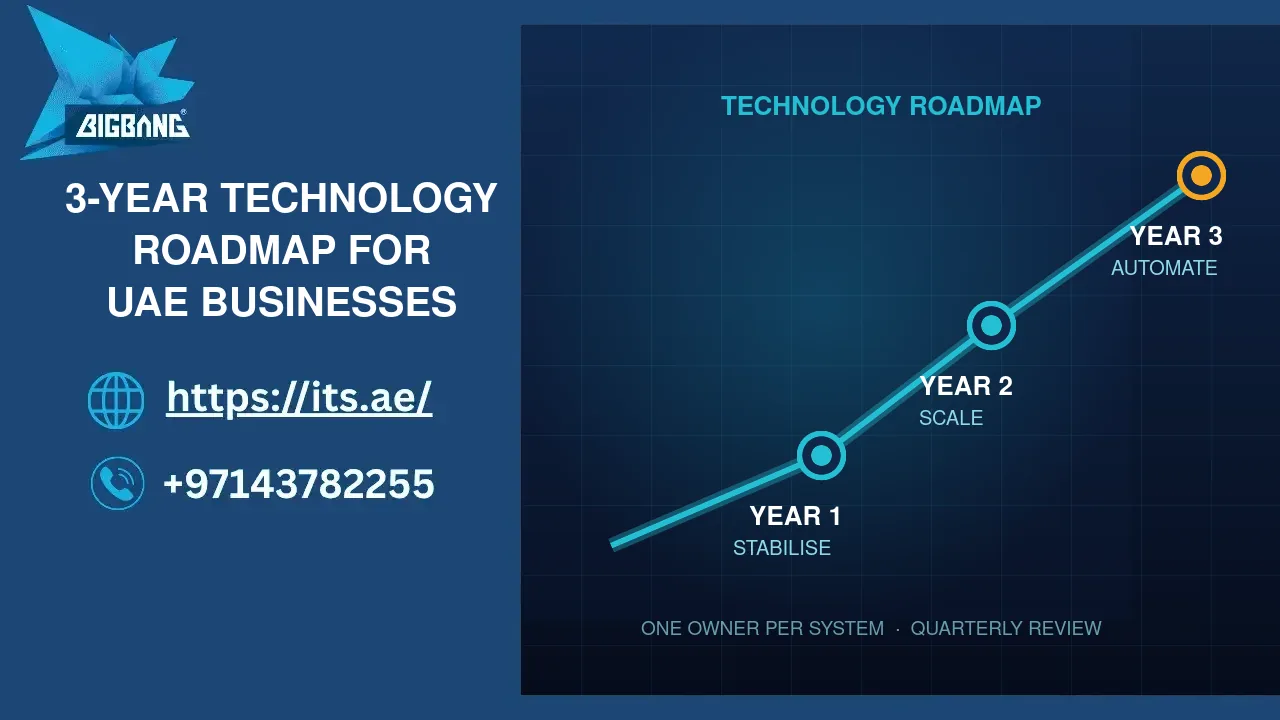
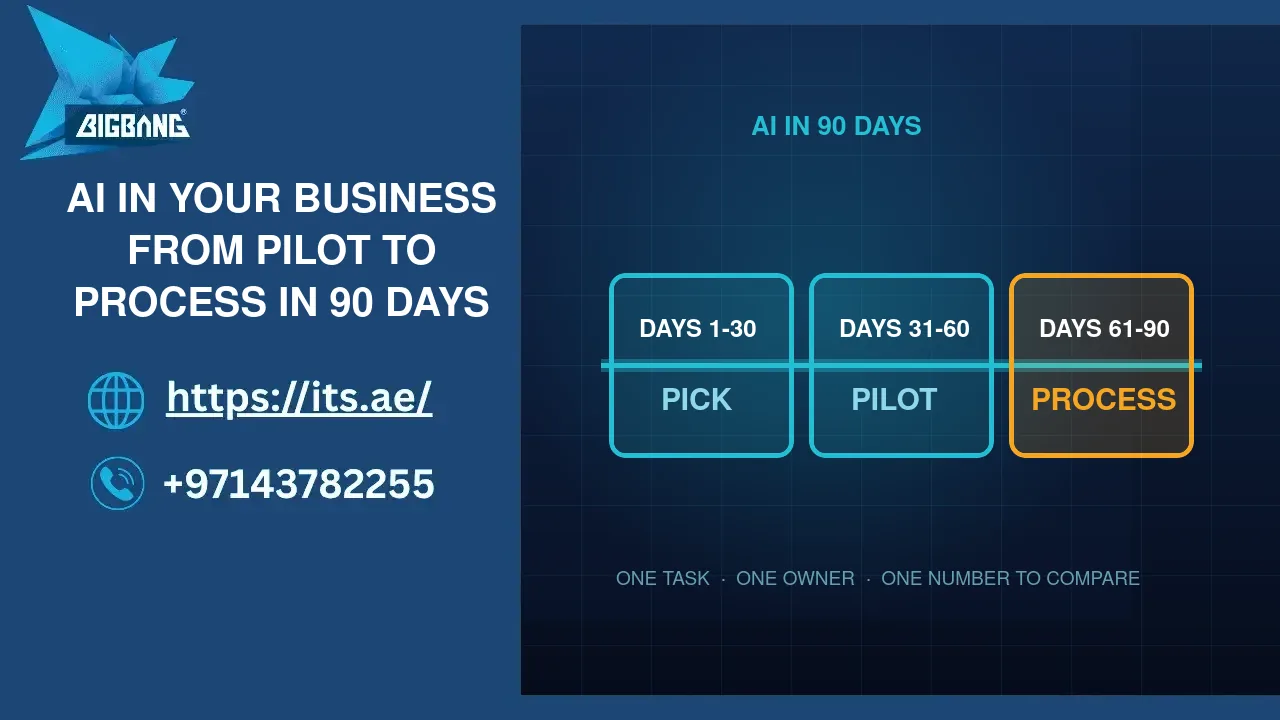
A small business gets value from AI by picking 1 repeated task and running it through 3 phases over 90 days. Days 1–30, pick and measure: one task, one owner, a baseline in minutes per item, and a written rule on what data may be pasted. Days 31–60, pilot: one shared prompt, a checklist for the human check, a weekly sample read by the owner, and a log of mistakes. Days 61–90, make it a process: a one-page SOP, an access list for the company account, a fixed place for outputs, and a 20-minute monthly review. Only then connect it to email, phones or the ERP. In the three-year technology roadmap this is a Year 3 item, built on systems that already hold clean data.
Where AI Pays Back First in a Company This Size
AI for small business is a list of tasks, not a strategy. In the UAE companies of this size we work with, the same 5 pay back first: each is repeated daily, follows a pattern, and is easy to check.
- Routine customer replies. Emails and WhatsApp messages asking delivery status, opening hours or a quote for a standard item. The assistant drafts; a person reads and sends.
- Call and ticket summaries. 3CX transcribes calls and voicemails and produces summaries (the setup is in its AI transcription guide), so a call ends with a note instead of a memory.
- Supplier documents into the system. Invoice number, line items and totals extracted from supplier invoices and delivery notes into the accounting system or logistics ERP, with a person approving each record.
- First-line answers on the website and in chat. Opening hours, coverage areas, “do you supply this”, answered from your published material and handed to a person when the question leaves the script.
- Internal documents. First drafts of SOPs and proposals, and the bilingual version of anything already written in one language.
And 3 places where it does not pay back yet:
- Anything the owner cannot check. If nobody in the company can tell a wrong answer from a right one, the task is not ready for delegation, to AI or to anyone.
- Anything with legal or financial finality. Contract terms, tax positions, the final price to a customer. AI prepares the file; a person signs.
- Anything where the data cannot leave the company. Payroll, medical records, a client under NDA. Keep those out until the provider has answered, in writing, where it processes and stores data.
Days 1–30 — Pick and Measure
The first month costs almost nothing and decides everything. 6 decisions:
One task. Not “customer service” but “the first reply to a WhatsApp enquiry about a product we stock”: narrow enough that one person does it every day.
One owner. The person who does the task now, not the most technical person in the office; they know what good looks like.
A baseline number. Minutes per item times items per week, measured for 2 weeks with a stopwatch or a timestamp column. Without it the pilot cannot succeed or fail; it can only feel better.
A definition of “good enough”. One written sentence, such as “a reply the owner would send without editing”, plus a pass rate you chose before the pilot starts.
A data rule. One list of what may be pasted (product names, public prices, your own templates) and what may not (customer names, phone numbers, ID copies, bank details, anything from a client under NDA).
A company account, not personal accounts. The business and API products of the major providers state that they do not use customer inputs to train their models by default. Anthropic says so in its privacy centre, OpenAI on its API data page, and Microsoft for Copilot with enterprise data protection. Consumer accounts have different terms, so read the policy for the plan you buy, and keep the account in the company’s name with the owner as administrator.
Days 31–60 — Pilot
The second month is the same task done the new way, first by the task owner, then by the team.
One written prompt. The task owner writes the instruction once: what the assistant is given, what it must produce, in what tone and languages, and what it must never do. Everyone uses the same one; individual “prompt skills” are how results become uneven.
A checklist for the human check. 3 to 5 lines run before the output goes anywhere: names correct, numbers match the source, nothing promised that the company does not offer, no customer data in the prompt.
A weekly sample. The owner reads a sample of outputs every week, without delegating it; this is what calibrates the checklist.
Mistakes logged, not hidden. A shared sheet: date, what went wrong, whether the check caught it. A pilot with no logged mistakes was not checked.
Choosing the model. Today’s Claude line-up, per the models overview, runs from Claude Haiku 4.5 (fast and cheap) through Claude Sonnet 5 and Claude Opus 5 to Claude Fable 5.1 (the most capable). Start on the model the provider recommends for most work (today that is Claude Opus 5). Move only when the mistake log says so: up when the cheaper model fails your checklist, down when a simpler one passes it. Our guide to Claude AI services covers the tiers and pricing; we do not repeat prices here because they change.
Days 61–90 — Make It a Process
The third month turns a pilot into something that survives the owner being on holiday.
The SOP, one page. The task, the prompt, the checklist, the data rule, who does it, who reviews it, and what to do when an output looks wrong.
The company account and the access list. Who has a seat, who administers it, and that a leaver’s seat closes the same day, in the same routine as email and two-factor authentication.
Where outputs are stored. In the system that owns the record: the CRM note, the ERP document, the ticket. Not in chat history.
What gets logged. Items per week, minutes per item, mistakes caught, mistakes missed: 4 numbers, in the baseline sheet.
The monthly 20-minute review. The owner, the task owner, the 4 numbers and the mistake log. The outcome is one of 3 words: keep, adjust, stop.
When to connect it to systems. After a month of stable numbers, copy-paste becomes the bottleneck. That is when to connect the assistant to the mailbox, the 3CX queue, the ERP or the website through an integration with the checklist built in, so the human check happens inside the tool. This is the part we build. Our AI solutions page lists what we integrate, and our article on a contact centre for a small business shows the chat and WhatsApp queue the drafted replies usually go into.
Data, Privacy and the UAE
Customer names, phone numbers and order histories are personal data under the UAE’s Personal Data Protection Law, Federal Decree-Law No. 45 of 2021, and an AI tool in the loop changes none of those obligations. 5 rules cover most companies of this size:
- No customer identifiers in personal accounts. Not once, not “just to test”. The owner included.
- A company account with administrator control, so the company can see, export and delete what staff have put in.
- A retention setting you chose. Ask what the provider keeps after a request, for how long, and whether your plan can shorten it.
- Know the region. Ask the provider, in writing, where prompts are processed and stored. Claude models are also offered through Amazon Bedrock and Google Cloud Vertex AI, which gives an integrator a choice of hosting region.
- Regulated clients have their own rules. Government entities and regulated sectors often set their own rules on where data may go; ask before the pilot, not after.
This is practical guidance, not legal advice; our article on the UAE data protection law and your website goes further, and a lawyer covers your specific case.
How to Lead It
In our experience, AI in a small business fails for management reasons, not technical ones. The owner’s part is small and cannot be delegated.
Set the one task and the one number. If the owner cannot name both, the company is experimenting, not piloting.
Do the first review yourself. The weekly sample is where the owner learns what the tool gets wrong; delegate it and you learn that from a customer.
Treat mistakes as calibration. A logged mistake improves the checklist. A hidden one ends the pilot 3 months later, when a customer finds it.
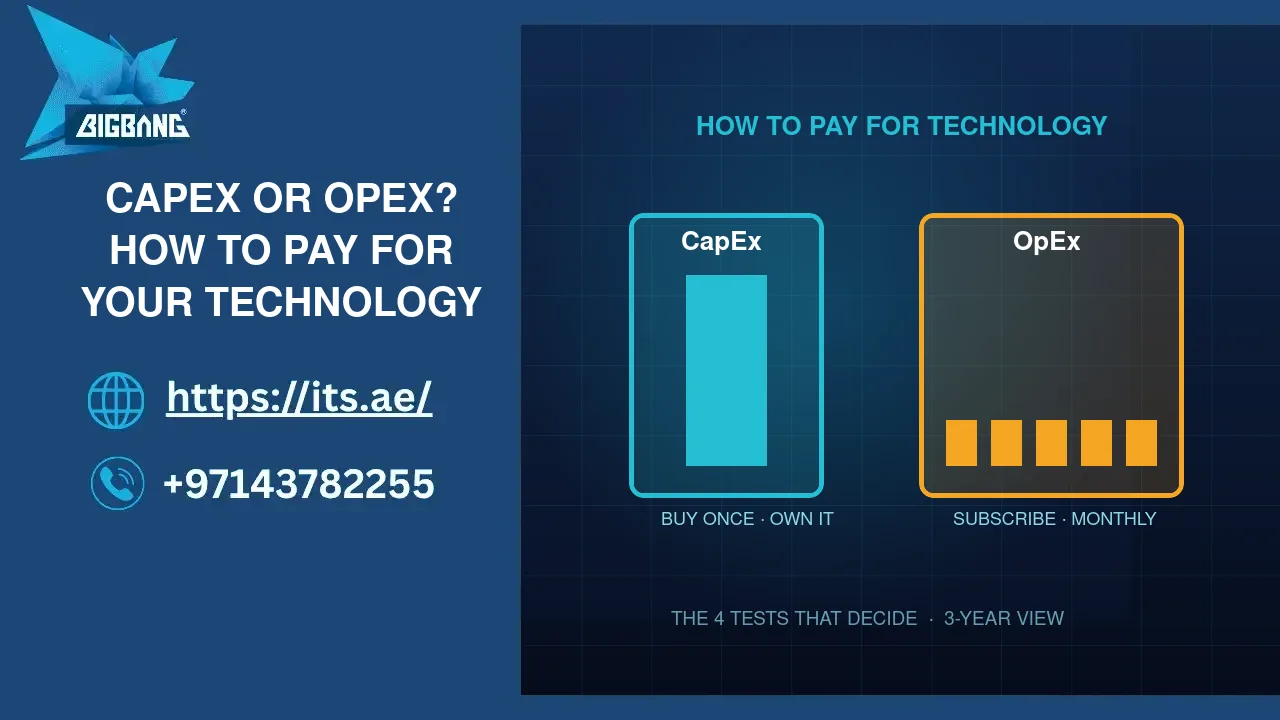
Budget it as a small monthly line. Subscriptions and API usage are operating expense, like hosting: one budget line, reviewed quarterly with the rest of the roadmap.
Ask 3 questions in writing, of the provider and of the integrator: where is the data processed, what is retained and for how long, and what happens to our prompts and integration when the model is updated or retired. NIST’s AI Risk Management Framework is voluntary; its AI RMF Core is 4 functions: govern, map, measure and manage. The 90-day plan is that sequence at the scale of one task.
| Phase | Owner does | Team does | Exit test |
|---|---|---|---|
| Days 1–30 — Pick and measure | Names the task, the task owner and the data rule; opens the company account | Measures minutes per item for 2 weeks; writes the “good enough” sentence | A baseline number and a one-line pass rule exist on paper |
| Days 31–60 — Pilot | Reads the weekly sample; decides the model tier from the mistake log | Uses the one shared prompt; runs the checklist; logs every mistake | The pass rule is met on the weekly sample for 2 consecutive weeks |
| Days 61–90 — Process | Signs the one-page SOP; holds the 20-minute monthly review; approves any integration | Stores outputs in the owning system; keeps the 4 numbers current | The task runs for a month without the owner touching it, and the numbers hold |
Three Examples from Our Work
A trading company’s sales team. Salespeople typed nothing into the CRM after calls, so the pipeline lived in their heads. We turned on 3CX call transcription and AI summaries for 1 salesperson first, with the summary pasted into the CRM note after she had read it. The rest of the team asked for it within a month. Every call now ends in a CRM note, and the owner reads the pipeline instead of asking for it.
A services company on WhatsApp and web chat. Messages arrived on 3 different phones and a shared inbox, and the first reply depended on who was awake. We routed both channels into one 3CX queue with AI-drafted first replies that an agent approves before sending. The win was response time and consistency, not headcount: the same people answer, faster, from one script. The approval step stayed. It is the human check.
Our own company. In our own operations we draft bilingual documentation and first-pass reviews of server logs and support tickets with Claude. An engineer checks every output before it reaches a client, the prompts live in a shared library, and the mistake log is reviewed monthly. We use it because it saves specific hours in specific tasks, which is the only reason to use it.
Frequently Asked Questions
What is the best first AI task for a small business?
The task one person repeats every day, that follows a pattern, and whose result that person can check in under a minute. Routine customer replies, call summaries and supplier invoice entry all fit. Choose by frequency and checkability, not by how impressive the demonstration looks, and measure it for 2 weeks before you change anything.
Do we need a developer or a data team to use AI in a company of 5 to 50 staff?
Not for the first 90 days. The pilot runs on a company subscription, one written prompt and a checklist that the task owner maintains. A developer or integrator is needed at the end, when copy-paste becomes the bottleneck and the assistant should connect to the mailbox, the phone system, the ERP or the website.
Is it safe to put customer data into ChatGPT or Claude?
Not into a personal account. The business and API products of the major providers state that they do not train on customer inputs by default, but the plan you buy, the retention setting and the processing region all matter. Use a company account with administrator control, apply a written data rule, and ask the provider in writing.
Which Claude model should a small business start with?
Start on the model the provider recommends for general work and keep the mistake log from the first day. Move up to a more capable model only when the log shows the cheaper one failing your checklist, and move down when a simpler model passes the same test. The current range runs from Claude Haiku 4.5 to Claude Fable 5.1.
Sources
- Anthropic Privacy Center — Is my data used for model training? (commercial products) (accessed 2026-09-16)
- Claude Developer Platform — Models overview (accessed 2026-09-16)
- NIST AI Resource Center — AI RMF Core (govern, map, measure, manage) (accessed 2026-09-16)
- OpenAI Platform — Your data (API data usage and retention) (accessed 2026-09-16)
- Microsoft Learn — Enterprise data protection in Microsoft 365 Copilot (accessed 2026-09-16)
- 3CX — AI Transcription Configuration Guide (accessed 2026-09-16)
- NIST — AI Risk Management Framework (AI RMF) (accessed 2026-09-16)
- UAE Government Portal (u.ae) — Data protection laws (accessed 2026-09-16)
Where We Are
BIGBANG ITS has planned and run technology for UAE businesses since 2003, headquartered at the Sharjah Research, Technology and Innovation Park with a branch in Business Bay, Dubai. Support runs 24/7 and the office is open Saturday to Thursday, 09:00–18:00 Gulf time. For an AI pilot sized to one task in your company, contact us or call +971 4 378 2255.
Talk to us directly — we usually reply within minutes during business hours.