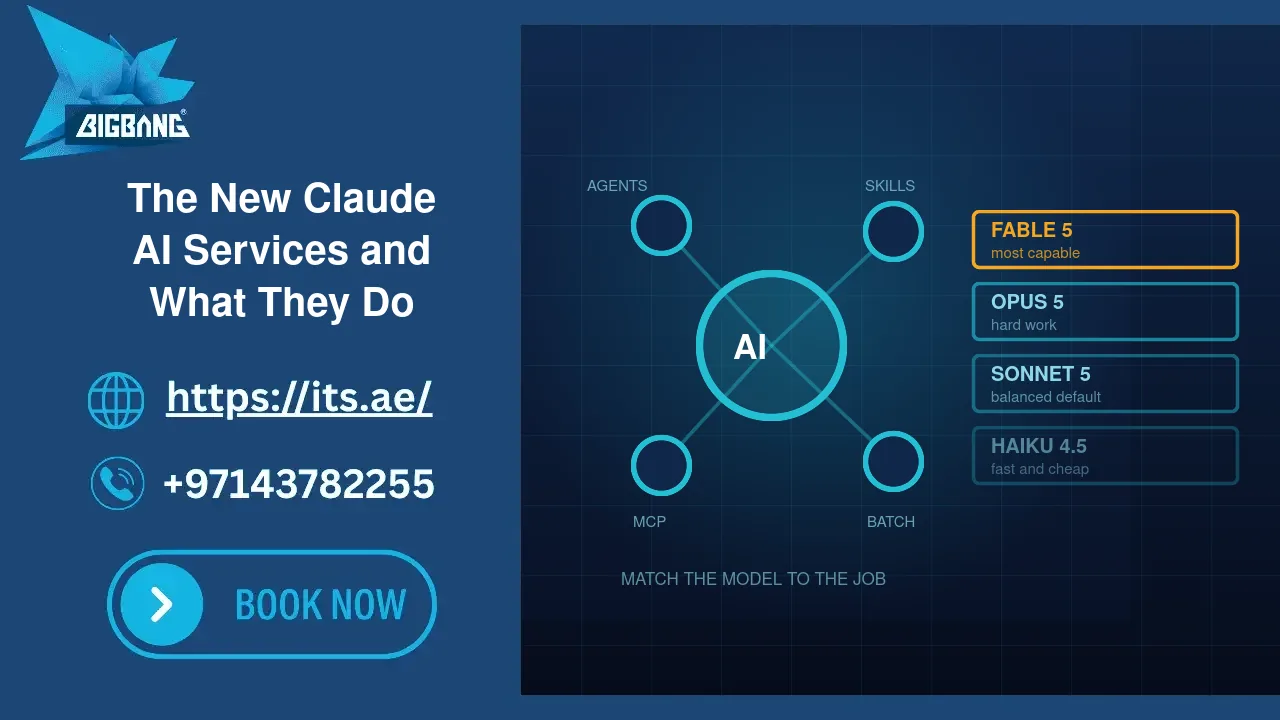
Two years ago, “using AI” in a business meant pasting text into a chat window and copying the answer back out. That is no longer where the value is. The services Anthropic now offers around Claude have moved from a single conversation box to a set of building blocks — models at four price and capability tiers, agents that Anthropic hosts and runs on a schedule, a standard way to connect a model to your own systems, and cost controls that decide how hard the model thinks before it answers. This article explains what those services actually are, in plain terms, and which ones are worth a UAE business’s attention right now.
Model names, capabilities and prices in this space change every few months. Everything below reflects the position at the time of writing; confirm current pricing on Anthropic’s own pricing page before you budget against it.
Quick Answer
Anthropic’s current offering has four parts worth knowing. Four Claude models at different capability and cost tiers, so you match the model to the job instead of paying top rates for everything. An effort setting that lets you dial how much thinking a model does per request — the biggest single cost lever most teams never touch. Managed Agents, where Anthropic runs the agent loop and hosts the workspace, including agents that fire on a schedule with no server of yours involved. And MCP, an open standard for connecting a model to your own data and tools. For most businesses the practical entry point is not a chatbot; it is automating one specific, repetitive, document-heavy process.
The Model Line-Up, and Why Four Tiers Exist
The single most common mistake we see is running everything on the most expensive model. The tiers exist because tasks are not equally hard.
Claude Fable 5.1 — released on 1 September 2026 as the successor to Fable 5, and the most capable generally available model, aimed at the hardest reasoning and long-running agentic work. A 1M-token context window. Priced at $10 per million input tokens and $50 per million output, the same rate as Fable 5.
Claude Opus 5 — the workhorse for demanding work: complex analysis, coding, multi-step reasoning. Also 1M context, at roughly $5 / $25 per million tokens.
Claude Sonnet 5 — the balanced tier, and a strong choice for high-volume production traffic once a workflow is proven. 1M context, around $2 / $10.
Claude Haiku 4.5 — fast and inexpensive, for classification, routing, extraction and high-volume simple work. 200K context, around $1 / $5.
The gap between the top and bottom tier is roughly tenfold. A workload that routes simple requests to Haiku and reserves Opus for the genuinely hard ones costs a fraction of one that sends everything to the top.
What a “token” means for your budget
A token is roughly three-quarters of an English word; Arabic typically consumes more tokens per word than English, which matters when you are budgeting bilingual work. A 1M-token context window means the model can hold something on the order of well over a thousand pages in a single request — which is why “feed it the whole contract set and ask” is now a realistic instruction rather than a fantasy.
Effort: The Cost Lever Almost Nobody Uses
Current Claude models decide for themselves how much internal reasoning to spend on a request, and you can set the ceiling: low, medium, high, xhigh or max. High is the default.
This matters more than model choice for many workloads. Classification, routing, short summaries and chat replies usually perform just as well at low effort, and cost dramatically less. Coding and long-horizon agent work genuinely repay high effort. Setting one global level and forgetting it is leaving money on the table in both directions — overpaying on the easy traffic and under-serving the hard traffic.
There is a related finding worth knowing before you build anything elaborate: a newer model at lower effort often beats an older model at high effort. Before designing a complicated cascade of cheap and expensive models, measure the simpler option first.
Managed Agents: Software That Does the Work, Not Just Describes It
This is the genuinely new capability, and the one most likely to change what a small team can do.
A traditional API call answers a question. An agent works a task: it reads files, runs steps, checks results, and keeps going until the job is finished. Building one used to mean writing the loop, hosting the machine it ran on, managing state between runs, and handling everything that goes wrong in between.
With Managed Agents (currently in beta), Anthropic runs the loop and hosts the workspace the agent works in. You define the agent once — its instructions, its model, its tools — and start a session whenever you need it. The agent gets a real environment: it can run commands, read and write files, and execute code, all inside a container Anthropic provisions per session.
Scheduled agents are the part with the clearest business shape. An agent can be configured to fire on a schedule — every night, every Monday morning — with no server, no cron job and no infrastructure on your side. A nightly reconciliation that reads yesterday’s exports and produces an exceptions report. A Monday agent that reviews the week’s support tickets and writes a summary of recurring themes. These are jobs businesses have wanted automated for a decade and have not automated because the integration work cost more than the problem.
MCP: Connecting Claude to Your Own Systems
The Model Context Protocol is an open standard for exposing a system’s data and actions to an AI model. Instead of writing bespoke glue for every tool, a system publishes an MCP server once and any MCP-capable AI can use it.
The practical significance for a business is that the interesting questions are never about public information. They are “which of our invoices are overdue”, “what did this client order last year”, “which tickets are still open past SLA”. Answering those requires the model to reach into your systems — your CRM, your accounting package, your ticketing, your file store. MCP is what makes that a configuration exercise rather than a development project, and the ecosystem of ready-made connectors is now large enough that most common business systems are covered.
The Rest of the Toolkit, Briefly
Claude Code — Anthropic’s coding agent, available as a CLI, a desktop application, a web app and IDE extensions. Aimed at development teams rather than general business use, but the productivity difference on a software team is substantial.
Agent Skills — packaged capabilities that let Claude produce real files: Word documents, Excel workbooks, PowerPoint decks, PDFs and charts, generated in a sandbox and returned as downloadable files. This is what turns “summarise this data” into “send me the formatted monthly report”.
Web search and web fetch — server-side tools that let the model look things up and read pages during a request, so answers can reflect current information rather than only what the model was trained on.
Code execution — the model writes and runs code in a sandbox to do actual computation. This is how you get arithmetic and data analysis you can trust, rather than a plausible-looking number.
Batch processing — submit a large volume of requests to be processed asynchronously at half the standard price. If the work is not time-sensitive — classifying a year of records, translating a catalogue — this halves the bill for no loss of quality.
Prompt caching — reusing an unchanged prefix (a long system prompt, a reference document) across many requests instead of paying to reprocess it every time. On the right workload this is the single largest saving available, and it costs nothing in output quality.
Admin controls — organisation-level management of members, workspaces, API keys, spend and rate limits. The part that matters when AI stops being one person’s experiment and becomes something the business depends on.
Where You Can Run It
Claude is available directly from Anthropic’s API, and also through Claude Platform on AWS, Amazon Bedrock, Google Vertex AI and Microsoft Foundry. For organisations in the UAE with existing cloud commitments or data-residency requirements, this matters: you can often consume Claude through the cloud account and contractual framework you already have, rather than opening a new vendor relationship. Feature availability differs by platform, so confirm that the specific capability you are designing around exists on the platform you intend to use.
What This Actually Looks Like in a UAE Business
Stripped of the vocabulary, the pattern that works is narrow and repetitive:
Document-heavy processes. Extracting structured data from invoices, delivery notes, purchase orders and contracts that currently arrive as PDFs and get retyped by a person.
Bilingual operations. Arabic and English side by side is a daily overhead for most businesses here — customer correspondence, product descriptions, contracts, support replies. This is one of the highest-return, lowest-risk applications available, and it is available today.
First-line support. Not replacing your team; answering the eighty per cent of questions that are the same eight questions, and routing the rest to a person with the context already gathered.
Scheduled reporting. The weekly summary somebody assembles by hand every Monday.
The projects that fail share a shape too: broad mandates (“use AI across the company”), no defined output, and no measurement of whether the result is better than what it replaced. Start with one process, one owner, and a number you can compare before and after.
Frequently Asked Questions
Which Claude model should a business start with?
Start with Claude Opus 5; that is Anthropic’s own recommendation for most workloads. Move up to Claude Fable 5.1 only when your tests on Opus 5 at higher effort still fall short. Use Claude Sonnet 5 where speed and cost matter, and Claude Haiku 4.5 for high-volume simple tasks such as classification and routing.
Can we use Claude through AWS or Google Cloud instead of Anthropic directly?
Yes. Amazon Bedrock and Google Cloud both list Claude Fable 5.1, Opus 5 and Sonnet 5, billed through your existing cloud account. Partner pricing is set by AWS and Google, not Anthropic, and some features arrive on the cloud platforms later than on Anthropic’s own API, so check availability before designing around a specific capability.
How much do batch processing and prompt caching actually save?
Batch processing charges 50 per cent of the standard price on both input and output tokens, for work that can wait up to 24 hours. Prompt caching bills cache reads at one tenth of the base input price on most models, and 2.5 per cent on Claude Fable 5.1, with a 25 per cent premium on the first write of the cached prefix.
Sources
- Anthropic — Claude Platform docs: Models overview (current line-up, context windows, pricing) (accessed 2026-09-16)
- Anthropic — Claude Platform docs: Pricing (API, batch and prompt-caching rates) (accessed 2026-09-16)
- Anthropic — Introducing Claude Fable 5.1 and Claude Mythos 5.1 (September 2026) (accessed 2026-09-16)
- Anthropic — Claude Platform docs: Effort (accessed 2026-09-16)
- Anthropic — Claude Platform docs: Claude Managed Agents overview (accessed 2026-09-16)
- Anthropic — Claude Platform docs: Scheduled deployments (Managed Agents) (accessed 2026-09-16)
- Anthropic — Claude Platform docs: Batch processing (accessed 2026-09-16)
- Anthropic — Claude Platform docs: Prompt caching (accessed 2026-09-16)
- Model Context Protocol — What is the Model Context Protocol (MCP)? (accessed 2026-09-16)
- Amazon Web Services — Claude by Anthropic: models in Amazon Bedrock (accessed 2026-09-16)
- Google Cloud — Anthropic’s Claude on Google Cloud models (accessed 2026-09-16)
- Anthropic — Claude Code docs: Overview (accessed 2026-09-16)
How We Work With This
BIGBANG ITS builds and runs these integrations for businesses in the UAE. Our AI solutions are sold as execution capacity rather than as a vague retainer: a defined block of engineering hours plus an included token quota, so you know what you are buying and what it will cost to run. That structure exists because the two questions clients always ask are “what will it cost to build” and “what will it cost every month afterwards”, and most AI proposals answer neither.
If there is a process in your business that is repetitive, document-heavy and currently done by a person who would rather be doing something else, that is the conversation worth having. Get in touch and we will scope it honestly — including telling you when the answer is that automation is not worth it.
Talk to us directly — we usually reply within minutes during business hours.