Three of the largest cloud companies in the world are building AI data centres in India at the same time, and the sums are large even by their standards. Amazon, Microsoft and Google have each published their own figures, and a Reuters report this month put the three plans side by side. We read the primary announcements rather than the summaries. This article sets out what was actually announced, what is happening closer to home in the UAE, and what a company with 5 to 300 staff in Dubai or Sharjah should take from it.
Quick Answer
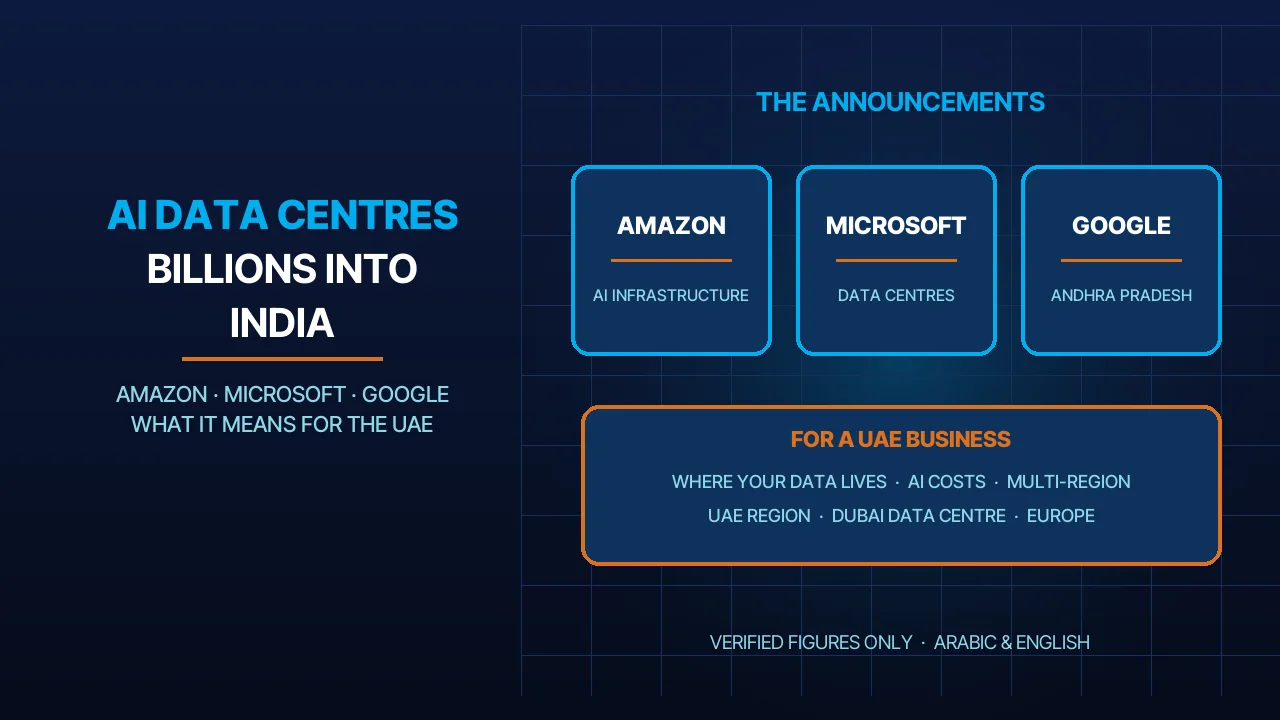
Amazon says its total planned investment in AI and cloud infrastructure in India is over USD 21 billion between 2026 and 2030, expanding AWS capacity in Mumbai and Hyderabad. Microsoft announced USD 17.5 billion over four years (2026 to 2029) on top of an earlier USD 3 billion, which Microsoft now describes as a USD 20.5 billion commitment. Google is building its first AI hub in India in Visakhapatnam, Andhra Pradesh, with approximately USD 15 billion over 2026 to 2030. For a UAE business, the practical effect is more AI capacity in the region, more choice of where data lives, and more reason to decide deliberately rather than by default.
What Was Announced
Amazon. On 25 June 2026, Amazon CEO Andy Jassy met Prime Minister Narendra Modi in New Delhi and announced an additional USD 13 billion to expand AI and cloud infrastructure in India by 2030. Amazon’s own release states that this takes its total planned AI and cloud infrastructure investment to over USD 21 billion between 2026 and 2030, and that the money will expand AWS data centre capacity in the Mumbai and Hyderabad regions, with access to custom AI chips and managed AI services. The wider figure is USD 48 billion across all of Amazon’s businesses in India over the same period, according to Amazon’s announcement.
Microsoft. On 9 December 2025, Microsoft announced what it called its largest investment in Asia: USD 17.5 billion over four years, calendar 2026 to 2029, for cloud and AI infrastructure, skilling and operations in India. That came on top of a USD 3 billion commitment from January 2025. When Microsoft opened its fourth Indian cloud region, India South Central in Hyderabad, on 6 August 2026, it described the two together as a USD 20.5 billion investment commitment. The USD 20.5 billion figure in the news summaries is therefore the sum of two announcements, not a single new one.
Google. On 14 October 2025, Google Cloud announced approximately USD 15 billion over five years, 2026 to 2030, to build its first AI hub in India at Visakhapatnam in Andhra Pradesh: a gigawatt-scale data centre campus, new energy sources, an expanded fibre network and a new international subsea cable gateway, with partners AdaniConneX and Airtel. Google broke ground on the site in April 2026, so the project is now in construction.
Why India. The Reuters report that prompted the headlines frames the three projects as part of Prime Minister Modi’s stated ambition to host the whole world’s data, and says India is betting that owning the physical backbone of AI can be as valuable as building frontier models. The same report notes the cost: India holds 4% of the world’s freshwater for 18% of its people, and S&P Global estimates that 60% to 80% of Indian data centres could face high water stress this decade, according to Reuters via Arab News. Residents near Amazon’s site outside Mumbai have protested over power, water and noise, which Amazon says it is addressing with water-free cooling and a dedicated power supply.
The Gulf Side of the Same Story
The UAE is not watching this from the sidelines. Microsoft has set out a USD 15.2 billion investment in the UAE covering 2023 to 2029, much of it through its partnership with G42. In November 2025, Microsoft and G42 announced a 200-megawatt expansion of data centre capacity delivered through Khazna Data Centers, expected to start coming online before the end of 2026. Separately, G42, OpenAI, Oracle, NVIDIA, SoftBank and Cisco are building Stargate UAE, a 1-gigawatt compute cluster inside the 5-gigawatt UAE–U.S. AI Campus in Abu Dhabi, with the first 200 megawatts expected to go live in 2026. In short, the compute a UAE company needs for AI is being built in both places, and the choice between them is becoming a real one.
What It Means for a UAE Business
Compute and AI model prices. None of the announcements states a price, so we will not invent one. What we can say from our own work is that capacity and competition move prices in one direction over time, and that the per-token cost of the models we deploy for clients has fallen repeatedly in the past two years. More regional capacity in India and the UAE makes it more likely that the AI services you buy will be served from nearby, with lower latency and fewer surprises on cost. It does not make any specific service cheaper on a specific date.
Choosing where your data lives. Cheaper capacity in India does not change your obligations in the UAE. Personal data of UAE customers and staff still falls under UAE law, and we set out what that means for a company website in our guide to the UAE data protection law. The sensible pattern we see is: regulated or customer-identifying data stays in a UAE region, and only workloads that carry no personal data, such as model training on anonymised data or batch processing, go wherever capacity is cheapest. Our comparison of hosting in the UAE, Saudi Arabia or Europe explains the latency and compliance trade-offs in more detail.
Building AI into operations now. The companies spending these billions expect demand from businesses like yours. The gap we see in UAE SMEs is not access to AI but a clear first use case. We wrote a 90-day plan for AI enablement that starts with one process, one owner and one measurable result, and our AI solutions team builds and runs those first workloads for clients who do not want to hire for it.
Keeping your options open. We advise against tying a small company to a single region or a single provider while the market is moving this fast. Our managed servers include AWS-based machines in the UAE region, and for clients who want their hardware in the country we offer VPS, dedicated servers and colocation in a Dubai data centre. For office productivity, our managed Microsoft 365 plans keep mailboxes and files under one tenant that we administer. A workload that runs in Dubai today can move to Mumbai or Abu Dhabi later if the numbers justify it; a workload built around one provider’s proprietary tools cannot.
Three Decisions to Make This Quarter
- Classify your data. List which systems hold personal or regulated data and confirm each one runs in a UAE region. Anything else is a candidate for the cheapest capable region.
- Pick one AI workload. Choose a single process with a measurable cost, such as inbound enquiry handling or document processing, and run it for 90 days with a named owner.
- Write down your exit path. For every cloud service you use, note how you would export the data and move it. If the answer is “we could not”, fix that before you add more.
Frequently Asked Questions
Will AI services become cheaper for UAE companies because of the India investments?
Probably over time, but no announcement states a price or a date. More regional capacity usually means more competition and lower latency for services served from nearby. We treat the news as a reason to plan for falling unit costs, not as a reason to delay a project that already pays for itself today at current prices.
Can a UAE company store customer data in an Indian cloud region?
Technically yes, legally it depends on the data. Personal data of UAE residents is governed by UAE law, and sector rules such as those for health or finance may require in-country storage. Our practice is to keep identifying data in a UAE region and use other regions only for workloads that carry no personal data.
Does the UAE have comparable AI data centre capacity of its own?
Yes, and it is growing. Microsoft has committed USD 15.2 billion to the UAE through 2029, a 200-megawatt Microsoft and G42 expansion is expected to start coming online before the end of 2026, and the Stargate UAE cluster in Abu Dhabi is planned at 1 gigawatt. Capacity close to home is not the constraint for most companies.
Sources
- About Amazon India — Amazon CEO Andy Jassy meets PM Modi; announces plans to invest $48B in India from 2026–2030: aboutamazon.in (accessed 2026-10-12)
- About Amazon — Amazon announces it will invest $48 billion in India by 2030: aboutamazon.com (accessed 2026-10-12)
- Microsoft Source Asia — Microsoft invests US$17.5 billion in India to drive AI diffusion at population scale: news.microsoft.com (accessed 2026-10-12)
- Microsoft Stories India — Microsoft announces US $3bn investment over two years in India cloud and AI infrastructure: news.microsoft.com (accessed 2026-10-12)
- Microsoft Source Asia — Microsoft’s newest India datacenter region goes live: news.microsoft.com (accessed 2026-10-12)
- Google India Blog — Our First AI Hub in India, Powered by a $15 Billion Investment: blog.google (accessed 2026-10-12)
- Google India Blog — Google AI Hub: Scaling India’s AI Infrastructure and Community Impact: blog.google (accessed 2026-10-12)
- Reuters via Arab News — Modi wants India to power the AI age. Residents are pushing back: arabnews.com (accessed 2026-10-12)
- CNN Business Arabic — India seeks to host the world’s data, amid fears of resource scarcity (Arabic): cnnbusinessarabic.com (accessed 2026-10-12)
- Microsoft On the Issues — Microsoft’s $15.2 billion USD investment in the UAE: blogs.microsoft.com (accessed 2026-10-12)
- Microsoft Source EMEA — Microsoft and G42 Accelerate UAE’s Digital Future with Major Data Centre Expansion: news.microsoft.com (accessed 2026-10-12)
- G42 — Global Tech Alliance Launches Stargate UAE: g42.ai (accessed 2026-10-12)
Where We Are
BIGBANG ITS has planned and run technology for UAE businesses since 2003, headquartered at the Sharjah Research, Technology and Innovation Park with a branch in Business Bay, Dubai. Support runs 24/7 and the office is open Saturday to Thursday, 09:00–18:00 Gulf time. To plan where your data and AI workloads should live, contact us or message us on WhatsApp.
Talk to us directly — we usually reply within minutes during business hours.