The owner of a Dubai services company now finds the company website embarrassing. The marketing head says it is slow on mobile. An agency has sent a quote for a new site, with a fresh design and a schedule measured in weeks. Before signing, the owner asks the question behind every website redesign or optimization decision: does the business need a new website, or work on the one it has? We optimise, re-host and rebuild sites for UAE companies, and the answer depends on 4 measurements, not on how old the design feels.
Quick Answer
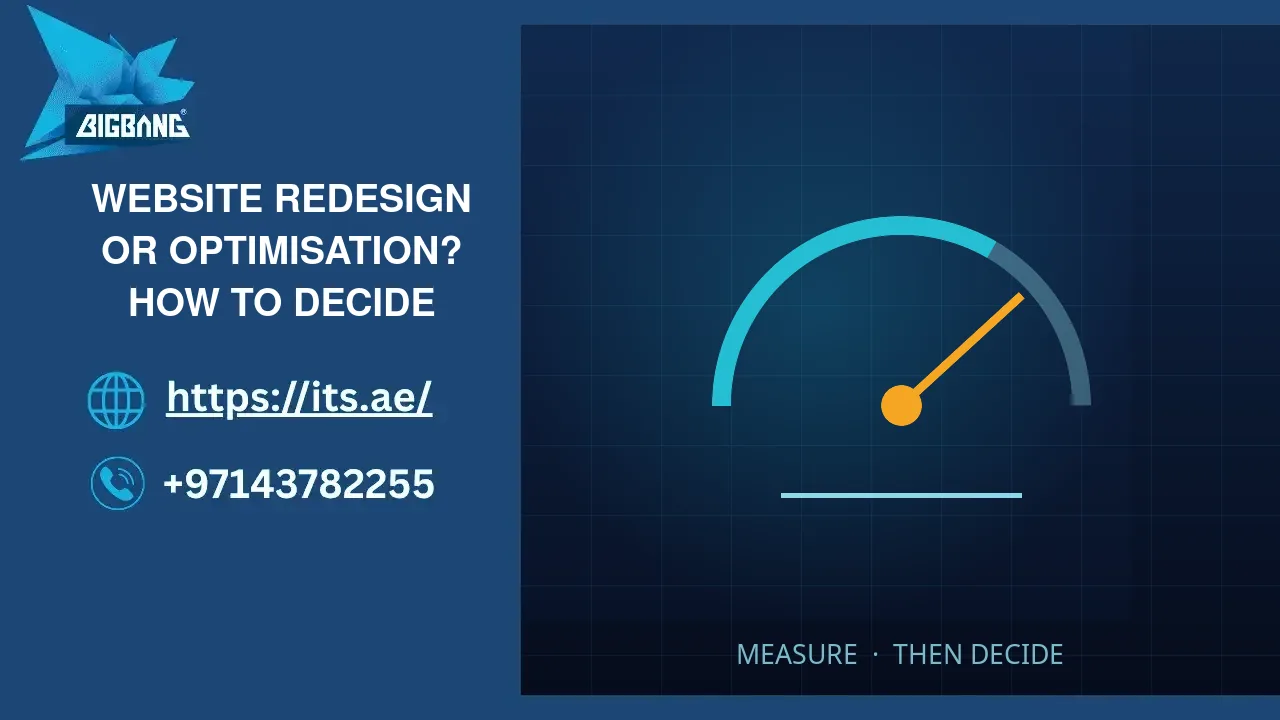
Measure before you decide. Check your Core Web Vitals from real visitors (LCP within 2.5 seconds, INP of 200 milliseconds or less, CLS of 0.1 or less), your server response time, your enquiry numbers and whether the content still describes the business. Then choose 1 of 3 paths. If the content is right but the site is slow, optimise what you have. If the server is the bottleneck, especially at busy hours, move to better hosting. Rebuild only when the site cannot be edited, fails on mobile, no longer matches the brand, runs on an unsupported platform, or is structured against the way customers buy. In our experience, many sites sent to us for a rebuild need the first or second path.
Website Redesign or Optimization: Measure First
A slow site and an outdated site look the same from the owner’s chair. 4 checks separate them.
Field data, not the lab score. PageSpeed Insights shows 2 kinds of result: lab data from a simulated load, useful for debugging, and field data from real Chrome users, which captures real-world experience. Decide on field data. Google’s thresholds for a good experience are an LCP within 2.5 seconds, an INP of 200 milliseconds or less and a CLS of 0.1 or less, measured at the 75th percentile of page loads. Search Console’s Core Web Vitals report groups your URLs as Good, Need improvement or Poor, based on data from real users.
Server response time. Time to First Byte is the hosting signal. web.dev rates 0.8 seconds or less as good and more than 1.8 seconds as poor. Test it at a quiet hour and at your busiest hour. If it is fine at night and poor at noon, the server is short of resources, and no new design will fix that.
Enquiries and conversions. Open your analytics and count form submissions, WhatsApp clicks and calls from the site over the last 6 months. A site that loads slowly but still brings enquiries has a speed problem. A fast site that brings nothing has a message problem.
The content and brand check. Read the home page as a stranger. Does it say what the company does today, with today’s logo, services and contact details? If the answer is no, speed work alone will not help.
The causes of slowness, from images to plugins to caching, are covered in our article on why your website is slow. This one is about the decision.
The 3 Paths
Optimise. The design and content are right; the site is heavy. Images are uncompressed, too many plugins load on every page, nothing is cached. In our experience it is the cheaper and quicker path, and visitors see the same site afterwards, only faster.
Move to better hosting. The site is reasonably built, but the server cannot keep up: response time is high, the hosting panel shows CPU or memory at its limit, or pages slow down when visitors arrive together. If the site is a store, checkout and cart pages cannot be served from cache, so the server matters more; our guide to hosting for a WooCommerce store covers PHP workers, object caching and response time under load. If traffic has outgrown the plan, our guide to hosting for high-traffic sites covers load balancing, CDN and the step up from shared hosting. In our experience, the step for a typical company site is smaller: a WordPress hosting plan or a VPS.
Redesign. The problem is the site itself: staff cannot edit it, it breaks on mobile, the brand has changed, or the structure does not follow how customers choose and buy. A platform out of support belongs here too. PHP, which WordPress runs on, gives each release 2 years of full support and 2 more of security fixes only, after which the branch is no longer supported. In our experience, a site whose theme or code cannot run on a supported version needs rebuilding, not tuning.
| Symptom | Likely path | Why |
|---|---|---|
| Slow on mobile, content and design still right | Optimise | Images, scripts, plugins and caching are fixable without touching the design |
| Fast at night, slow at peak hours | Hosting | The server runs out of resources when visitors arrive together |
| High server response time on every page, panel shows CPU or memory at the limit | Hosting | The plan is too small for the site, whatever the front end does |
| Staff cannot edit pages without a developer | Redesign | The theme or builder blocks editing; optimisation does not change that |
| Not usable on a phone | Redesign | The layout itself is wrong for small screens |
| Brand, services or audience have changed | Redesign | The message is wrong, and speed does not fix a message |
| Platform or PHP version out of support | Redesign | No security fixes; the code must move to a supported version |
| Visitors cannot find services or prices in the way they shop | Redesign | The structure is wrong, not the speed |
What Optimisation Includes, and What It Cannot Fix
Our optimisation service covers page speed, mobile responsiveness, image and code compression, server performance tuning, database optimisation, conversion and usability fixes, and a site audit at the start. We work mainly on WordPress, and also on Joomla, Magento, Shopify and custom-built sites. Our usual timeline for a small or medium site is 3 to 7 days; larger sites take longer. We recommend a fresh audit every 6 to 12 months, and after any major change.
What it cannot fix: a message that no longer fits the company, pages that do not exist, or a theme that blocks staff from editing. If the audit finds one of those, we say so, and the money goes to a rebuild instead.
If You Do Redesign
Keep URLs, or map every one. List every URL on the old site and decide where each goes. Google’s guidance for a move with URL changes is to prepare a mapping from old URLs to new ones and use permanent redirects such as 301s. A page that disappears without a redirect can lose what it earned in search.
Keep what ranks. Before anyone designs, export the pages that bring visitors from Search Console. Their content and URLs move across first.
Content before design. Write the pages, then design around them. Designing around placeholder text produces a site that has to be redone when the real text arrives.
Migrate without downtime. Build the new site on a staging copy, test it, then switch. If the new site also changes host, our website migration service moves it from your current provider to ours.
Budget for after launch. On our website design plans, a new WordPress site runs from AED 1,651.42 for the Personal Plan to AED 7,352.32 for an e-commerce single store, one time; our article on what a business website costs in the UAE explains why quotes differ. Our Website Maintenance Plan 1 covers 1 hour a month of support and updates to graphics, text, code and SEO.
From Our Work
The rebuild that was not needed. A services company came to us holding a quote for a full rebuild, because the site felt slow and old. The audit found the real problem, and it was not the design: uncompressed images and more than 30 plugins. We optimised the site instead of replacing it. The site kept its design. The rebuild quote had been for a problem the site did not have.
Fast at night, slow at peak. An online store’s pages were fast at night and slow at peak hours. A new design would not have helped, because the slowdown followed the number of shoppers, not the pages themselves. The fix was a bigger hosting plan and a cache. The design did not change, and the store did not have to relaunch.
The rebuild that was right. A company had rebranded, and its staff could no longer edit the old site. Optimisation would only have made a site with the wrong message load faster. Here a rebuild was the right call. We built the new site and set a redirect from every old URL to its new address, so that old links and search results would land on the right page.
Frequently Asked Questions
Should I redesign or optimise my website?
Optimise when the content and design still fit the business and the problem is speed. Move hosting when the server response time is high or the site slows at busy hours. Redesign when staff cannot edit it, it fails on mobile, the brand has changed or the platform is out of support. Measure first, then decide.
How often should a business website be redesigned?
There is no fixed cycle, and age alone is not a reason. Redesign when the site no longer says what the company does, cannot be edited, fails on phones or runs on an unsupported platform. In between, we recommend a performance audit every 6 to 12 months and after any major change to the site.
Will a website redesign hurt my SEO?
It can, if URLs change without redirects or pages that bring visitors are dropped. Google advises mapping every old URL to a new one and using permanent redirects such as 301s. Export your best pages from Search Console before the design starts, move their content across, and check the redirects on launch day.
How long does website optimisation take?
It depends on the size of the site and the number of issues. Our usual timeline for a small or medium site is 3 to 7 days; larger or more complex sites take longer. The work starts with an audit, so you know what will be fixed and what, if anything, needs a rebuild instead.
Can better hosting make my website faster?
Yes, when the server is the bottleneck. Check Time to First Byte at a quiet hour and at your busiest hour; web.dev rates 0.8 seconds or less as good. If it is poor only at peak times, or the hosting panel shows resources at the limit, a bigger plan helps. If it is good, the slowness is in the pages.
Sources
- Web Vitals — web.dev, Google (accessed 2026-10-03)
- Time to First Byte (TTFB) — web.dev, Google (accessed 2026-10-03)
- About PageSpeed Insights — Google for Developers (accessed 2026-10-03)
- Core Web Vitals report — Search Console Help, Google (accessed 2026-10-03)
- Supported Versions — PHP.net (accessed 2026-10-03)
- Site moves with URL changes — Google Search Central (accessed 2026-10-03)
Where We Are
BIGBANG ITS has planned and run technology for UAE businesses since 2003, headquartered at the Sharjah Research, Technology and Innovation Park with a branch in Business Bay, Dubai. Support runs 24/7 and the office is open Saturday to Thursday, 09:00–18:00 Gulf time. For an audit that tells you which of the three paths fits your site, contact us or call +971 4 378 2255.
Talk to us directly — we usually reply within minutes during business hours.