Many of the customer messages a UAE company receives now arrive on WhatsApp, often in Arabic, often outside office hours, and often in a dialect rather than the Arabic of a newspaper. An AI chatbot can answer a good share of them, but only if it was set up for the Arabic your customers actually write, knows when to stop, and hands the conversation to a person without losing it. When we set one of these up for a client, we see the same pattern each time: the technology is ready for a defined list of tasks, and a human is still needed for the rest. Here is that list, how to measure the result, and what to pilot first.
Quick Answer
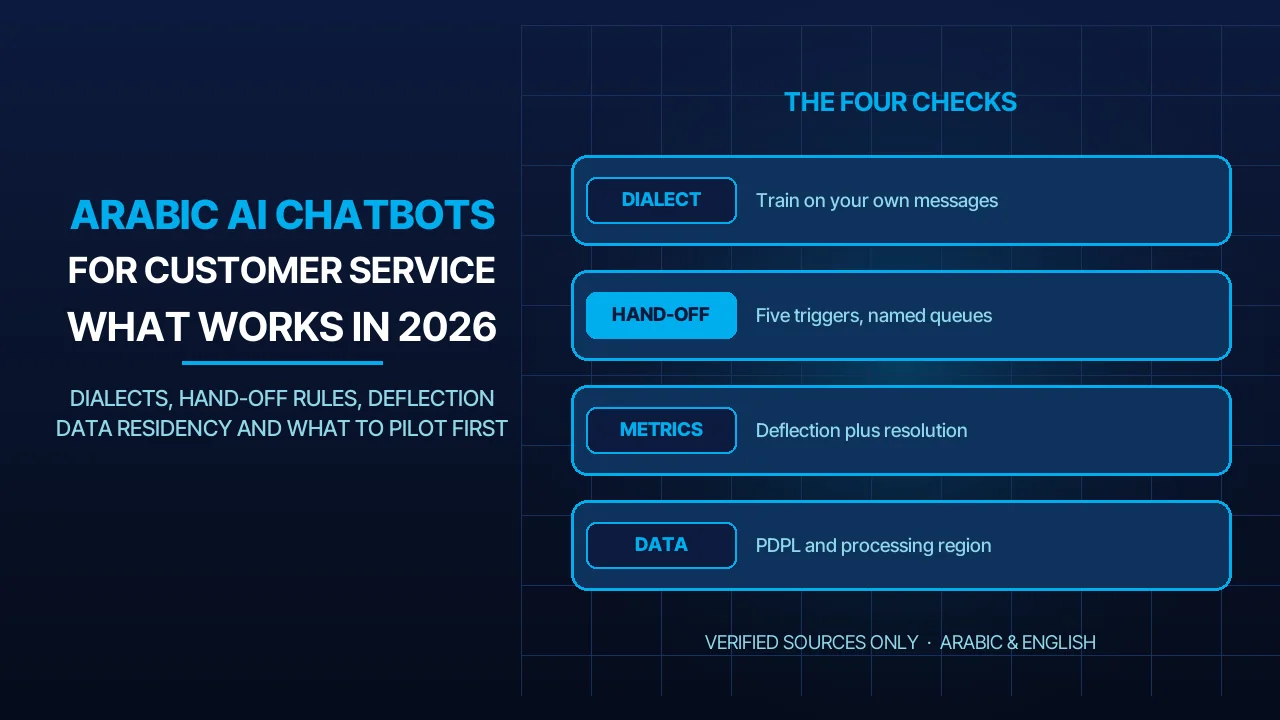
In 2026 an Arabic AI chatbot can handle opening hours, prices, locations, order and booking status, appointment booking and first-line FAQ, in Modern Standard Arabic and, once trained on your own customers’ messages, in their Gulf, Levantine or Egyptian dialect, when it works from your approved data. Complaints, cancellations, payment disputes, anything involving health, and any angry customer should reach a person within one or two turns. Measure deflection (conversations the bot closed alone) and resolution (the customer did not come back within 48 hours), and keep customer data under the UAE Personal Data Protection Law. BIGBANG Cloud CX runs this model: Arabic and English AI agents in front of a human team on WhatsApp, Instagram and calls; see our platform overview.
What an Arabic Chatbot Can Take in 2026, and What It Cannot
The answer depends on the task, not the language. Google’s Dialogflow CX language table marks Arabic as supported for text, speech-to-text, text-to-speech, sentiment analysis and data stores, with one gap: the default welcome intent has no pre-filled Arabic training phrases, so you write your own. Microsoft’s conversational language understanding service lists Arabic among its supported utterance languages. Language support is no longer the barrier. Judgement is. Here is how we split the work:
| Task | Bot alone | Bot drafts, human sends | Human only |
|---|---|---|---|
| Opening hours, location, prices from an approved list | Yes | – | – |
| Appointment booking and rescheduling | Yes, calendar connected | – | – |
| Order, delivery or ticket status | Yes, system connected | – | – |
| Lead qualification (need, timing, branch) | Yes, then route | – | – |
| Product recommendation or quotation | – | Yes | – |
| Complaint, delay, damaged goods | Acknowledge only | – | Yes |
| Cancellation, payment dispute | – | – | Yes |
| Medical, legal or financial advice | – | – | Yes |
| Visibly angry customer | – | – | Yes, immediately |
The middle column is where a small team saves most. A bot that drafts the Arabic reply with the right product name and price, and lets an agent approve it in one tap, cuts handling time without putting a machine in charge of a decision.
Dialect: The Problem Is Not Arabic, It Is Your Customers’ Arabic
Speech and text behave differently. On the speech side, vendors split Arabic by country. Azure Speech lists separate locales for Arabic in the UAE (ar-AE), Saudi Arabia, Qatar, Kuwait, Bahrain, Oman, Egypt, Jordan, Lebanon, Syria, Iraq and the Maghreb for real-time transcription. On the text side the opposite happens: Dialogflow CX treats ar-ae, ar-sa, ar-eg and the other country tags as aliases of a single ar tag. One model therefore receives Emirati, Egyptian, Levantine and Modern Standard Arabic together, plus Arabic typed in Latin letters and mid-sentence switches to English.
What works is training on your own messages. Microsoft’s guidance for its language service is to build most of the project in one language and add a small share of examples, around 5% of the original set, in any language that performs poorly in testing. We apply the same rule to dialect: export 200 to 300 real customer messages from the last quarter, label the intent, and add them as training examples.
Voice notes need a separate decision. Many UAE customers send voice notes rather than typing. Transcription covers Arabic, but OpenAI’s documentation says that Whisper supports 98 languages with accuracy varying by language. We transcribe voice notes for the agent to read and do not let the bot act on a transcript alone in the first months.
Hand-off Rules That Keep the Customer
Write the rules before you switch the bot on. A hand-off is not a failure; a customer stuck in a loop is. Our standard set has five triggers: the customer asks for a person in any wording; the bot fails to match an intent twice in a row; the message contains a complaint, cancellation or payment word; the sentiment score drops (Dialogflow CX offers sentiment analysis for Arabic); or the request is outside the approved knowledge base. Each trigger routes to a named queue, not a generic inbox.
The hand-off must carry the context. The agent should see the full transcript, the detected intent, the customer profile and a note from the bot. In BIGBANG Cloud CX the smart-routing agent assigns the thread to a department or person and the conversation stays on one customer record, so nobody asks the customer to repeat themselves.
Respect the WhatsApp clock. On the WhatsApp Business Platform a customer’s message opens a 24-hour customer service window for free-form replies; outside it you can only send an approved message template. Set the human response target inside that window and keep an approved Arabic follow-up template for the hand-offs that slip past it. Our WhatsApp Business API guide covers templates and categories.
Measuring Deflection and Resolution Honestly
Deflection alone will lie to you. Deflection is the share of conversations the bot closed without a human, and it is easy to inflate: a bot that says “thank you, goodbye” after every unanswered question deflects 100% and resolves nothing. Pair it with resolution: the share of bot-closed conversations where the customer did not write again on the same topic within 48 hours. We do not quote a benchmark; the figure depends on your mix of tasks.
Track four numbers weekly. Deflection rate; resolution rate; hand-off rate by trigger; and human first-response time after hand-off, measured against the 24-hour WhatsApp window. Add a fifth for voice notes: the share of transcripts the agent corrected. BIGBANG Cloud CX reports response times, open conversations, closed tickets and customer sources; the bot-side figures come from the conversation logs and your weekly review. For the phone queue, see our note on a contact centre for a small UAE business.
Read the failures, not the averages. Once a week, someone who speaks your customers’ dialect reads 30 conversations that ended in a hand-off or an unanswered message. Each is a missing training phrase, a missing fact, or a task for the human-only column.
Data Residency and the UAE Personal Data Protection Law
A chatbot is a data processor. Every message, phone number and booking it touches is personal data. The UAE’s Federal Decree-Law No. 45 of 2021, the Personal Data Protection Law, came into force on 2 January 2022; it applies to processing inside or outside the country, prohibits processing without the owner’s consent except in defined cases, gives people the right to correct their data and stop processing, and sets requirements for cross-border transfer of personal data. Free zones and regulated sectors have their own rules; check yours. This is not legal advice.
Ask every AI vendor where the data is processed. Azure Speech states that it stores and processes speech data in the region where you create the resource, and its region list includes UAE North. Dialogflow CX lets you pin an agent to a region, but its published list covers the Americas, Europe and Asia Pacific, and its global option keeps data at rest in the United States. Your contract and privacy notice must match what you chose. Our own hosting platforms run from our data centres in Europe, with a Dubai option on request, and we confirm the processing location of any platform we deploy, BIGBANG Cloud CX included, before you sign. Our AI solutions page explains how we handle hosting and data residency.
Minimise what the bot keeps. A bot does not need an Emirates ID to book a dental cleaning. Collect only what the task requires, set a retention period for transcripts, and keep internal notes away from the customer and the model vendor.
What We Recommend: Three Decisions Before You Pilot
- Decision 1: one channel, three tasks. WhatsApp first, because that is where the Arabic volume is. Start with opening hours and location, booking or order status, and lead qualification. Nothing involving money; six weeks shows whether the dialect is covered.
- Decision 2: hand-off and retention rules on one page. Five triggers, one named queue each, a response target inside the 24-hour window, a transcript retention period. Sign it before launch. Our 90-day AI enablement plan shows where this page sits in a wider roll-out.
- Decision 3: name the person who reads the failures. One native speaker of your customers’ Arabic, one hour a week, with authority to add training phrases and facts.
If you want the pilot run on BIGBANG Cloud CX, we configure the Arabic and English agents on your data, connect WhatsApp, Instagram and your phone line, and show you how to read the five weekly numbers from the platform’s reports.
Frequently Asked Questions
Can one chatbot handle both Arabic and English customers?
Yes. Current language services accept Arabic and English in the same project, and a customer who writes in English should get English back, even when they switch languages mid-conversation. The practical rule is to keep the knowledge base in both languages with the same facts, so the bot never gives a different price depending on the language.
Does the chatbot need to understand Emirati dialect specifically?
It needs to understand the Arabic your customers write, which in the UAE mixes Gulf, Levantine, Egyptian and Modern Standard Arabic, plus Arabic in Latin letters. Google’s and Microsoft’s language services treat Arabic as one language for text; dialect coverage comes from training on your own messages. Export real conversations, label them, add what the bot missed, and review weekly.
How many staff do we need to run an AI chatbot?
Fewer than you think, but not zero. A company of 10 to 50 staff typically needs one person who owns the knowledge base and reads the failed conversations for about an hour a week, plus the agents who already answer customers and now receive the hand-offs. The platform does the routing; the people do the judgement.
Sources
- Google Cloud, Dialogflow CX language reference: cloud.google.com/dialogflow/cx/docs/reference/language (accessed 2026-11-08)
- Google Cloud, Dialogflow CX regionalization and location settings: cloud.google.com/dialogflow/cx/docs/concept/region (accessed 2026-11-08)
- Microsoft Learn, Azure Speech language and voice support: learn.microsoft.com/azure/ai-services/speech-service/language-support (accessed 2026-11-08)
- Microsoft Learn, Supported regions for Azure Speech: learn.microsoft.com/azure/ai-services/speech-service/regions (accessed 2026-11-08)
- Microsoft Learn, Conversational language understanding language support: learn.microsoft.com/azure/ai-services/language-service/conversational-language-understanding/language-support (accessed 2026-11-08)
- OpenAI Platform, Speech to text guide: platform.openai.com/docs/guides/speech-to-text (accessed 2026-11-08)
- Twilio Docs, Key concepts and terms for the WhatsApp Business Platform: twilio.com/docs/whatsapp/key-concepts (accessed 2026-11-08)
- UAE Government portal (u.ae), Data protection laws: u.ae/en/about-the-uae/digital-uae/data/data-protection-laws (accessed 2026-11-08)
Where We Are
BIGBANG ITS has planned and run technology for UAE businesses since 2003, headquartered at the Sharjah Research, Technology and Innovation Park with a branch in Business Bay, Dubai. Support runs 24/7 and the office is open Saturday to Thursday, 09:00–18:00 Gulf time. If you want an Arabic-first AI assistant working in front of real agents on WhatsApp, Instagram and calls, contact us or message us on WhatsApp.
Talk to us directly — we usually reply within minutes during business hours.