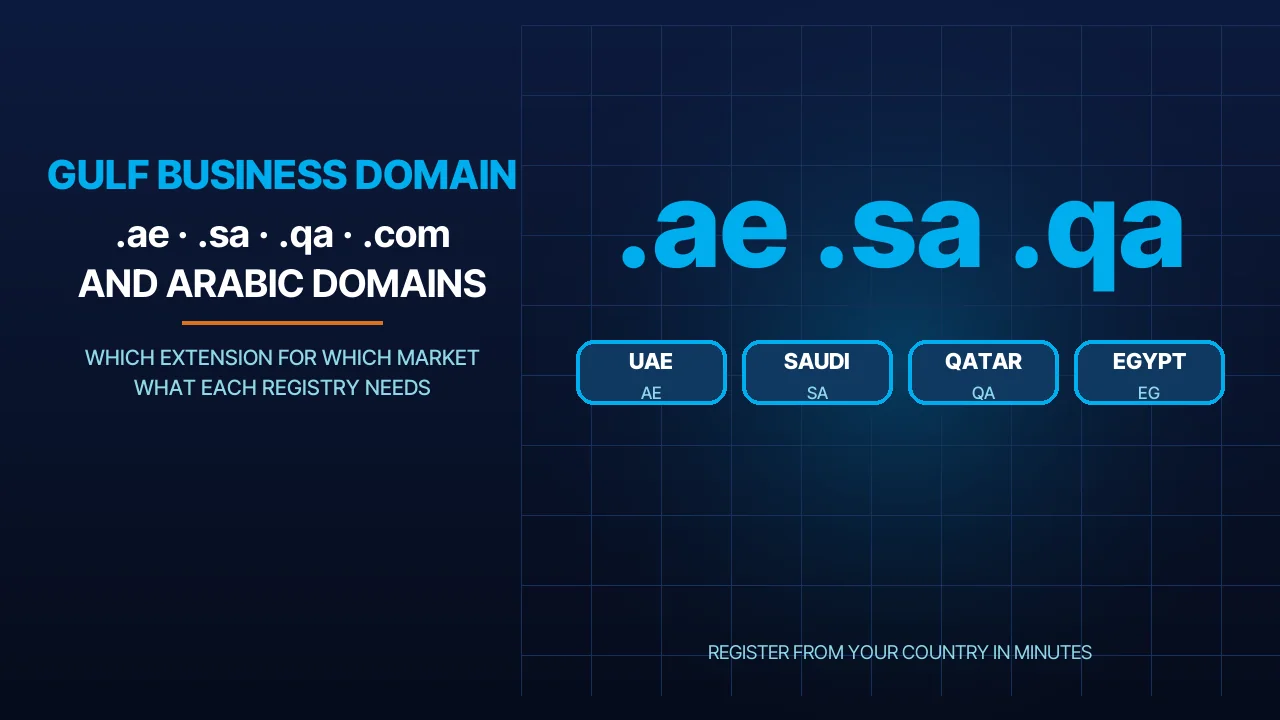
You have set up a business in Riyadh, Doha or Dubai, the website is due this week, and the first question is already on the table: which domain do you register? The designer suggests .com because it is “global”, the accountant asks why you would not take your own country’s extension, and someone has forwarded an offer for an Arabic domain at a price that makes you look twice. In our experience with Gulf companies since 2003, this decision takes ten minutes once you know three things: who runs the registry, what documents it asks for, and where your customers will look for you. This article gives you those three facts and tells you when an Arabic domain is worth the money being asked for it.
Quick Answer
Register your own country’s extension for the local market (.ae, .sa or .qa) and add the same name under .com if you sell or market outside your country, then point one at the other. The country code tells a customer you are a licensed company in their market; .com protects you when you expand. An Arabic domain (such as .امارات) is an addition to the brand, not a replacement for the Latin domain, because email and shared links still work more reliably in Latin script. We register domains under .ae, .co.ae, .com, .net, .qa, .sa, .om and 500+ other extensions, and if your choice is strictly between .ae and .com, see our .ae vs .com comparison.
The Rule: Your Country’s Extension for the Local Market, .com for Export
A country code is proof of presence. When a customer in the UAE sees a site ending in .ae, they understand that the name is registered in the national registry and subject to its rules. That is exactly what the .aeDA FAQ states: an address ending in .ae is registered in the UAE and belongs to a namespace regulated by the Telecommunications and Digital Government Regulatory Authority. The same principle applies to .sa in Saudi Arabia and .qa in Qatar: the extension belongs to a country, and its national registry sets the eligibility conditions.
.com is the common currency. It asks for no documents, every customer in the world recognises it, and it can be typed on any keyboard. Its one weakness is that the good names were taken years ago, so you end up with a long name, a hyphen or a number. That is why we tell a client who sells at home first: start with your country’s extension, then take .com if the same name is still available.
When is one enough? A shop, a clinic or an office serving one city is fine with the country code alone. A software company, an exporter or an agency working with clients in three countries needs .com as the main address and the country codes as redirects. What we see at our clients is that the expensive mistake is not picking the wrong extension; it is leaving the same name available under the other extension until a competitor or a reseller registers it.
The Gulf Extensions
Here is a practical table of what we know about each extension. The documents column lists what we have read in the registry’s published policy or what we ourselves ask for at order time; we do not list any condition we have not read at its source.
| Extension | Who runs it | Documents | Do we offer it? |
|---|---|---|---|
| .ae | .aeDA, part of the Telecommunications and Digital Government Regulatory Authority (TDRA), UAE | Per the eligibility policy published on the TDRA site; registration is open directly at the second level (mybusiness.ae) | Yes |
| .co.ae | Same registry, at the third level | Same eligibility policy; useful for commercial companies when someone else already holds the name under .ae | Yes |
| .امارات | TDRA (the Arabic-script country code for the UAE) | Per TDRA policy; ask before ordering | Ask us |
| .sa | The Saudi registry, under the umbrella of the Communications, Space and Technology Commission (CST) | Set by the registry; we ask you for what is needed when you place the order | Yes |
| .qa | Qatar’s Communications Regulatory Authority (CRA), through accredited registrars | Set by the registry; we ask you for what is needed when you place the order | Yes |
| .om | The national registry of the Sultanate of Oman | Set by the registry; we ask you for what is needed when you place the order | Yes |
| .kw / .bh / .eg | The national registries of Kuwait, Bahrain and Egypt | — | Not currently offered |
| .com / .net | Accredited registrars worldwide | No documents | Yes |
What does the .ae policy actually say? A name is between 2 and 63 characters, made of English letters, digits and hyphens; it cannot start or end with a hyphen, and a hyphen cannot sit in the third and fourth positions, according to the published domain name specifications. Registration is possible at the second level (mybusiness.ae) and at the third level (mycompany.co.ae), as the same page notes. There is also a reserved-names list that is not published in full, so do not be surprised if an ordinary-looking name is refused. The authority shows a counter of more than 350,000 registered domains on the .aeDA home page, which explains why so many names are already taken. We wrote a full guide to this extension in our .ae domain guide.
What about .sa and .qa? We register both for clients, but we do not set out their eligibility rules here because we did not read them in an official source while preparing this article. What we do in practice: you request the name, we tell you within one working day what the registry asks for, and if your company does not qualify we suggest the alternative before you pay. The Saudi registry operates under the umbrella of the Communications, Space and Technology Commission, and in Qatar the Communications Regulatory Authority manages domain names through accredited registrars.
Arabic Domains: When They Are Worth It
An Arabic domain is a name written entirely in Arabic script, such as “yourcompany.امارات”. The .امارات extension is an official country-code domain in Arabic, delegated to the UAE’s telecommunications regulator on 2010-05-05 according to the IANA root zone record, and its technical form in DNS is xn--mgbaam7a8h. In other words, the browser converts the Arabic letters into that code behind the scenes, and that is exactly where most of the trouble we see comes from.
Worth it when the brand is Arabic and the audience is local. A billboard on Sheikh Zayed Road carrying an Arabic name is read and remembered faster than a Latin name spelled out in English letters. A government body, an association or a cultural project that addresses people only in Arabic has a clear case. So does anyone who owns a registered Arabic trademark and wants to stop others from taking the name.
Not worth it as your only address. In our experience, email on an Arabic domain runs into systems that do not accept non-Latin addresses, a customer typing the address on a phone set to English stumbles, and a copied link sometimes appears in the unreadable xn-- form. That is why we always set the Arabic domain up as a redirect to the Latin domain and keep email on the Latin one.
And the “premium Arabic domain names” offered at high prices? The high price here is set by the seller, not the registry, and it rests on the assumption that a generic word will bring visitors by itself. We have no data that proves this for the Gulf market, so our advice is: do not pay more for a premium Arabic name than you would pay for an advertising campaign that actually brings visitors, unless the name is your trademark.
Mistakes We See at Gulf Companies
Registering the domain in an employee’s or designer’s name. This is the thing we fix most often. The employee leaves or the agency closes, and the name sits in an account you cannot access. Register the domain in the company’s name as it appears on the trade licence, with a general company email rather than a personal one.
Leaving renewal to memory. An expired domain goes back to the registry and then to the market, where someone else can buy it. Turn on auto-renew, keep a valid card on file, and make sure the notification email reaches a mailbox someone actually reads.
Buying from one registrar and hosting with another without writing it down. There is nothing wrong with separating the two, but record where the name is registered and who manages the DNS records. When it is time to move the website or change email, the company ends up hunting for the password of an account someone created four years ago.
Changing DNS on the same day you move the website. The update does not reach every server at the same moment, as the .aeDA FAQ explains about zone file propagation. Lower the TTL at least a day before the move; we explain the method in our DNS propagation guide.
Ignoring close variants of the name. The name with and without a hyphen, and the name under .ae, .co.ae and .com. You do not need to register everything, but register the variants your customer will type by mistake, and point them at your site.
Relying on an unaccredited reseller without knowing the actual registrar. .aeDA distinguishes between the accredited registrar and the reseller working on its behalf, and the reseller has no direct access to the registry. Ask which accredited registrar your order goes through, and remember that you have the right to transfer the name to another registrar with the authorisation code at any time while the registration is in force.
How to Register from Your Country in Minutes
1. Check availability. Type the name into the domain checker on our portal and request the extensions that matter to you together, so you can see at a glance which ones are free. We list more than 500 extensions, including the four Gulf ones mentioned above.
2. Choose your currency. The portal shows prices in AED, USD, SAR, EGP, EUR and GBP, and we accept payment in any currency. The current price of each extension is on the portal; we do not print it here because it moves with registry fees.
3. Enter the owner details as they appear on the licence. Company name, address and a general email. These details are what carry you through any dispute, and for .ae your registrar is required to send changes to the registry within 5 days at most, according to the authority’s FAQ.
4. Send documents if requested. Country-code extensions may ask for a trade licence or proof of trademark. We review them, send them to the registry, and tell you if anything is missing before time runs out.
5. Set up DNS and email. You can register the name before you have a website or hosting and point it later. The full illustrated guide is in how to purchase a website domain.
If the name you want is taken, or you are torn between two extensions, write to us with the company name, its country and its market, and we will reply with one clear recommendation.
Frequently Asked Questions
Can I register a .ae domain if I am outside the UAE?
Eligibility is set by the .aeDA policy published on the TDRA site, and its FAQ refers companies operating outside the country to that policy specifically. Send us your company details and country before paying; within one working day we will tell you whether registration is possible and what documents are needed, or suggest .com or another extension.
.sa or .com for my Saudi company?
If your customers are in Saudi Arabia, start with .sa: it says you are a company in their country. Take .com under the same name if available and point it at your site, so nobody else takes it and you can expand. The .sa conditions are set by the Saudi registry; we ask for what is needed at order time.
How long does it take to register a .qa domain?
Generic extensions such as .com go live within minutes of payment. Country-code extensions such as .qa pass through the national registry and may require documents, so the time depends on your file and the registry’s review. We review the order the same day, submit it once complete, and keep you informed until the name is yours.
Does an Arabic domain help with Google?
We have no data showing that an Arabic extension by itself improves rankings. What improves rankings is good Arabic content on a fast website, under any extension. The real value of an Arabic domain is in offline advertising and brand protection. Make it a redirect to your Latin domain, and keep your content and email on the Latin domain.
Sources
- .ae Domain Administration (.aeDA), Frequently Asked Questions (accessed 2026-10-18)
- .ae Domain Administration (.aeDA), home page (accessed 2026-10-18)
- IANA root zone database, .امارات (accessed 2026-10-18)
- IANA root zone database, .ae (accessed 2026-10-18)
- Communications, Space and Technology Commission, Saudi Arabia (accessed 2026-10-18)
- Communications Regulatory Authority, Qatar (accessed 2026-10-18)
Where We Are
BIGBANG ITS has planned and run technology for UAE businesses since 2003, headquartered at the Sharjah Research, Technology and Innovation Park with a branch in Business Bay, Dubai. Support runs 24/7 and the office is open Saturday to Thursday, 09:00–18:00 Gulf time. Contact us or message us on WhatsApp.
Talk to us directly — we usually reply within minutes during business hours.