You run a 3CX phone system, or you are about to buy one, and your office is in Dubai or Sharjah. The question nobody answers plainly is where the actual phone lines come from, and whether running them over the internet is legal in the UAE. Forum threads describe other countries, the operator’s sales desk talks in bundles, and the overseas SIP provider quoting a few dollars a month cannot explain how its numbers would reach a PBX in Business Bay. We have connected trunks to 3CX for UAE clients for years; this is how the legal and technical pieces fit together.
Quick Answer
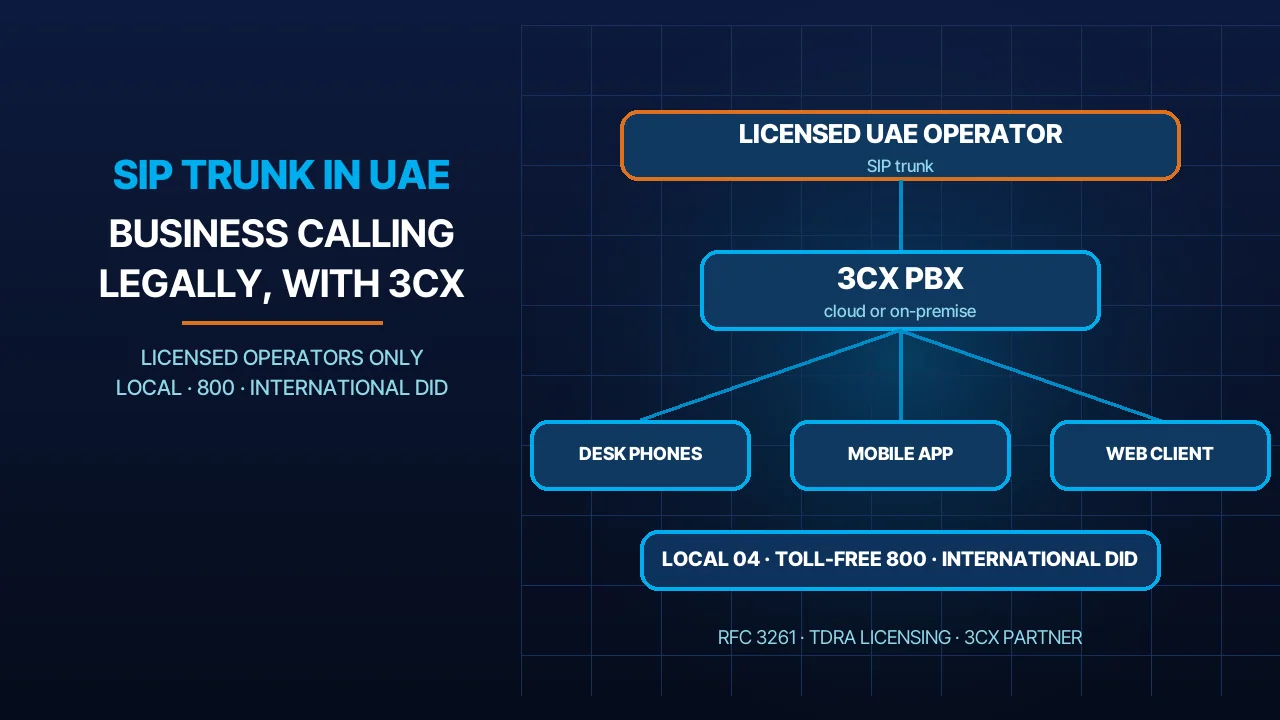
A SIP trunk is the internet-based line that connects your 3CX phone system to the public telephone network, so your extensions can make and receive calls on real numbers. In the UAE, voice over IP is a telecommunications service under the Telecom Law, so the trunk that carries your UAE numbers must come from a licensed operator. The PBX itself can be hosted by you or by a partner such as us. In practice you order the trunk and numbers from the licensed operator, we configure it in 3CX, route each number to a queue or extension, and add international numbers where needed. New to the terms? Start with the difference between VoIP and SIP.
What a SIP Trunk Is (and What It Is Not)
SIP is the signalling. The Session Initiation Protocol is defined in RFC 3261 as an application-layer protocol for creating, modifying and ending sessions between participants. It sets the call up and tears it down; the voice itself travels in a separate media stream. A trunk is the agreed connection between your PBX and a provider’s network, and a channel is one concurrent call on that trunk.
The trunk is your bridge to the phone network. 3CX puts it simply in its manual: a SIP trunk provider connects you to the PSTN, the ordinary telephone network, and holding your own trunk account means you keep control of your numbers. 3CX is built around that model: you bring your own trunk and numbers rather than renting lines bundled with the PBX.
What it is not. A SIP trunk is not the PBX; 3CX is the PBX. It is not your internet connection, although it depends on one. It is not a phone number by itself; numbers are DIDs attached to the trunk. And it is not a consumer calling app on a laptop.
The UAE Rule: Licensed Operators Only
VoIP is a regulated telecom service. The regulator’s own FAQ states that VoIP services are telecommunications services and, when offered to subscribers, are regulated activities under Federal Law by Decree No. 3 of 2003, which requires a licence or an exemption. The same page lists who may provide them: the licensees, or third parties either in collaboration with a licensee or with TDRA approval.
What that means for your PBX. The trunk that carries your UAE numbers and your calls to UAE and international destinations comes from a licensed operator. The PBX software, where it runs, who manages it and how calls are routed inside it are your decisions. TDRA’s FAQ also warns that a person using VoIP services not provided by or in collaboration with a licensee, carried over a flat-rate internet line that was not priced for it, may be committing an offence. That is the scenario of an overseas trunk quietly carrying a Dubai office’s calls, and it is the one we decline to set up.
Our role. We are a 3CX partner. We do not sell UAE trunks ourselves; we arrange them through licensed operators, then design and configure the PBX. Where a company needs a number in another country, for example a London line for UK customers, we provide an international DID from a provider in that country after the legal-document review those providers require. For calling into North America we also offer a USA SIP trunk product; its current price is on the portal.
How a UAE Trunk Connects to 3CX
- Decide where 3CX runs. Hosted by us, on your own cloud VPS, or on a server in your office. The choice fixes the public IP address the operator will see, so make it before ordering the trunk.
- Order the trunk and numbers from the licensed operator. You will need the trade licence, the number of channels, and a list of numbers: new ones, or existing ones to port. The operator hands back either registration credentials or an IP-based trunk. 3CX’s manual explains the two: register-based or IP-based authentication, and with IP-based trunks any change of the PBX host must be reported to the provider.
- Prepare the network. A static public IP, firewall rules for SIP and media ports, and SIP ALG switched off on the router. 3CX asks on-premise and self-hosted installs to run its firewall check before adding a trunk, and we do the same on hosted systems.
- Add the trunk in 3CX. Under Admin, Voice & Chat, Add Trunk: choose the country and provider template or the generic one, enter the credentials or IP, the main trunk number, and a default route for any number not yet assigned.
- Add and route the DIDs. Each number is entered in E.164 format and assigned to an IVR, ring group, queue or user extension. The 3CX manual describes DIDs as numbers that route calls directly to those destinations.
- Create outbound rules and caller ID. Outbound rules decide which trunk carries a call by dialled prefix, number length, extension or group. By default calls present the main trunk number, or the extension’s own DID when one is assigned.
- Test before go-live. Inbound to every DID, outbound to a mobile and a landline, an international call, voicemail, and the emergency number. 3CX ships a built-in SIP trunk checker for the registration side; the rest is a phone in hand.
Local, Toll-Free and International Numbers on One PBX
A single 3CX can hold numbers from several sources, each on its own trunk with its own outbound rule. Our guide to UAE business phone numbers covers the number types in detail; the summary for a trunk setup is this.
| Number type | Who issues it | What you need | Typical use |
|---|---|---|---|
| UAE geographic number (02, 04, 06 and so on) | The licensed operator, with the trunk | Trade licence and company details | Main office line, branch lines |
| UAE toll-free 800 number | The licensed operator; portable between operators | A porting request to the new operator if you already own one | Customer service and sales lines |
| International DID (UK, USA, KSA and others) | A provider in that country | Legal-document review: company documents, sometimes a local address | A local number for an overseas market |
| USA SIP trunk | Our USA SIP trunk product | An order on the portal | Outbound calling to North America |
Toll-free numbers are portable. TDRA’s FAQ confirms that an 800 number can be moved from one operator to another, that the new operator handles the port, and that the process takes about 5 working days. In 3CX the ported 800 number is simply another DID on the UAE trunk, usually pointed at a queue. For queues, agents and reporting on that line, see our note on contact centres for small businesses in the UAE.
Capacity: Channels, Codecs, Quality
Channels, not extensions. A trunk is sized by concurrent calls, and so is the 3CX licence. The number to plan for is the busiest moment of the day, not the number of staff. In our experience a sales-heavy team and a back-office team of the same size need very different channel counts, so we look at call logs from the old system before recommending a figure.
Codecs. The codec is how voice is encoded for the network. G.711 is uncompressed and gives the cleanest audio for the most bandwidth; G.729 compresses hard and saves bandwidth at some cost in quality; Opus adapts to conditions. The operator decides which it supports, and the PBX should be set to match so that calls are not transcoded in the middle.
Quality is the network’s job. Three things decide whether a call sounds right: latency, jitter and packet loss. The fixes are the usual ones: wired desk phones, voice prioritised over other traffic on the office router, and enough upstream bandwidth at peak. For a hosted PBX, its distance from the operator’s network also matters, which is why we host 3CX for UAE clients close to the UAE rather than wherever is cheapest.
Costs You Should Expect
We do not quote figures here because prices change and differ by operator; the components do not.
From the operator: a monthly fee per channel, a monthly fee per number, and call minutes billed by destination (local, mobile, international), sometimes in bundles. A toll-free line reverses the usual direction: the business pays for the inbound minutes its callers would otherwise pay.
For the PBX: the 3CX licence, sized by simultaneous calls and edition, which we explain in our note on 3CX phone system pricing; hosting, whether a server of yours or a hosted PBX from us; and one-time setup, migration and training. The current price of our hosted PBX and USA trunk is on the portal, linked above.
Around it: desk phones or headsets, and any international DIDs, which carry their own monthly fee per number. If you are comparing trunk providers for the international side, our comparison of SIP trunks for 3CX is the place for that; this article deliberately stays off it.
Mistakes We Fix Most Often
SIP ALG left on. The router feature meant to help SIP through NAT is the most common cause of one-way audio and calls that drop after a fixed number of seconds. We switch it off on every site.
Too few channels. A trunk ordered for the number of desks, then a busy morning, and callers hear engaged tones while half the office is idle.
Caller ID the operator does not own. Presenting an international DID on the UAE trunk, or the other way round, gets calls rejected or shown as anonymous. Each trunk presents its own numbers, and outbound rules keep them apart.
Moving the PBX without telling the operator. With an IP-based trunk the operator trusts a specific address. Migrate the server, forget the call, and the trunk is dead until someone updates it.
Numbers in mixed formats. DIDs entered with and without the country code, so some route and some fall into the default route. We enter everything in E.164 and keep the default route pointed at a human.
An overseas trunk carrying UAE calls. It fails the legal test above, and it usually fails the quality test too, because the audio travels across continents to reach a caller across the street.
No emergency routing and no QoS. Both are five-minute tasks on day one and painful discoveries on day ninety. The same checklist applies when the PBX sits inside BIGBANG Cloud CX.
Frequently Asked Questions
Is a SIP trunk legal in the UAE?
Yes, when it comes from a licensed operator or a party working with one. TDRA treats VoIP as a telecommunications service that requires a licence or exemption, so the trunk carrying your UAE numbers must be licensed. Running 3CX as your PBX on top of that trunk, hosted anywhere you choose, is a normal business setup.
Can I use an international SIP trunk with 3CX in Dubai?
For international numbers, yes: a UK or US DID from a provider in that country gives your overseas customers a local number that rings in Dubai. What we do not do is route a UAE office’s everyday calls through an unlicensed overseas trunk, because that is the case TDRA describes as a possible offence.
How many channels does my 3CX SIP trunk need?
Count concurrent calls at your busiest hour, not employees. A ten-person sales team can need more channels than a forty-person back office. We take the call logs from the old system, find the peak, add headroom for growth, and size both the trunk and the 3CX licence to that figure rather than to a headcount.
Can I keep my existing UAE phone number when moving to 3CX?
Usually, yes. Geographic numbers stay with you when the same operator supplies the trunk, and TDRA’s portability rules let an 800 number move between operators through the new operator in about 5 working days. The number becomes a DID in 3CX, routed to the queue or extension that used to answer it.
Sources
- RFC 3261: SIP: Session Initiation Protocol (accessed 2026-10-18)
- Configuring SIP Trunks / VoIP Providers in 3CX Phone System (accessed 2026-10-18)
- Bring your numbers and SIP trunk to 3CX (accessed 2026-10-18)
- TDRA FAQs: VoIP and Toll-free Number Portability (accessed 2026-10-18)
Where We Are
BIGBANG ITS has planned and run technology for UAE businesses since 2003, headquartered at the Sharjah Research, Technology and Innovation Park with a branch in Business Bay, Dubai. Support runs 24/7 and the office is open Saturday to Thursday, 09:00–18:00 Gulf time. Contact us or message us on WhatsApp.
Talk to us directly — we usually reply within minutes during business hours.