VoIP (Voice over Internet Protocol) is the technology that enables voice calls over the internet. SIP (Session Initiation Protocol, standardised by the IETF in RFC 3261) is the signaling protocol that controls how those calls are set up, managed, and ended. The key difference is simple: VoIP is the communication technology, while SIP is the protocol that makes it work. They are not the same — but most modern business phone systems use both together. This guide explains the VoIP and SIP difference in plain terms, covers SIP trunking, compares both with traditional phone systems, and helps UAE businesses choose the right communication solution.
What Is VoIP and SIP?
Understanding the VoIP and SIP difference helps businesses evaluate modern communication systems. VoIP enables voice communication over the internet, while SIP is a signaling protocol used to establish and manage communication sessions. Knowing what is VoIP and SIP is also essential when assessing cloud communication systems used for remote work, call centers, and enterprise communication. 
What Is VoIP?
VoIP stands for Voice over Internet Protocol. It allows users to make voice calls using an internet connection instead of traditional phone lines.
What Does VoIP Stand For and What Is Its Use?
VoIP stands for Voice over Internet Protocol. Its main use is enabling voice communication over IP networks such as:
- Broadband internet
- Cloud systems
- Enterprise networks
Businesses use VoIP for:
- Internal communication
- Customer support
- International calls
- Video meetings
- Unified communication systems
How VoIP Works
VoIP works by converting your voice into compressed digital data packets and transmitting them over an internet connection. When you speak, the VoIP system captures the audio, encodes it using a codec (such as ITU-T G.711, 64 kbit/s pulse code modulation, or G.729, 8 kbit/s CS-ACELP compression), and breaks it into small packets. These packets travel across the IP network independently and are then reassembled at the receiver’s end in the correct order, where they are decoded back into audio. The quality of a VoIP call depends on three factors: available bandwidth, network latency, and packet loss. Most modern broadband connections in the UAE support HD VoIP calls without issues when the network is properly configured.
Common Business Uses of VoIP
VoIP is widely used for:
- Office communication
- Remote work systems
- Call centers
- Cloud PBX
- Video conferencing
Understanding VoIP functionality helps businesses evaluate how modern communication systems support voice calls, collaboration tools, and remote teams.
Advantages of VoIP
- Lower communication cost
- Easy scalability
- Remote access
- Advanced features
- CRM integration through solutions such as 3CX Integration with CRM
- Unified communication
Disadvantages of VoIP
- Depends on internet quality
- May face latency issues
- Requires proper security setup
What Is SIP?
SIP stands for Session Initiation Protocol. It is responsible for initiating, managing, and terminating communication sessions.
What Is SIP Protocol?
The SIP protocol manages:
- Call setup
- User registration
- Session control
- Call termination
Some businesses also compare SIP vs SIPS: a call made to a SIPS URI guarantees TLS-encrypted transport for all SIP signalling between the caller and the callee’s domain, which protects the signalling (not the media stream itself) and improves communication security.
How SIP Works
SIP works by sending text-based signaling messages between communication endpoints — such as IP phones, PBX systems, mobile apps, and softphones. When you make a call, SIP sends an INVITE message to the recipient’s device. If accepted, SIP negotiates the session parameters (audio codecs, video settings, etc.) and establishes the media channel. When the call ends, SIP sends a BYE message to terminate the session cleanly. SIP itself does not carry voice or video data — it only handles the signaling. The actual media is transmitted separately using RTP (Real-time Transport Protocol, defined in RFC 3550). This separation makes SIP highly flexible and compatible with a wide range of devices and communication platforms.
What Is SIP Trunking?
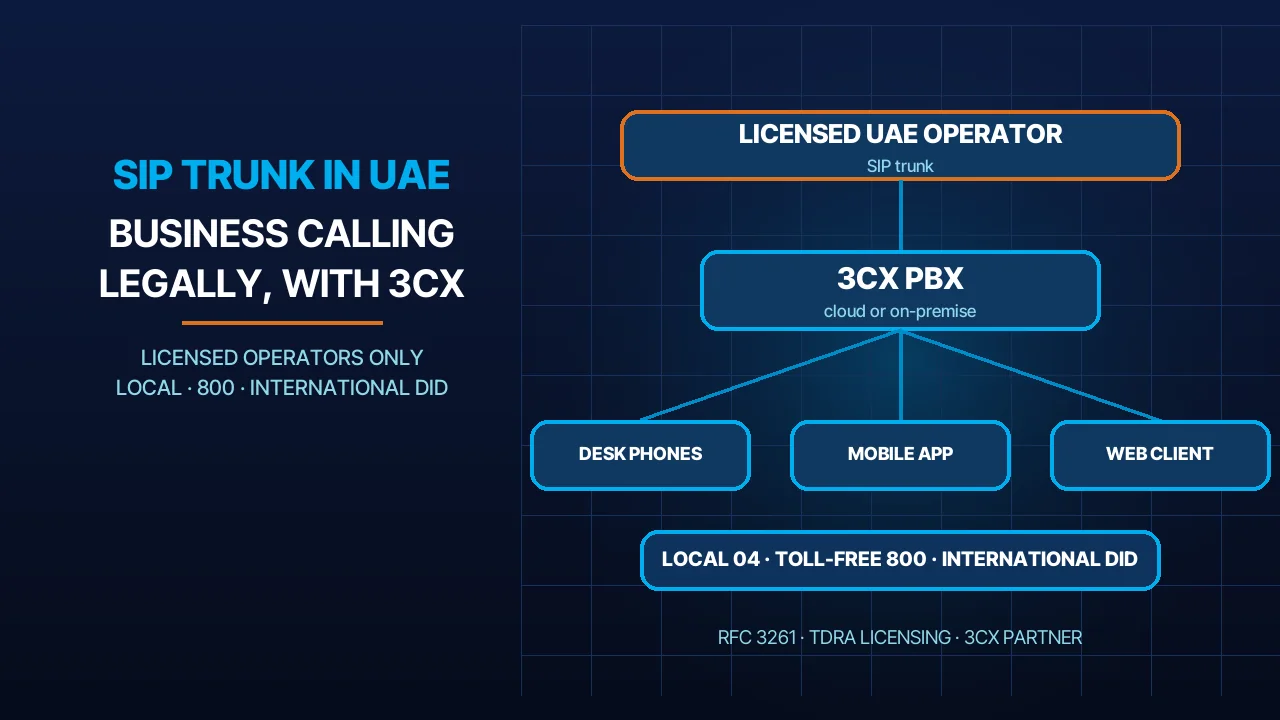
SIP trunking connects business phone systems to the internet and PSTN using SIP. In the UAE the trunk comes from a licensed operator: du, for example, publishes a Business SIP 10 trunk at AED 580 per month plus 5% VAT for 10 channels and 100 numbers (AED 1,000 one-time activation), scalable from 10 to 100 channels. It replaces traditional phone lines and enables scalable communication, lower costs, and flexible deployment. Businesses often evaluate the difference between VoIP and SIP trunking when upgrading communication systems. If you are comparing providers, check our guide on the cheapest SIP trunk for 3CX to reduce business communication costs.
| Not sure if SIP trunking is right for your business? Get a free consultation from BIGBANG ITS FZE — certified 3CX partner in the Middle East. Contact us on WhatsApp or at its.ae/contact |
Advantages of SIP
- High scalability
- Flexible communication
- Supports multimedia
- Lower infrastructure cost
Disadvantages of SIP
- Requires configuration
- Needs technical setup
- Depends on network stability
VoIP and SIP Difference Explained
Many businesses ask what is the difference between SIP and VoIP when choosing communication systems. The key difference:
- VoIP = communication technology
- SIP = protocol used to manage communication sessions
| Feature | VoIP | SIP |
| Purpose | Voice communication over internet | Session control protocol |
| Function | Transmits voice data | Manages communication sessions |
| Role | Technology | Protocol |
| Usage | Phone systems | Signaling |
Modern businesses often pair VoIP and SIP with a cloud PBX system to manage calls and teams without the need for traditional on-premises hardware. Learn more about what is a cloud PBX system and how it replaces traditional phone systems.
Are VoIP and SIP the Same?
No, they are not the same. They work together but serve different roles in communication systems.
SIP vs VoIP vs PBX
- VoIP = voice communication technology
- SIP = signaling protocol
- PBX = phone system management
Difference Between SIP and Analog Phone Systems
Analog systems use physical lines, while SIP uses internet-based communication. SIP provides better scalability, lower cost, and remote access.
Difference Between SIP and PRI Lines
PRI uses traditional telecom infrastructure, while SIP uses internet-based connectivity. SIP is more scalable, flexible, and cost-efficient.
How SIP and VoIP Work Together
VoIP and SIP are not competitors. SIP is used within VoIP systems to initiate calls, manage sessions, connect users, and enable unified communication. Many businesses use platforms like 3CX to integrate VoIP and SIP systems into a unified communication solution that supports calls, messaging, and video. To understand the system in detail, read how does 3CX work and how it integrates with SIP trunking.
VoIP vs Landline: Which Is Better?
VoIP offers lower cost, flexibility, scalability, and remote access. Landlines are more limited and less flexible for modern businesses.
VoIP vs Cellular Communication
VoIP is preferred for business communication, remote work, and international calls. Cellular is used for mobility without internet access.
How to Choose Between SIP and VoIP for Your Business
Choosing the right solution depends on company size, communication needs, existing infrastructure, and scalability goals. Businesses often compare SIP trunk providers when selecting enterprise solutions. In the UAE that comparison is short: the TDRA classifies VoIP as a telecommunications service, and VoIP services may only be provided by TDRA licensees (Etisalat and du) or by third parties working with a licensee or approved by the TDRA, so the trunk decision is really a choice of licensed operator and package, while installing your own PBX on a private network needs no licence.
| Ready to upgrade your business communication system? BIGBANG ITS FZE deploys fully managed VoIP and SIP solutions for UAE businesses of all sizes. Request a free assessment today → its.ae/contact |
Businesses setting up a 3CX-based system can significantly reduce configuration time by following a structured deployment guide tailored to their infrastructure. For businesses focused on reducing costs, finding a reliable and affordable SIP trunk for 3CX can make a significant difference in monthly communication expenses without affecting call quality.
Enterprises often evaluate solutions such as 3CX vs Teams when deciding between dedicated VoIP phone systems and collaboration platforms.
Small Businesses
Best option: VoIP systems due to low cost and simplicity. Businesses looking for a scalable communication solution should also review the Best VoIP Provider for Small Business to compare features, pricing, and deployment options suitable for growing companies.
Enterprises
Best option: SIP trunking with 3CX PBX systems for scalability, centralized management, and lower communication costs. Before deployment, businesses should review the 3CX Phone System Price to compare licensing editions and estimate the total cost of ownership. 3CX licenses by simultaneous calls and, since 23 April 2026, sells three commercial editions, Basic, PRO and AI (Enterprise+ was retired and Enterprise renamed AI Edition); our hosted plans start at AED 1,403.93 per year including 5% VAT for 8 simultaneous calls (Cloud PBX store).
Remote Teams
Cloud VoIP systems are ideal for flexibility and remote access. Follow our step-by-step guide on how to setup 3CX on Windows for quick deployment.
Call Centers
Use combined VoIP + SIP systems for performance and scalability.
Benefits of VoIP Phone Systems for UAE Businesses
Businesses in the UAE increasingly adopt VoIP phone systems because they offer cost savings, remote flexibility, scalability, and better customer communication. Many organizations also evaluate Best Cloud Contact Center Solutions when upgrading customer service and omnichannel communication platforms. Industries include retail, healthcare, logistics, hospitality, and finance. Many companies are shifting to cloud-based communication solutions that offer better scalability, lower costs, and improved flexibility compared to traditional phone systems. Modern VoIP platforms like 3CX also allow employees to manage voicemail directly from their mobile apps, keeping teams connected whether in the office or working remotely. Learn how to set up voicemail on the 3CX app for mobile users and improve remote communication efficiency.
Top Features to Look for in a VoIP Phone System
When choosing a system, look for:
- HD voice quality
- SIP compatibility
- Call recording
- CRM integration
- Mobile apps
- Analytics
- Security features
Selecting the right VoIP SIP provider ensures better performance, reliability, and scalability. Small businesses often compare different providers to identify the Best Internet Phone Service Provider based on call quality, reliability, scalability, and support services.
What Is SIP in VoIP?
SIP (Session Initiation Protocol) is the signaling protocol used in VoIP systems to establish, manage, and terminate communication sessions. While VoIP handles the transmission of voice over the internet, SIP controls how calls are initiated, connected, and ended between users and devices.
SIP Full Form in VoIP
SIP stands for Session Initiation Protocol. It is responsible for managing communication sessions within VoIP networks, including call setup, user registration, session management, and call termination. SIP is widely used in modern business phone systems because of its flexibility and compatibility.
Are SIP and VoIP the Same?
No, SIP and VoIP are not the same. VoIP is the technology that enables voice communication over the internet, while SIP is a protocol used within many VoIP systems to manage communication sessions. They work together but serve different purposes.
How BIGBANG ITS FZE Helps Businesses Deploy VoIP and SIP Solutions
At BIGBANG ITS FZE, businesses get complete communication solutions, including VoIP systems, SIP trunking, IP PBX Phone System, cloud communication platforms, and unified communication solutions. We are trusted by enterprises and growing businesses across the UAE for secure, scalable, and high-performance communication systems. BIGBANG ITS is an official 3CX certified partner in the Middle East, delivering enterprise-grade VoIP and SIP communication solutions for businesses across the UAE. This partnership ensures that clients receive:
- Reliable and scalable 3CX deployments
- Professional SIP trunk integration
- Advanced cloud communication systems
- Continuous technical support and optimization
Why Choose BIGBANG ITS FZE for VoIP and SIP Solutions?
- Certified 3CX Partner in the Middle East
- Officially recognized for enterprise deployments
- Expertise in SIP trunking and cloud communication
- End-to-end deployment and support
- Scalable solutions for UAE businesses
| Talk to a VoIP Expert — Free of Charge Talk to a VoIP Expert (Free Consultation) Get a tailored SIP & VoIP solution for your business in UAE https://its.ae/contact |
Quick Answers About SIP and VoIP
Many users search for terms such as “What is SIP in VoIP?”, “SIP full form in VoIP”, and “Are SIP and VoIP the same?”. In simple terms, VoIP is the technology that enables voice communication over the internet, while SIP is the protocol that manages and controls communication sessions.
Sources
- IETF — RFC 3261: SIP: Session Initiation Protocol (June 2002; INVITE and BYE requests; SIPS URI guarantees TLS transport, section 26.2.2) (accessed 2026-10-11)
- IETF — RFC 3550: RTP: A Transport Protocol for Real-Time Applications (accessed 2026-10-11)
- ITU-T — Recommendation G.711: Pulse code modulation (PCM) of voice frequencies (accessed 2026-10-11)
- ITU-T — Recommendation G.729: Coding of speech at 8 kbit/s using CS-ACELP (accessed 2026-10-11)
- ITU-T — Recommendation H.323: Packet-based multimedia communications systems (accessed 2026-10-11)
- du — Business SIP Trunk: Business SIP 10 at AED 580/month + 5% VAT, 10 channels, 100 numbers, AED 1,000 activation; 10 to 100 channels (accessed 2026-10-11)
- TDRA — Frequently Asked Questions: VoIP (telecommunications service under Federal Law by Decree No. 3 of 2003; only licensees such as Etisalat and du, or TDRA-approved third parties, may provide it; private PBX installation needs no licence) (accessed 2026-10-11)
- 3CX — AI Edition: Enterprise+ retired, Enterprise renamed AI Edition, three commercial editions Basic, PRO and AI (23 April 2026) (accessed 2026-10-11)
FAQs
What is the difference between VoIP and SIP?
VoIP (Voice over Internet Protocol) is the technology that enables voice communication over the internet. SIP (Session Initiation Protocol) is the signaling protocol that controls how VoIP calls are initiated, managed, and terminated. The key difference is that VoIP is the broader communication technology, while SIP is one of the protocols used to make it work. Most modern business phone systems use both together.
Is SIP considered VoIP?
SIP is not VoIP itself, but it is a protocol used within VoIP systems. VoIP refers to any voice communication transmitted over the internet, while SIP is the signaling protocol that manages how those calls are set up and ended. All SIP-based communication is a form of VoIP, but not all VoIP systems use SIP — some use other protocols such as ITU-T H.323 (packet-based multimedia communications systems) or proprietary systems.
What is the full form of SIP and VoIP?
VoIP stands for Voice over Internet Protocol. It refers to the technology that transmits voice calls over internet networks instead of traditional phone lines. SIP stands for Session Initiation Protocol. It is the signaling protocol responsible for initiating, managing, and terminating communication sessions in VoIP systems.
What is a SIP account in VoIP?
A SIP account is a user account registered on a SIP server that allows a device — such as an IP phone, softphone, or mobile app — to make and receive VoIP calls. It works similarly to an email account but for voice communication. Each SIP account has a SIP address (similar to a username) and is authenticated by a SIP provider or business PBX system to connect calls over the internet.
What is the purpose of SIP in VoIP?
SIP is used to initiate, manage, and terminate communication sessions within a VoIP system. It handles call setup, user registration, session management, and call termination, allowing VoIP devices and applications to communicate efficiently over IP networks.
Do you need SIP for VoIP?
Not always. VoIP is the technology used to transmit voice over the internet, while SIP is one of the protocols used to manage communication sessions. Many modern VoIP systems rely on SIP because it is flexible, scalable, and widely supported, but some VoIP solutions use alternative protocols such as H.323 or proprietary technologies.
What is the difference between SIP trunking and VoIP?
VoIP is the technology that enables voice communication over the internet, while SIP trunking is a service that uses SIP to connect business phone systems to the public telephone network. VoIP focuses on voice transmission, whereas SIP trunking focuses on connectivity and call routing.
Talk to us directly — we usually reply within minutes during business hours.