“Contact centre” used to mean a floor of headsets, a six-figure switch and a vendor who visited quarterly. For a small business in the UAE today it means something much simpler: a way for four or ten people to answer every call, chat and WhatsApp message from the same queue, on whatever device they have, with a record of what happened. That is now a software subscription and a week of setup. This guide explains what a small business actually needs from a contact centre, what to leave out, and what it costs when built on 3CX.
Quick Answer
A small-business contact centre needs five things: a queue that distributes incoming calls to whoever is free, an IVR menu so callers reach the right team, recording and reporting so you know what was said and how long people waited, a CRM link that shows who is calling before you pick up, and the same tools for chat and WhatsApp, because customers no longer only phone. All five are standard in 3CX, which licenses by simultaneous calls rather than per agent, runs on our UAE hosting, and connects to the licensed operators here through SIP trunks. A ten-person team typically runs comfortably on an 8SC or 16SC licence; the annual figures are in our 3CX pricing guide.
What Changed
Three things made the traditional contact centre obsolete for companies this size. The phone system moved to software that runs on an ordinary server or in the cloud, so the hardware cost disappeared. Licensing moved from “per seat” to “per simultaneous call”, which suits a small team where not everyone is on the phone at once. And the channels multiplied: a customer who used to phone now sends a WhatsApp message, opens the live chat on your website, or emails — and expects the same person, or at least the same answer, on all of them.
The Five Things You Actually Need
1. A call queue, not a hunt group
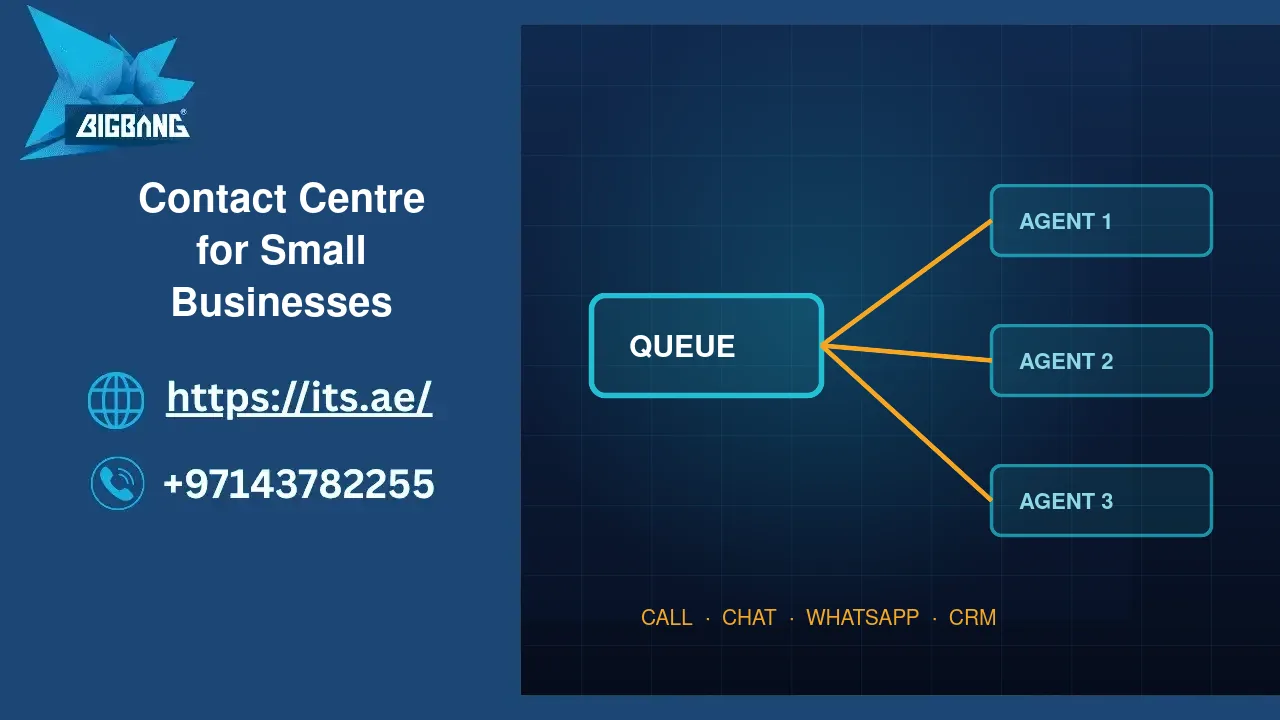
A hunt group rings phones in order. A queue holds the caller with music and a position announcement, routes to the agent who has been idle longest (or the most skilled, or a round-robin), tracks how long each caller waited, and sends overflow somewhere sensible — voicemail, a mobile, another queue — after a threshold you set. The difference is visible in one number: abandoned calls. Small businesses that move from ringing phones to a queue typically see abandonment drop from a fifth of calls to a few percent, simply because callers know they are in line.
2. An IVR that is short
“Press 1 for sales, 2 for support, 3 for accounts” is enough. Every extra level loses callers. Record the prompts in Arabic and English, offer the language choice first, and make “0 for reception” work at every level. In 3CX the menu is drawn in the Call Flow Designer and can check the time of day, so after 18:00 calls go to the on-call mobile rather than a voicemail nobody reads until morning.
3. Recording and reporting
Recording protects you in disputes and trains new staff faster than any manual. Reports tell you when the peaks are, which agent handles the most calls, and how long callers wait on Sunday mornings — the information that turns “we need another person” into “we need another person between 10 and 12”. Keep recordings on your own server; under the UAE data protection law they are personal data and should not sit on a vendor’s cloud you do not control.
4. A CRM link
When the phone rings, the agent should see the customer’s name, last order and open ticket before answering. 3CX integrates with the common CRMs (HubSpot, Zoho, Salesforce, Microsoft Dynamics, Odoo and others) and with anything else through its template generator; calls are logged to the customer record automatically. Our article on 3CX integration with CRM walks through the setup.
5. Chat and WhatsApp in the same queue
This is the feature that separates a phone system from a contact centre. 3CX takes website live chat, WhatsApp Business messages and SMS into the same agent client as the calls, with the same queue logic and the same reporting. A customer who starts on WhatsApp and asks to be called gets one click, not a copied number.
What to Leave Out
Small teams are sold features built for large ones. Skip predictive diallers, workforce-management suites, speech analytics dashboards and “omnichannel AI” bundles until you have the call volume to justify a person to run them. 3CX’s newer licences include AI transcription and call summaries, which are genuinely useful at any size — but a system you can operate without a specialist matters more than any single feature.
Agents Anywhere
The agent client runs on Windows, macOS, iOS and Android and in a browser. A support person can take queue calls from the office desk phone in the morning, the laptop at home in the afternoon and the mobile app on the road, appearing to the customer as the same extension throughout. For remote or hybrid teams that is the whole case for the move: no VPN, no forwarding rules, no personal numbers exposed. IP desk phones from Snom and Dinstar gateways for existing analogue lines are on our VoIP phones and gateways page.
The UAE Specifics
Voice calls over the internet in the UAE must terminate through the licensed operators. In practice, your contact centre connects to a SIP trunk from e& or du (or their authorised partners), keeps your existing numbers, and the 3CX server itself is hosted here — on our infrastructure, in the region, under a maintenance contract. That arrangement satisfies the regulator, keeps recordings in the country, and gives you a support line to people who built the system rather than a ticket queue abroad.
What It Costs
Three lines make up the bill:
- The 3CX licence, priced by simultaneous calls (4SC, 8SC, 16SC and up) and by edition. Chat, WhatsApp, queues, recording and CRM integration are in the Pro and Enterprise tiers; AI features in the AI edition. Current annual prices are in the 3CX pricing guide.
- Hosting and management of the server, with updates, backups and monitoring — a fixed monthly amount from us.
- The SIP trunk and minutes from the operator, which you would pay for any phone system.
For a ten-person business the whole arrangement usually lands well under the cost of a single additional salary — which is the honest comparison, because a queue that stops abandoned calls does the work of one.
Getting It Right in a Week
- List your inbound reasons for calling and group them into at most four menu options.
- Decide who answers what, and in what order, when they are busy.
- Record the prompts in both languages — a real voice, not text-to-speech, for the greeting at least.
- Connect the CRM before go-live so the first day’s calls are already logged.
- Run the old and new numbers in parallel for a week, then port.
Where We Are
BIGBANG ITS is a 3CX partner headquartered at the Sharjah Research, Technology and Innovation Park with a branch in Business Bay, Dubai. Support runs 24/7 and the office is open Saturday to Thursday, 09:00–18:00 Gulf time. For a contact centre sized to your team, contact us or call +971 4 378 2255.
Talk to us directly — we usually reply within minutes during business hours.