Most UAE trading companies we meet run on Excel for longer than they should. One workbook holds stock, another holds the price lists, and a third is rebuilt every quarter for the VAT return, with the owner as the only person who knows how the three fit together. That works with 5 staff and one warehouse. It stops working when a second branch, a second currency or a tax query arrives, and the first symptom is usually a number that two people cannot agree on.
Quick Answer
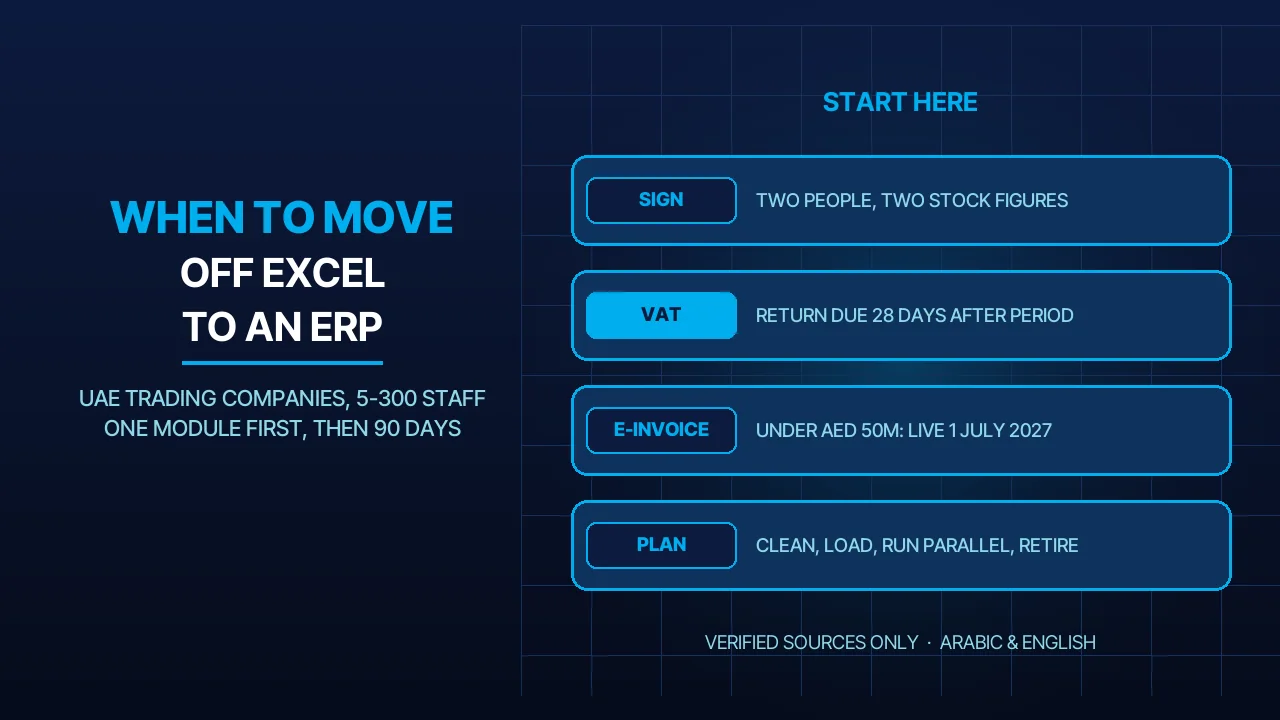
Move off Excel when stock, invoices and VAT live in separate files that someone reconciles by hand. Start with one module, not a whole system: inventory if you hold stock in more than one place, accounting if the VAT return takes more than a day to assemble. The Federal Tax Authority expects registered businesses to file and pay within 28 days of the end of each tax period, and mandatory e-invoicing reaches businesses with revenue under AED 50 million on 1 July 2027. Give the first module 90 days, run it beside Excel for one month, then retire the sheet. Our logistics ERP page shows how we scope a first module, and our change-management article covers the people side.
Five Signs You Have Outgrown Excel
Two people give two stock figures. The warehouse supervisor counts 140 cartons; the sales sheet says 162, because 22 were promised to a customer and never deducted. Excel has no idea of reserved, in-transit or damaged stock unless someone invents a column for it. When you spend more time explaining differences than acting on them, the sheet has become the job.
The VAT return is a project, not a report. A registered business has 28 days from the end of its tax period to file the return and pay, and the FTA’s guidance takes the form section by section, from outputs in boxes 1 to 8 to inputs and net VAT due in boxes 9 to 14. If filling those boxes means copying from three workbooks and hunting for a missing tax invoice, you are rebuilding an accounting system by hand every tax period.
Stock exists in places the sheet does not know about. A second warehouse, a bonded store near the port, goods on consignment with a distributor, a van that doubles as a mobile store. Each one is a location, and a location is exactly what a spreadsheet cannot model without becoming a second spreadsheet.
Your invoices are PDFs built by hand. The Ministry of Finance is explicit that unstructured formats such as PDF, Word documents, images, scans and emails are not e-invoices. Under the UAE’s five-corner model an invoice is structured data that passes through an Accredited Service Provider and is reported to the FTA. An Excel template that prints to PDF is not a path to that; it is the thing you will have to replace.
One person is the system. If the finance manager’s laptop is the general ledger, a resignation or a failed disk is a business-continuity event. The Ministry of Finance notes that 82% of UAE businesses are micro businesses with annual turnover under AED 3 million. Being small is not a reason to wait; it is the reason to fix this while the data is still small enough to clean.
Which Module to Start With
We do not recommend buying “an ERP”. Buy one module, run it well, and let it pull the next one in. For a trading company the starting points are three.
| Start with | If this is your pain | What it replaces | Prepare first |
|---|---|---|---|
| Inventory | More than one stock location; stock-outs and overstock at the same time | The stock workbook and the reorder sheet | One item list with one code and one unit per item |
| Accounting and VAT | The quarterly return takes days; input VAT gets missed | The invoice register and the VAT workbook | Customer and supplier TRNs; a chart of accounts |
| Sales and invoicing | Quotes, delivery notes and invoices disagree; e-invoicing is coming | Word and Excel invoice templates | Legal name, TRN and address for every customer |
Inventory first, for most traders. Stock is where the money sits, and it is the module whose data you can verify by walking into the warehouse. ERPNext’s stock reconciliation tool lets you upload counted quantities from a CSV template, or scan them in with a barcode reader, and then check the stock ledger for the result.
Accounting and VAT first, if the return hurts most. Both ERPNext and Odoo have UAE localisations. ERPNext ships a UAE VAT 201 report whose figures depend on three settings being right: the emirate on the company address and on each sales invoice, the zero-rated and exempt flags on items, and the VAT accounts chosen in its UAE VAT settings. Odoo’s UAE localisation issues invoices in English, Arabic or both, shows the VAT amount per line, and pulls exchange rates from the UAE Central Bank by default. The brand matters less than the outcome: the return becomes a report you print, not a file you build.
Sales and invoicing first, if e-invoicing is your deadline. This is the right entry point when most of the pain is at the customer-facing end: quotes that do not match delivery notes, credit notes nobody can trace. It is also the module that must talk to an Accredited Service Provider, so starting here forces the data clean-up e-invoicing will demand anyway.
What E-Invoicing Readiness Means for a Trader
The dates are set in Ministerial Decision No. 244 of 2025 as amended. Businesses with revenue of AED 50 million or more must appoint an Accredited Service Provider by 30 October 2026 and implement the system by 1 January 2027. Businesses with revenue below AED 50 million, which means most trading companies reading this, must appoint a provider by 31 March 2027 and implement by 1 July 2027. Voluntary implementation has been open since 1 July 2026.
Readiness is a data problem before it is a software problem. In the UAE model your provider validates the invoice data before it is exchanged, so a missing TRN or a mismatched legal name is caught at validation rather than discovered at the next VAT return. The Ministry also notes that because invoice tax data is reported to the FTA through accredited providers, it will pre-populate certain fields in VAT returns, which helps only if the data going in is right. Our e-invoicing deadlines article sets out the five-corner model and the penalties; for a trader the practical test is short. Can you export every customer with legal name, TRN and address, and every item with one code and one unit? If not, that export is your first 90-day task.
The First 90 Days
This is the sequence we use for trading companies of 5 to 300 staff. The calendar matters more than the software.
Days 1–30: clean before you load. Export the item list, customer list and supplier list from Excel. Remove duplicates, agree one code and one unit of measure per item, and collect the missing TRNs. Decide the warehouse structure: which physical locations exist, and which are really bins inside one location. A clean import of 800 items beats a messy import of 3,000.
Days 31–60: load, count, run in parallel. Import the master data, then do a physical count and post it as the opening stock. Run the module beside Excel for one full month. Every day one person compares the two and logs the differences; most of them will turn out to be Excel’s. Train the two or three people who touch stock daily, not the whole company. Our change-management article covers the colleague who keeps a private sheet “just in case”.
Days 61–90: close one period in the system and retire the sheet. Post a month of purchases, sales and stock movements, then produce that month’s VAT figures from the system and compare them with the old workbook. If they match within the differences you have already explained, stop updating the sheet and keep it as history. Then pick the next module. The rule we set out in AI enablement in 90 days applies here too: one process, one owner, one measurable result.
Three Decisions to Make
- Which module, and for whom. Name the module, the two or three daily users and the single owner. Our logistics ERP plans are sized by team, from up to 5 users and 1 company with warehouse, inventory, sales, purchasing and accounting, to 100 users and 10 companies, each on its own cloud server with installation, basic configuration and 24/7 support included.
- Where the data lives and how it is backed up. The moment the ERP replaces Excel it becomes the system of record. Daily backups held away from the server are the minimum; see our backup solutions. Protect every login with two-factor authentication.
- What you will stop doing. Write down the sheets that will be retired on day 90 and tell the team now. An ERP that runs beside Excel for a year is two systems, and two systems always disagree.
Frequently Asked Questions
Does a trading company below the VAT threshold need an ERP?
Not for tax reasons. VAT registration is mandatory only once taxable supplies and imports pass AED 375,000, and voluntary above AED 187,500. Below that, the reasons to leave Excel are operational: more than one stock location, more than one person editing the same figures, or a customer asking for structured invoices. Start with inventory.
Can we keep Excel for anything after the move?
Yes, for analysis, never for records. Export from the ERP into Excel to build a margin report or a forecast, but never type a transaction into Excel that should have gone into the system. The rule we give clients is short: Excel reads from the ERP and never writes to it. Anything else recreates the problem you paid to remove.
When does e-invoicing apply to a trading company below AED 50 million?
Under Ministerial Decision No. 244 of 2025, a business with revenue below AED 50 million must appoint an Accredited Service Provider by 31 March 2027 and implement e-invoicing by 1 July 2027. Business-to-consumer transactions are excluded until the Minister sets a date. Anyone may start voluntarily from 1 July 2026, a sensible way to test a new invoicing module.
Sources
- UAE Federal Tax Authority — Filing VAT Returns and Making Payments (accessed 2026-11-08)
- UAE Federal Tax Authority — Registration for VAT (accessed 2026-11-08)
- UAE Ministry of Finance — eInvoicing programme (accessed 2026-11-08)
- UAE Ministry of Finance — Ministerial Decision No. 244 of 2025 on the Implementation of the Electronic Invoicing System (PDF) (accessed 2026-11-08)
- UAE Ministry of Finance — Ministerial Decision No. 66 of 2026 amending Decision No. 244 of 2025 (PDF) (accessed 2026-11-08)
- ERPNext documentation — Stock Reconciliation (accessed 2026-11-08)
- ERPNext documentation — UAE VAT 201 report (accessed 2026-11-08)
- Odoo 18 documentation — United Arab Emirates fiscal localization (accessed 2026-11-08)
Where We Are
BIGBANG ITS has planned and run technology for UAE businesses since 2003, headquartered at the Sharjah Research, Technology and Innovation Park with a branch in Business Bay, Dubai. Support runs 24/7 and the office is open Saturday to Thursday, 09:00–18:00 Gulf time. If your trading company is deciding what to move out of Excel first, contact us or message us on WhatsApp.
Talk to us directly — we usually reply within minutes during business hours.