The system went live on a Monday. By Thursday the sales team was back on WhatsApp and the warehouse was back on paper. The software was fine: it did what the demo had promised. What nobody had managed was the change. This article is for the owner, general manager or operations head of a UAE business with 5 to 50 staff who is about to replace spreadsheets or an old system with an ERP, a CRM or a software phone system. It is written for the reader who suspects the staff will not use it.
Quick Answer
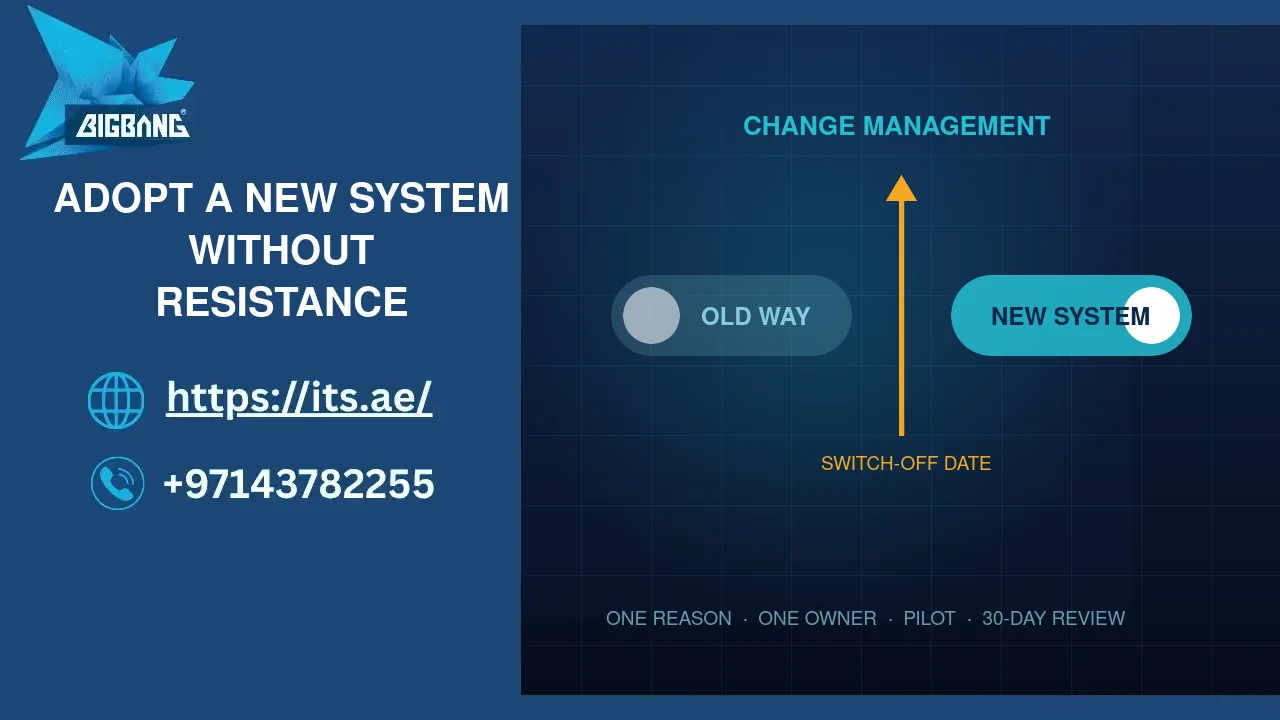
Change management for a new system in a UAE business is a management job with 6 parts, not a software job: one visible reason, in one sentence; one owner inside the company who is not the vendor; a pilot with 2 or 3 of the people who do the work daily, and a number to compare; a date on which the old way is switched off; training on each person’s own tasks, not on features; and a review at 30 days of what people still do outside the system. In our experience an ERP, a CRM and a 3CX phone system succeed or fail for the same 6 reasons, and the vendor controls none of them.
Why Good Systems Fail in Small Companies
In the companies we work with, a stalled adoption has 1 of 4 causes, often 2. The software is seldom one of them.
Bought for the owner’s report, not the user’s task. The demo showed a dashboard. The salesperson who has to fill the 40 fields behind it was not in the room. In our experience a system that lengthens the user’s day is used for as long as the owner is watching.
Nobody owns it after go-live. The vendor’s project ends at go-live. If no one inside the company owns the system from that day, the first unanswered question produces the first person back on the old way.
The old way kept alive “just in case”. The spreadsheet stays on the shared drive; the old number still rings. Given 2 ways to do a task, the people we watch choose the one they know, and the new system becomes a second job.
Training on features, not on the job. A 3-hour tour of every menu, for everyone, the week before go-live. On Monday the person who needs to raise a delivery note cannot find where.
Agile Without the Ceremony
“Agile” has a bad name in small companies because it arrives with sprints, boards and job titles. The principles behind the Agile Manifesto ask for working software delivered frequently, with a preference for the shorter timescale, for business people and developers working together daily, and for a team that reflects at regular intervals and then adjusts its behaviour. For a company of 20 people that is 3 habits.
Small releases. One process goes live at a time: quotations this month, invoicing next, stock after that. Each release is small enough that a bad week can be undone.
A weekly 20-minute check. The owner of the system sits with the people using it, once a week. Not a status report: what was slow, what was skipped, what was done outside the system.
Fix what hurts before adding what is nice. The weekly list is sorted by pain, not by the vendor’s feature list. The owner’s report comes after the salesperson can raise a quotation in 2 minutes.
Microsoft’s Dynamics 365 implementation guidance says the same from the vendor’s side: apply change management in proportion to the project’s risk and complexity, and a training plan in a slide deck is not all the change management needed. At this size the proportionate amount is the 6 parts below.
The 6 Parts of Change Management for a New System
Each part is a management decision. None can be delegated to the vendor.
1. One visible reason, in one sentence. “We are moving to the CRM so that any of us can answer a customer without asking Ahmed.” Not “going digital”. A sentence the newest employee can repeat, printed where the team sits, because the team will test the system against it.
2. An owner inside the company. Not the vendor. Not the owner of the company either, unless the company is tiny: the person who signs the invoices cannot also sit in the weekly check. The three-year technology roadmap set the rule of one owner per system; this is where it earns its keep.
3. A pilot with the people who do the work. 2 or 3 people who do the task daily, for 2 to 4 weeks, on real orders and calls. Measure 1 number before it starts: minutes to raise a quotation, calls with no note, invoices issued outside the system. The method is the one in AI in 90 days: a small pilot, one owner, one number.
4. A switch-off date for the old way. Announced at least 2 weeks ahead, in writing, by the owner of the company. From that date the spreadsheet is read-only, the old number forwards to the queue, the paper form is not accepted. The exception list is written before the date, not argued after it: the 2 customers who insist on a paper delivery note, and nothing else.
5. Training on the person’s own tasks. 30 minutes per role, on the 3 things that role does every day, in the language the person works in, with real data. Record each session so next month’s hire gets the same 30 minutes. A driver needs to close a delivery on the app, not the administration menu.
6. The 30-day review. 30 days after switch-off, the owner of the system lists what people still do outside it: the WhatsApp group that was not closed, the notebook by the phone, the invoice typed in Word. Each item has a reason: a missing feature, permission, training or decision. Fix the top 3, then set the next review.
What Changes, by System
Each system changes a different person’s day and meets its own resistance.
| System | What changes for people | The usual resistance | What removes it |
|---|---|---|---|
| ERP | Every order, purchase and stock movement is entered once, by the person who does it, when it happens | “I will enter it at the end of the day”; the warehouse keeps its paper ledger; sales quotes from a spreadsheet | One process live at a time; the paper ledger removed on the switch-off date; a phone or tablet at the point of work |
| CRM | Every call, visit and email to a customer is logged; the pipeline meeting is run from the CRM screen | “Logging takes longer than the call”; the salesperson’s private notebook; a pipeline kept in the head | Calls logged automatically from the phone system (our article on a contact centre for a small business covers the link); the weekly meeting held from the CRM only |
| Cloud phone system (3CX) | The desk phone becomes an app on the laptop and the mobile; calls arrive from a queue and are recorded | “The old phone worked”; staff keep giving customers their mobile numbers; the app is not installed | 30 minutes per role; the old numbers ported and switched off on a date; our comparison of 3CX with traditional and cloud phone systems covers what changes when the PBX becomes software |
| E-invoicing | Invoices leave the accounting system as structured data through an accredited service provider; a PDF or a scan is not an e-invoice | “The customer wants a PDF”; invoices still typed in Word and scanned | The obligation arrives in phases by revenue, so the switch-off date comes from the calendar, not from preference; the phases are in our article on UAE e-invoicing deadlines |
What Is Specific to a UAE Business
Bilingual teams. In the companies we work with, the office works in English, the warehouse in Arabic, Urdu or Hindi, and the accounts in whichever language the auditor prefers. Train in the language of the person, not of the manual: sessions in Arabic and English, a third language when a team needs it, and the recording in the same language.
Turnover and handover. The day someone leaves is the day their account on the ERP, the CRM and the phone system is closed and the extension reassigned. The UK National Cyber Security Centre’s guide for small organisations covers securing accounts and devices at this size; our article on two-factor authentication for business covers the offboarding step.
Regulated data in the new system. A CRM holds customer data; a phone system holds recordings. The UAE government portal’s page on data protection laws summarises the federal Personal Data Protection Law, which applies to personal data processed inside or outside the country and sets requirements for cross-border transfer. Decide where the system is hosted before go-live; our article on the UAE data protection law and your website covers hosting in the UAE.
An external deadline. The Ministry of Finance defines an e-invoice as structured invoice data exchanged electronically and reported to the Federal Tax Authority through accredited service providers; PDFs, Word files and scans do not count. A deadline set by law is easier to hold than one set by the owner, so we use it to fix the switch-off date for invoicing.
How to Lead It
The leadership part is short and cannot be delegated.
Announce the reason and the date, then step back. The owner of the company says the sentence from part 1 and the date from part 4, in person, once. After that the owner of the system runs it.
Resistance is information, not disobedience. The salesperson who will not log calls is telling you that logging takes too long, or that nobody reads the log. Write each complaint down at the weekly check, sort the list, fix the top 3.
Measure use, not sentiment. Do not ask whether people like the system. Count records created, calls logged, invoices issued from the system, deliveries closed on the app.
Budget the change, not only the licence. The pilot, the training, the system owner’s hours and the slower month around switch-off are costs of the change. Our article on CapEx or OpEx for technology covers how each sits in the budget; the change is a line of its own.
A written rule. “No parallel systems after the switch-off date.” One sentence, signed by the owner, applied to spreadsheets, notebooks, WhatsApp groups and old phone numbers alike.
| Week | Owner does | Team does | Number to check |
|---|---|---|---|
| Week 0 | States the reason and the switch-off date; names the system owner | Hears it in person, in both languages | The baseline: the 1 number the pilot will be compared against |
| Weeks 1 to 3 | Attends the weekly 20-minute check | 2 or 3 people run the pilot on real work | The pilot number against the baseline |
| Week 4 | Confirms the date; signs the exception list | 30-minute training per role, recorded | Roles trained; sessions recorded |
| Week 5 | Switches the old way off | Works in the system only; logs complaints instead of arguing them | Records created, calls logged, invoices issued from the system |
| Week 9 | Reads the 30-day review; approves the top 3 fixes | Lists what is still done outside the system | Items outside the system, and the 3 being fixed |
Three Examples from Our Work
Drivers on WhatsApp after the ERP went live. A logistics company put deliveries on an ERP with a driver app. For weeks the drivers kept sending updates to the dispatcher on WhatsApp, and he typed them in himself, so the app looked used and was not. On the announced date he stopped accepting WhatsApp updates, and a delivery not closed on the app did not appear on the trip sheet. Within the week the drivers were closing deliveries on the app.
A CRM ignored until the phone system filled it. A sales team had owned a CRM for a year and used it for nothing; the pipeline lived in the sales manager’s head. We connected 3CX to the CRM so every call was logged without typing, and the owner ran the weekly pipeline meeting from the CRM screen only: a deal not in the CRM was not discussed. Deals were updated the night before the meeting, then daily.
Desk phones before training. A 3CX rollout stalled because the IP desk phones arrived before anyone was trained. Staff plugged them in, could not transfer a call, and went back to their mobiles. We ran 30-minute sessions per role, in Arabic and English, on the 3 things each role does: answer, transfer, see who is calling. The old numbers got a switch-off date, and on that date the mobiles stopped being the phone system.
This article closes our business leadership series. The three-year roadmap decided what the company needs and in what order, AI in 90 days how to pilot one task, digital sustainability what to switch off, and CapEx or OpEx how to pay. This one covers the part the invoice does not: getting people to use it.
Frequently Asked Questions
What is change management when a small business adopts a new system?
It is the management work that gets staff to use a new system instead of the old way. For a UAE business of 5 to 50 staff it has 6 parts: a visible reason, an owner inside the company, a pilot with the people who do the work, a switch-off date, training on real tasks and a 30-day review.
How long should the pilot run before the whole team moves?
In our experience 2 to 4 weeks, with 2 or 3 people who do the task daily, on real orders and calls. Measure 1 number before it starts and the same number at the end. If it moved, fix the top 3 complaints and set the switch-off date. If it did not, the pilot has shown what to change first.
Should we run the old system in parallel with the new one?
Only until the switch-off date, and only with the exception list written down. In our experience a parallel period without a date becomes permanent, because staff choose the way they know and the new system becomes a second job. Announce it at least 2 weeks ahead, make the old file read-only that day, and stop accepting paper and WhatsApp updates.
Who should own the new system after go-live?
One named person inside the company, not the vendor and not the owner of the company unless the company is tiny. In practice that is the operations head or the manager whose team uses the system every day. The owner runs the weekly 20-minute check, keeps the complaint list, decides what is fixed first and writes the 30-day review.
Sources
- Agile Manifesto signatories — Principles behind the Agile Manifesto (accessed 2026-09-30)
- Microsoft Learn — Dynamics 365 implementation guide: Understand and apply the change management discipline effectively and successfully (accessed 2026-09-30)
- UAE Ministry of Finance — eInvoicing programme (accessed 2026-09-30)
- UAE Government Portal (u.ae) — Data protection laws (accessed 2026-09-30)
- UK National Cyber Security Centre — Small organisations guide to cyber security (accessed 2026-09-30)
Where We Are
BIGBANG ITS has planned and run technology for UAE businesses since 2003, headquartered at the Sharjah Research, Technology and Innovation Park with a branch in Business Bay, Dubai. Support runs 24/7 and the office is open Saturday to Thursday, 09:00–18:00 Gulf time. For a rollout plan sized to your team, contact us or call +971 4 378 2255.
Talk to us directly — we usually reply within minutes during business hours.