Most companies in the UAE order printing the way they order stationery: someone needs cards before an exhibition, a brochure before a client visit, a roll-up before a booth opens. The work gets done, but it costs more than it should and rarely looks like one brand. A little planning — deciding what you actually need, understanding paper and finishes, and sending files a printer can use without asking questions — removes most of the cost and nearly all of the reprints.
Quick Answer
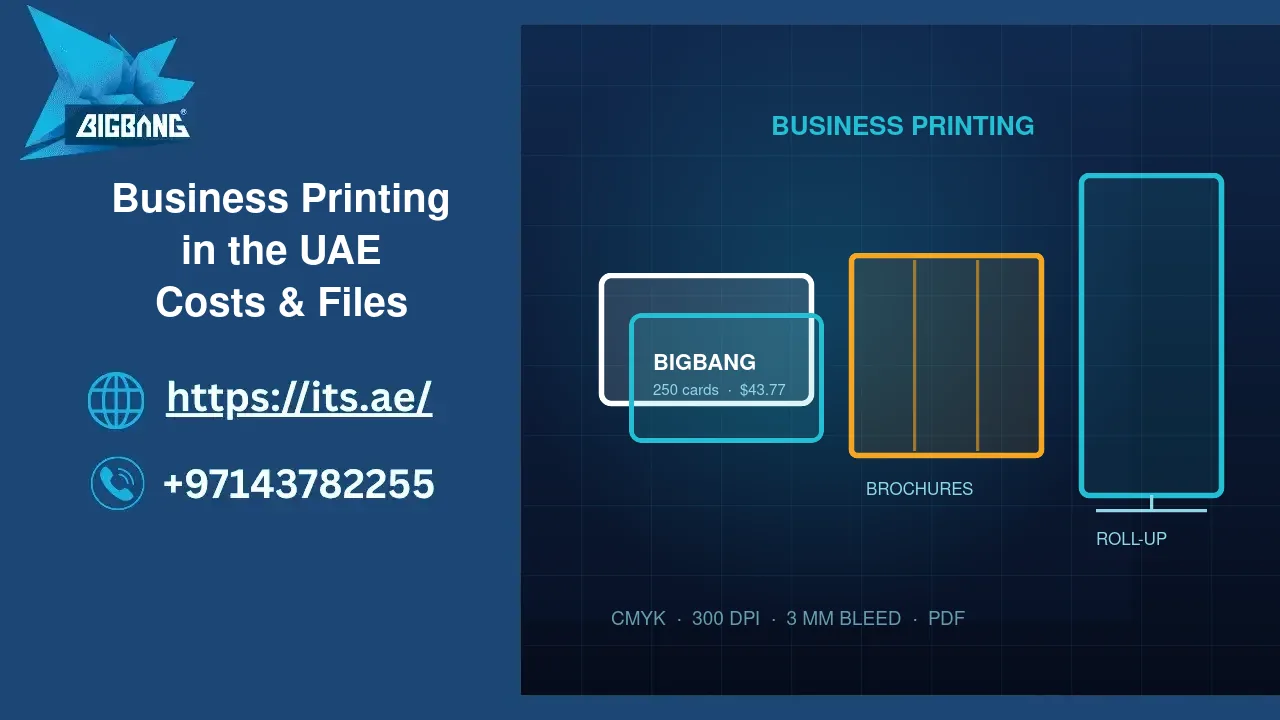
Five pieces cover the everyday needs of a small or mid-sized UAE company: business cards, letterhead and envelopes, a folded brochure, a roll-up banner, and labels or stickers. Budget from USD 43.77 for 250 business cards, USD 74.23 for an 85 × 200 cm roll-up, and from USD 100.87 for brochures. The single biggest saver is sending a correct print-ready file: CMYK, 300 dpi, 3 mm bleed, fonts outlined, exported as PDF. The single biggest delay is approving the proof late.
The five pieces most companies actually need
Business cards. Still the item handed over most often, and the one people judge fastest. A 350 gsm stock with matte lamination survives a pocket and a wallet; a thin uncoated card does not.
Letterhead and envelopes. Quotations, invoices and official letters carry your name into other companies’ files. A letterhead that matches your website and your cards makes the document look like it came from an organised company.
A folded brochure. Tri-fold for a quick overview at a counter or an exhibition; half-fold when the content needs room — a service list, a specification table, a short case study.
A roll-up banner. The cheapest way to own a space at an exhibition, a lobby or a training room. Print it with generous margins: the bottom 20 cm is usually hidden behind a table or a visitor.
Labels and stickers. Product labels, seal stickers for packaging, asset tags for equipment. Small pieces that quietly signal a company that pays attention.
What it costs
These are our published starting prices. Larger quantities change the price per piece, which is why the store shows a quantity option on each item rather than a single figure.
| Item | Starting price (USD) | Notes |
|---|---|---|
| Business cards — 250 pcs | 43.77 | Double-sided, standard stock |
| Roll-up banner 85 × 200 cm | 74.23 | Includes stand and carry bag |
| Tri-fold or half-fold brochures | from 100.87 | Price falls per piece as quantity rises |
| Flyers A5 / A4 | from 133.22 | 130 gsm gloss, printed both sides |
| Round stickers 5 cm | from 161.77 | Sheet or roll |
Letterheads, luxury cards, large format, corporate gifts and apparel are quoted per job, because the paper, size and finish change the number more than the quantity does.
Paper, weight and finish, in plain words
Weight (gsm) is how heavy the paper is. Flyers sit around 130–170 gsm, brochures 150–250 gsm, business cards 300–400 gsm. Heavier feels more expensive because it is.
Lamination is the thin film on top. Matte reads as calm and modern and hides fingerprints; gloss makes colours jump and suits food and product images. Soft-touch feels like suede and costs more.
Uncoated paper takes a pen — useful for anything a client will write on, and a poor choice for photographs.
A useful rule: pick the finish by what the piece must survive. A card lives in a wallet, a flyer lives for an afternoon, a roll-up lives in a store room between events.
The file checklist that prevents reprints
Most reprints we see come from one of six causes. Each has a cheap fix at the file stage:
- Colour mode: export in CMYK. A file in RGB will look brighter on screen than anything ink can produce, and the printed result disappoints.
- Resolution: images at 300 dpi at final size. A logo pulled from a website is 72 dpi and will look soft.
- Bleed: add 3 mm of background beyond the trim on every edge, so a slight cutting shift never leaves a white line.
- Safe area: keep text at least 5 mm inside the trim. Cutting is accurate, not perfect.
- Fonts: outline them, or embed them in the PDF. Arabic type suffers most when a font is missing — letters disconnect and the line breaks in the wrong place.
- Format: send PDF, ideally PDF/X. A Word file or a screenshot will be re-made by someone who does not know your brand.
If you do not have these files, that is normal — it is part of a design job, not an obstacle. What matters is that the final artwork exists somewhere in an editable form, so the next reprint does not start from zero.
Arabic and English on the same piece
Bilingual printing is where most templates quietly fail. Three things to watch: Arabic needs slightly more vertical space per line than Latin text at the same point size; a bilingual card reads better with a clear side for each language than with mixed lines; and phone numbers should keep one numeral style across the whole piece — do not mix Arabic-Indic and Latin digits on the same card.
Timeline, and what actually slows it down
Standard items move fast once artwork is approved. What stretches a schedule is rarely the press: it is a proof waiting for approval, content that is not final, or a colour expectation formed on a phone screen. Ask for a digital proof, check it at 100 %, and read every phone number and email aloud before you approve — a wrong digit costs a whole run.
Frequently asked questions
Can you print if I already have a designer?
Yes. Send print-ready PDFs and we produce from them. If the files are missing bleed or use RGB, we will tell you before printing rather than after.
How many business cards should I order?
250 is the sensible starting quantity for a new company or a new title. Order 1,000 only when the details — title, number, address — are stable, otherwise a change makes the savings disappear.
Do you deliver outside the UAE?
Printing is produced locally and delivered within the UAE. For other countries we prepare the print-ready files so a local printer can produce them without redesign.
Sources
- ISO 216 — international paper sizes (A series)
- Adobe — preparing documents for print (bleed, marks, output)
- The UAE Government portal — starting a business
Where We Are
BIGBANG ITS FZE designs and produces business printing from Sharjah for clients across the UAE — cards, stationery, brochures, roll-ups, signage and packaging, with print-ready files you keep. Prices and ordering are on our store, and the service page is here. Tell us what you need at contact us.
Talk to us directly — we usually reply within minutes during business hours.