Most UAE business owners first hear about the country’s data protection law from a compliance email and assume it is a problem for banks and hospitals. It is not. If your website has a contact form, a newsletter signup, analytics, or a booking system, you are collecting personal data — and the obligations that come with it apply to you. This guide explains, in practical terms, what the UAE’s data protection framework asks of an ordinary company website, what to change, and how to tell the difference between the parts you can handle yourself and the parts that need a lawyer.
This is practical orientation, not legal advice. The obligations below are general; how they apply to your specific business, sector and data should be confirmed with qualified counsel.
Quick Answer
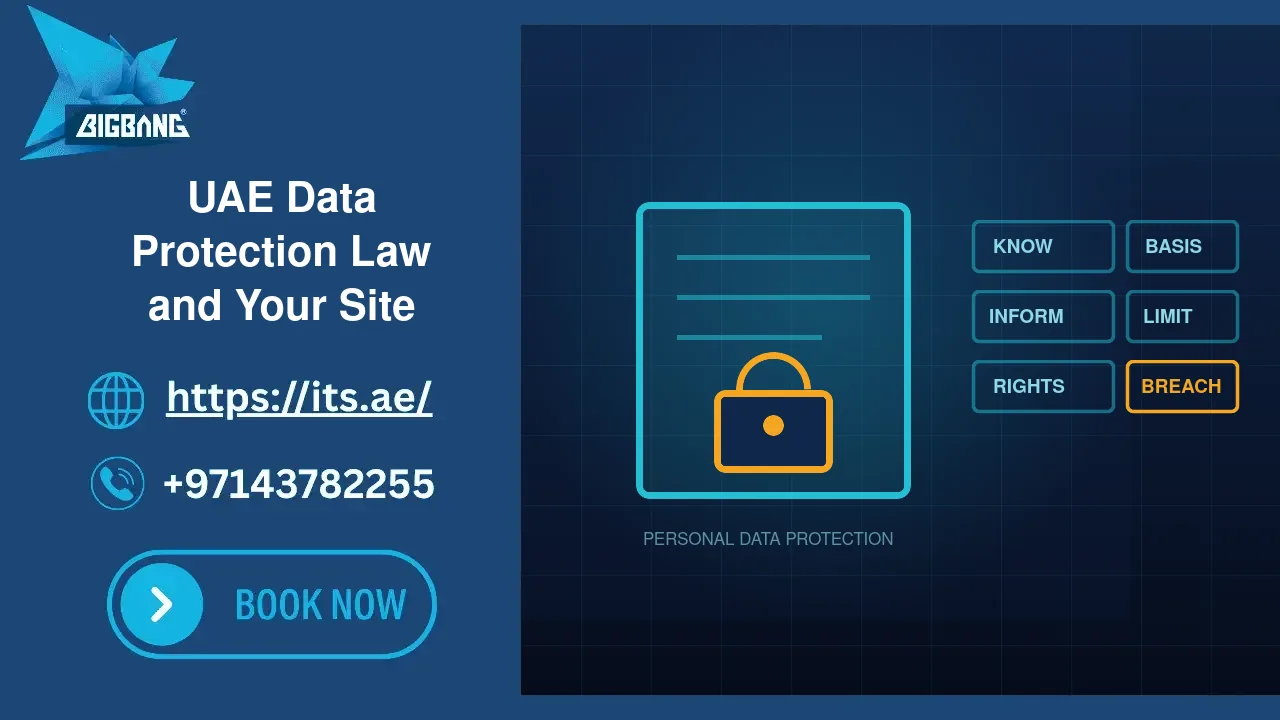
The UAE’s Personal Data Protection Law — Federal Decree-Law No. 45 of 2021, in force since 2 January 2022 — governs how personal data is collected and used. For a typical company website that means six practical things: know what you collect, have a lawful reason for collecting it, tell people clearly in a real privacy notice, keep it only as long as you need it, be able to answer requests for access or deletion, and be able to detect and report a breach. Most of the work is inventory and process, not technology.
You Are Almost Certainly Collecting Personal Data
Personal data is any information relating to an identified or identifiable person. On a business website that is a much wider net than people expect:
Contact and quote forms — name, email, phone, and often the free-text field where someone describes their situation, which can contain far more sensitive information than the form intended.
Newsletter signups — an email address on its own is personal data.
Analytics and advertising — IP addresses and device identifiers, and the tracking these tools set to follow a visitor across sessions.
Booking, support and account systems — the richest sources, and the ones most likely to hold data you have forgotten about.
Server logs — every web server records visitor IP addresses by default.
Job applications — a careers page collects CVs, which are dense with personal information and frequently retained indefinitely.
If a reasonable person could be identified from what you hold, directly or by combining it with something else, it is personal data.
The Six Things a Company Website Needs to Get Right
1. Know What You Hold
Everything else depends on this, and it is the step almost always skipped. Write down, for each system: what personal data it collects, why, where it is stored, who can access it, how long it is kept, and whether it is shared with anyone outside the business.
The exercise routinely surfaces things nobody remembered: a form plugin storing every submission in the database since 2019, an abandoned newsletter tool still holding a list, analytics sharing data with a platform nobody chose deliberately. You cannot protect or delete what you do not know you have.
2. Have a Lawful Reason
You need a legitimate basis for each use of personal data. Consent is one basis, and for marketing it is usually the relevant one — but consent has to mean something: freely given, specific, informed, and as easy to withdraw as it was to give. A pre-ticked box is not consent. Burying it in terms nobody reads is not consent.
Other uses rest on different grounds — fulfilling a contract, meeting a legal obligation. The practical point is that “we collected it because we could” is not a basis, and marketing to a list you bought is the clearest example of having none.
3. Tell People, Properly
Your privacy policy is where this obligation lands, and most are unfit for the purpose: copied from a template for another jurisdiction, written to be unreadable, and never updated when the site changed.
A usable privacy notice says, in plain language: what you collect, why, who you share it with, how long you keep it, what rights people have, and how to contact you about it. If your policy does not name your actual tools and actual retention periods, it is decoration.
4. Keep It Only As Long As You Need It
Indefinite retention is the default state of most websites and the easiest obligation to breach without noticing. Form submissions accumulate in the database for years. Old customer records are never purged. A departed employee’s mailbox stays live forever.
Set a retention period for each category, write it down, and enforce it — ideally automatically. Data you have deleted cannot be leaked, and reducing what you hold is the single most effective privacy measure available to a small business.
5. Be Able to Answer a Request
Individuals have rights over their data — broadly, to know what you hold about them, to have it corrected, and in many circumstances to have it deleted. You need a process that can actually deliver, within a reasonable and defined timeframe.
Test it before you need it. If someone emailed today asking for everything you hold about them, could you find it across your CRM, mailbox, form database, newsletter platform and backups? For most businesses the honest answer is no, and the fix is inventory (step one) rather than technology.
6. Be Able to Detect and Report a Breach
A personal data breach is not only a dramatic hack. It includes a misdirected email containing customer data, a lost laptop, or an exposed backup — and it includes a website compromise where an attacker had access to a database.
Two capabilities matter. First, detection: if your site were compromised, would you know? Many businesses discover a breach months later, and a breach you cannot detect is a breach you cannot report. Second, a documented response: who is told, what is assessed, what is recorded, and who notifies the regulator — federally, the UAE Data Office — and affected individuals where required. The notification deadline and procedure sit in the law’s implementing regulations rather than in the decree-law itself, so confirm the current requirement with your adviser instead of copying a figure from another jurisdiction.
Our guide on what to do in the first hour after a compromise covers the technical response; the reporting obligation runs alongside it.
What Actually Changes on Your Website
Concretely, expect to touch these:
The privacy policy — rewritten to describe what your site really does, naming the tools you use and the retention periods you apply.
Forms — a clear statement at the point of collection saying what the data is used for, unticked consent where consent is the basis, and no fields you do not actually need. Every extra field is data you must protect, keep and be able to delete.
Cookies and tracking — non-essential tracking should not run before the visitor agrees, and refusing should be as easy as accepting. Check what your site actually loads: analytics, advertising pixels, embedded video and chat widgets all set identifiers, and most sites carry several the owner never knowingly added.
Form storage — decide whether submissions need to be stored in the site database at all. Emailing to a mailbox and keeping the site free of the archive is often better, both for privacy and because the website is the exposed component.
Access control — how many people have administrator access, and does each still need it? Old accounts belonging to former staff and agencies are a standing risk, and they are also personal data you are holding.
Security measures — the law expects appropriate protection, not a specific product. Our UAE website security checklist sets out the practical baseline.
Cross-Border Transfers, Practically
Personal data leaving the UAE is subject to conditions, and this catches ordinary businesses because it is invisible in daily use. If your website is hosted abroad, your email is on an overseas platform, your CRM is a US service and your analytics send data to a third country, you are transferring personal data across borders continuously.
None of that is automatically prohibited, and the point is not to panic. The point is to know it is happening, record it in your inventory, and be able to explain the basis on which it occurs. Choosing UAE-based hosting for the data you can keep local simplifies the picture and is worth weighing for that reason alone.
The Free Zone Complication
One detail that surprises people: the DIFC (DIFC Law No. 5 of 2020) and ADGM (Data Protection Regulations 2021) operate their own data protection regimes, separate from the federal law. If your company is licensed in one of those free zones, the applicable framework may not be the federal PDPL at all.
This matters when picking a template or an adviser. A privacy policy drafted for a mainland company is not automatically right for a DIFC entity, and vice versa. If you are in a free zone, confirm which regime applies before you spend money on compliance work.
Where to Start, In Order
For a business that has not begun, this sequence gets you furthest fastest:
Inventory first. One document listing every place personal data lives. Nothing else is meaningful without it, and it usually takes an afternoon.
Then reduce. Delete what you do not need, turn off collection you cannot justify, and remove fields and old accounts. This lowers both risk and workload.
Then document. Rewrite the privacy notice around what you actually found, set retention periods, and write down your response process.
Then secure and monitor. Access control, backups, patching, and the ability to detect a compromise — because the obligation to report a breach assumes you can notice one.
Then get advice on the specifics. Free zone or mainland, your sector’s requirements, whether you need a data protection officer, and the exact wording of your notices. That is the part worth paying a lawyer for, and it is much cheaper once you arrive with an inventory in hand.
Frequently Asked Questions
Does this apply to a small business with a simple website?
The law is about the processing of personal data, not company size. A small business with a contact form and a mailing list is processing personal data. The expectations scale with what you hold and how sensitive it is, but “we are small” is not an exemption.
Do I need a data protection officer?
Not every business does. The requirement is tied to the nature and scale of processing — high-risk processing that uses new technologies or runs at large volume, systematic and comprehensive evaluation of sensitive data including profiling and automated decisions, and large volumes of sensitive data. A typical company website with a contact form is unlikely to trigger it, but this is exactly the question to confirm rather than assume.
Is a GDPR-style privacy policy good enough?
As a starting structure it is useful, and as a finished document it is not. The UAE framework is its own instrument with its own definitions and requirements, and a policy that describes European supervisory authorities and rights that do not map to UAE law reads as what it is — a template nobody adapted.
What about data we collected years ago?
It is still personal data and the obligations still apply. In practice, historic data is where most exposure sits: old form submissions, dormant customer lists, CVs from a hiring round in 2019. Reviewing and deleting what you no longer need is usually the highest-value first action.
Do I have to host in the UAE?
Not automatically. Cross-border transfer is regulated, not forbidden. Local hosting simplifies the analysis and shortens the list of transfers you have to justify, which is a practical argument rather than a legal requirement.
Sources
- u.ae (UAE Government) — Data protection laws (Federal Decree-Law No. 45 of 2021, in force 2 January 2022) (accessed 2026-09-15)
- ADGM — Office of Data Protection (ADGM Data Protection Regulations 2021) (accessed 2026-09-15)
- NIST SP 800-61 Rev. 3 — Incident Response Recommendations and Considerations for Cybersecurity Risk Management (accessed 2026-09-15)
Getting the Technical Side Right
Much of data protection is process and legal work. The parts that sit on the website — how forms collect and store data, what trackers load and when, who has administrator access, whether backups are protected, and whether you would detect a compromise at all — are engineering, and that is our half of it.
BIGBANG ITS FZE has supported UAE businesses since 2003. Our website security services cover access control, monitoring and breach detection, our backup solutions handle retention and recovery, and our UAE hosting keeps data local where you want it kept local.
Talk to our Dubai team about the technical side — and take the legal specifics to a qualified adviser, ideally with your data inventory already written.
Talk to us directly — we usually reply within minutes during business hours.