You are opening a company in Dubai or Sharjah, moving the office into a free zone, or the team has grown and the number printed on your website is still the manager’s mobile. You search for business phone numbers and get a mix of offers: a landline from the operator, a toll-free 800 number, an international number that rings in the UAE, and a cloud PBX that promises all of it at once. The real question is not “which number is cheapest?” but “which number fits your customers, who is allowed to issue it, and how does the call reach the right person on your team?” This guide covers the four types as we see them at our UAE clients since 2003, and says when each one earns its cost.
Quick Answer
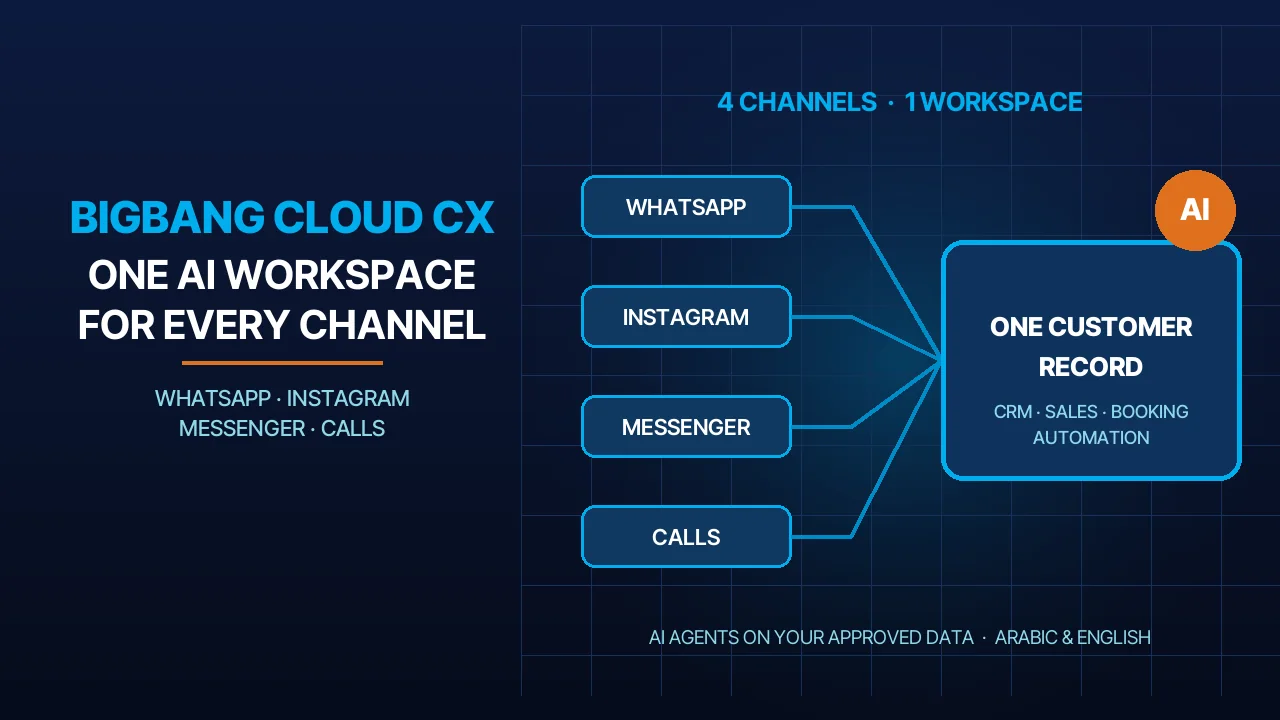
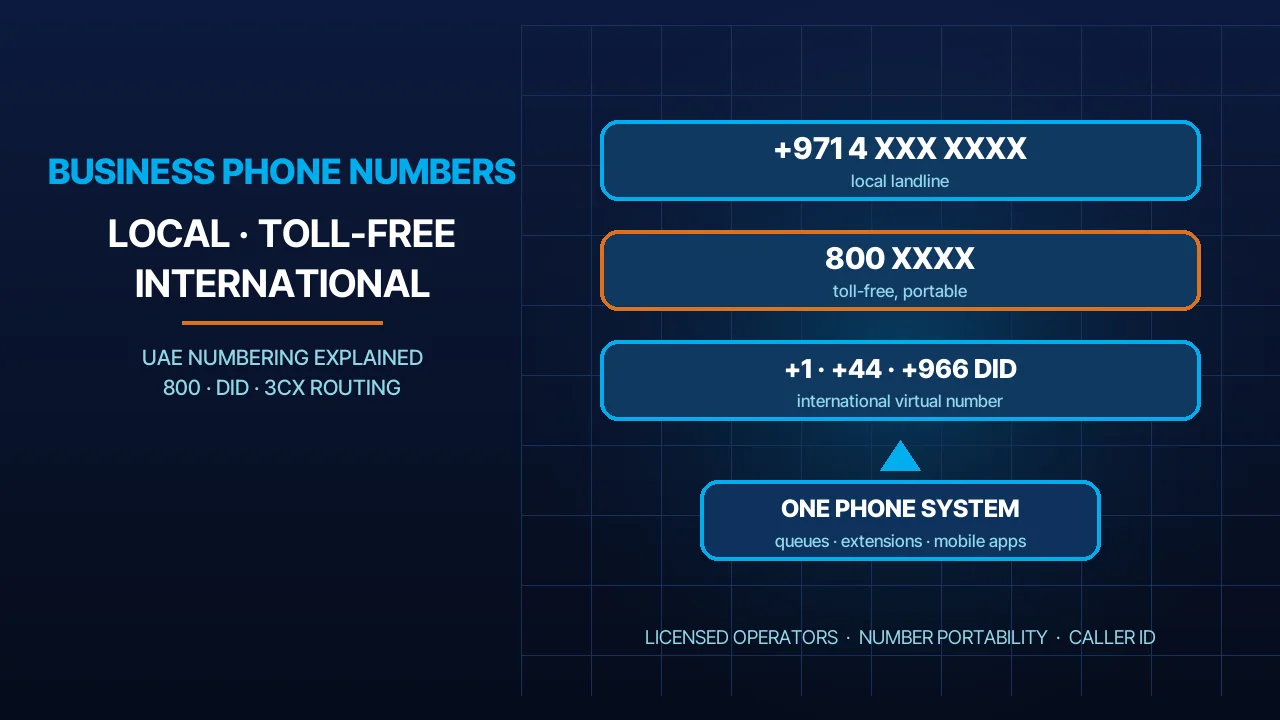
Business phone numbers in the UAE come in four types: a local landline with the emirate’s area code (04 Dubai, 02 Abu Dhabi, 06 Sharjah), a company mobile number, a toll-free 800 number where the owner pays for the call instead of the caller, and an international number (DID) with another country’s code that rings here. Local and toll-free numbers are issued by the UAE’s licensed operators; international numbers come from a VoIP provider once your documents are reviewed. What ties them together is a cloud phone system such as 3CX: one number rings on desk phone, mobile and computer and reaches the right queue. For calls and WhatsApp in one inbox: BIGBANG Cloud CX.
Types of Business Numbers in the UAE
The UAE runs a closed numbering plan: country code +971, a two-digit area code, then a seven-digit subscriber number. The area codes, according to the public numbering summary, are 02 Abu Dhabi, 04 Dubai, 06 Sharjah, Ajman and Umm Al Quwain, 07 Ras Al Khaimah and 09 Fujairah. Mobile numbers start with 050, 054 and 056 on Etisalat (now e&), 052, 055 and 058 on du, and 053 on Virgin Mobile. The 800 range is the toll-free range. The body that develops and implements the National Numbering Plan and the Number Portability Policy is the Telecommunications and Digital Government Regulatory Authority (TDRA).
The local landline. This is the number a UAE customer expects on a business card: 04 for Dubai or 06 for Sharjah tells them you really are in the city. A licensed operator issues it with a phone line or a SIP trunk in the name of your trade licence. Its one drawback is that it has historically been tied to the office location, which is exactly what a cloud PBX fixes, as we show below.
The company mobile number. Right for a sole trader or a field rep, and registered to the trade licence rather than to a person. We see it a lot as the WhatsApp Business number. The problem is that it is one person’s number: when that employee resigns or travels, the channel goes quiet.
The toll-free 800 number. The owner of the number pays for the call instead of the caller; it is usually requested for sales and support lines. We go into it in the next section.
The international number (DID). A virtual number with another country’s code, say London, New York or Riyadh, that rings on your phone system in the UAE. It suits anyone selling to customers abroad who wants them to call at their own local rate.
| Type | Format | Who issues it | When it fits |
|---|---|---|---|
| Local landline | +971 4 xxx xxxx (or 02, 06, 07, 09) | Licensed operator in the UAE | A physical office and local customers who expect the city code |
| Company mobile | +971 5x xxx xxxx | Licensed operator, on the trade licence | Sole trader, field rep or WhatsApp Business |
| Toll-free 800 | 800 followed by digits chosen by the owner | Licensed operator; portable between operators | Sales and support for customers inside the UAE |
| International (DID) | Other country’s code plus a local number there | VoIP provider after document review | Customers abroad who want to call at a local rate |
The Toll-Free 800 Number: When It Is Worth It
An 800 number is a message before it is a line: it tells the customer “call us, we pay”. That is why we see it at insurers, real-estate firms, delivery companies and clinics, where the customer hesitates before calling and compares five companies. At our clients who sell to consumers inside the country we notice that someone who dials a toll-free number is closer to buying, though we cannot put a general figure on it.
Three points settle the decision. First, the cost lands on you, so if your customers are companies calling from their offices the number will not matter much to them and a landline is enough. Second, portability: according to the TDRA’s FAQ, toll-free number portability lets a business move its 800 number from one operator to another and keep it, and the new operator handles the porting. In other words, the number you painted on the signage is not lost if you change operator. Third, caller name: the “Kashif” caller-ID feature shows the registered name of the calling business (up to 25 characters) on the screen of whoever you call, and is activated compulsorily on the numbers of all economic establishments, as the TDRA states on the same page. So pick the short name your customers know, because that is what they will see on every outbound call from you.
The details of porting fixed, mobile and toll-free numbers are on the TDRA’s porting numbers page. Inside the UAE we supply toll-free 800 numbers specifically, as part of the cloud PBX package on the portal; the current price is on the portal because it changes.
An International Number for Your Customers Abroad (DID)
DID stands for Direct Inward Dialing; some providers call it DDI or MSN. According to the official 3CX documentation, a VoIP provider supplies DID numbers that route calls directly to a queue, a ring group, an extension or the digital receptionist. An international number is simply a DID with another country’s code: your customer in London dials a number starting with +44 and pays as if calling a neighbour, and the call travels over the internet to your office in Sharjah or Dubai.
How we supply it. We give you a virtual number in the area code you choose, for any country once your company’s legal documents have been reviewed, because the operator in that country wants to know who is using the number. We hold a large inventory of numbers, and the number rings on any device already registered to your phone system: the desk phone, the mobile app and the computer. Billing is monthly or annual, and the details are on the cloud PBX page of the portal. For anyone who calls North America a lot we run a separate USA SIP trunk, and we explain the differences between trunks in our article on the cheapest SIP trunk for 3CX.
An example from our own setup. The international support line we answer on WhatsApp is +1 667 222 1616, a US number. A customer in the UAE, Saudi Arabia or Canada messages us on it, and the message reaches the support team here around the clock. That is exactly what an international number does for you in the opposite direction: a number in your customer’s country, and your team here.
One Number, Many Devices: The Role of the Cloud Phone System
A number on its own solves nothing if it rings on one handset in a corner of the office. What makes business phone numbers useful is the PBX behind them. In 3CX we attach every number (local, toll-free and international) to a SIP trunk, then route each one to its destination: the sales number to a queue of three agents, the 800 number to the auto-attendant that asks “sales or support?”, the international number to the English-speaking extension. The agent answers on the desk phone, the 3CX app on their mobile or the browser, and the customer has no idea where they are.
The caller-ID rule. According to the 3CX trunk guide, outbound calls show the trunk’s main number as caller ID by default, and an extension that has been assigned its own DID shows that DID on its outbound calls. In practice this means the sales rep who covers the London market calls customers from a +44 number rather than an 04 number, and the customer picks up. Setting these rules is half the value of the system, and we set them for you at installation.
Devices. The app is enough for many employees, and anyone who wants a physical handset or a gateway for a fax line or old copper lines will find the options under VoIP phones and gateways. If you want to see the call and the WhatsApp message in one inbox with performance metrics, that is what BIGBANG Cloud CX adds on top of the PBX. And if four or more people answer customers all day, read our guide to a contact centre for a small business in the UAE as well.
What the Law Requires
This is where many people lose time and money. VoIP services in the UAE are telecommunications services regulated under Federal Law by Decree No. 3 of 2003, they require a licence, and licensees are the ones who provide them in the country, as the TDRA states in its FAQ. The practical meaning: the local number and the 800 number are issued by a licensed operator in the UAE, in the name of your trade licence, and there is no other route.
What we warn against, from experience. One: a “virtual 04 number” sold by a foreign website on a credit card with no documents; that is a grey number that can be cut at any moment, and whoever printed it on their cards loses the customers with it. Two: running a foreign SIP trunk to make local calls presenting a UAE caller ID; we refuse to set that up. Three: delaying the renewal of the international number’s documents when they are requested, so the number stops and customer calls go missing. Four: registering numbers in an employee’s name rather than the company’s, and then the employee leaves.
Data and recording. Recording calls and keeping customer numbers is processing of personal data; we laid out the practical obligations in our article on the UAE data protection law, and our simple rule is: tell the caller about recording, set a retention period, and keep recordings on a server whose location and access you know.
How to Choose and Start Within a Week
Day one: decide who calls you. Consumers inside the country? An 800 number plus a local number. Local companies? A local number is enough. Customers abroad? An international number in each main market. A field team? A mobile app instead of scattered mobile numbers.
Day two: choose the VoIP provider. Ask about the licence, about porting your current number, about price lock, and about support in Arabic. We put the full question list in how to choose the best VoIP provider for a small business, and compared traditional and cloud PBXs in 3CX vs traditional and cloud phone systems.
Day three: prepare the documents. A valid trade licence, the authorised signatory’s documents, and a list of the numbers you want ported. The new operator handles the porting, but missing documents are what delays the request most often at our clients.
Days four and five: setup. We install the PBX, connect the trunk, route each number to its queue, record the auto-attendant in Arabic and English, and set the caller ID for each department.
Day six: testing. Call every number from an outside mobile, confirm your company name appears on outbound calls, and confirm the call moves to the mobile when the office does not answer.
Day seven: launch. Update the number on the website, your Google Business Profile and the email signature, and print the cards after the number works, not before. The current price of each option is on the portal.
Frequently Asked Questions
How do I get an 800 number for my company in the UAE?
You need a valid trade licence and a licensed UAE operator that issues the number in the company’s name. You pick the number, and it is attached to your PBX so it rings on the queue or extension you define. We supply toll-free numbers in the UAE within the cloud PBX package; the current price is on the portal.
Can I keep my business number if I change operator?
Yes. The TDRA’s Number Portability Policy allows fixed, mobile and toll-free numbers to move between operators while keeping the same number, and the new operator handles the whole procedure. The practical condition is that the documents are in the name of the company the number was registered to, so have the trade licence ready before you apply.
Is an international number legal in the UAE?
Yes, if it comes from a licensed provider and is used for its purpose: receiving calls from customers abroad on your phone system, and calling them back with that number as caller ID. The provider reviews your company documents first because the other country’s operator requires it. A foreign trunk for local calls with UAE caller ID is not acceptable.
What is the difference between a DID number and a SIP trunk?
A SIP trunk is the channel that carries calls between your PBX and the provider over the internet, and sets how many simultaneous calls you get. A DID is the number itself, the one a customer dials to reach you. One trunk carries dozens of DIDs, each with its own destination: a queue, an extension or an auto-attendant.
Sources
- FAQs – Telecommunications and Digital Government Regulatory Authority (accessed 2026-10-11)
- Porting Numbers – TDRA Consumer Tool Hub (accessed 2026-10-11)
- Configuring SIP Trunks / VoIP Providers in 3CX Phone System (accessed 2026-10-11)
- Telephone numbers in the United Arab Emirates – Wikipedia (accessed 2026-10-11)
Where We Are
BIGBANG ITS has planned and run technology for UAE businesses since 2003, headquartered at the Sharjah Research, Technology and Innovation Park with a branch in Business Bay, Dubai. Support runs 24/7 and the office is open Saturday to Thursday, 09:00–18:00 Gulf time. Contact us or message us on WhatsApp.
Talk to us directly — we usually reply within minutes during business hours.