Most UAE companies we meet did not plan their technology. They bought it: the cheapest hosting at the time, the phone system that came with the office fit-out, email set up by someone who has since left. Each purchase solved that week’s problem. Then the company grows from 8 people to 30, and every one of those decisions comes back as an emergency. A three-year technology roadmap is how an owner stops paying for surprises: a short written plan of what the business will need, in what order, and who owns each part.
Quick Answer
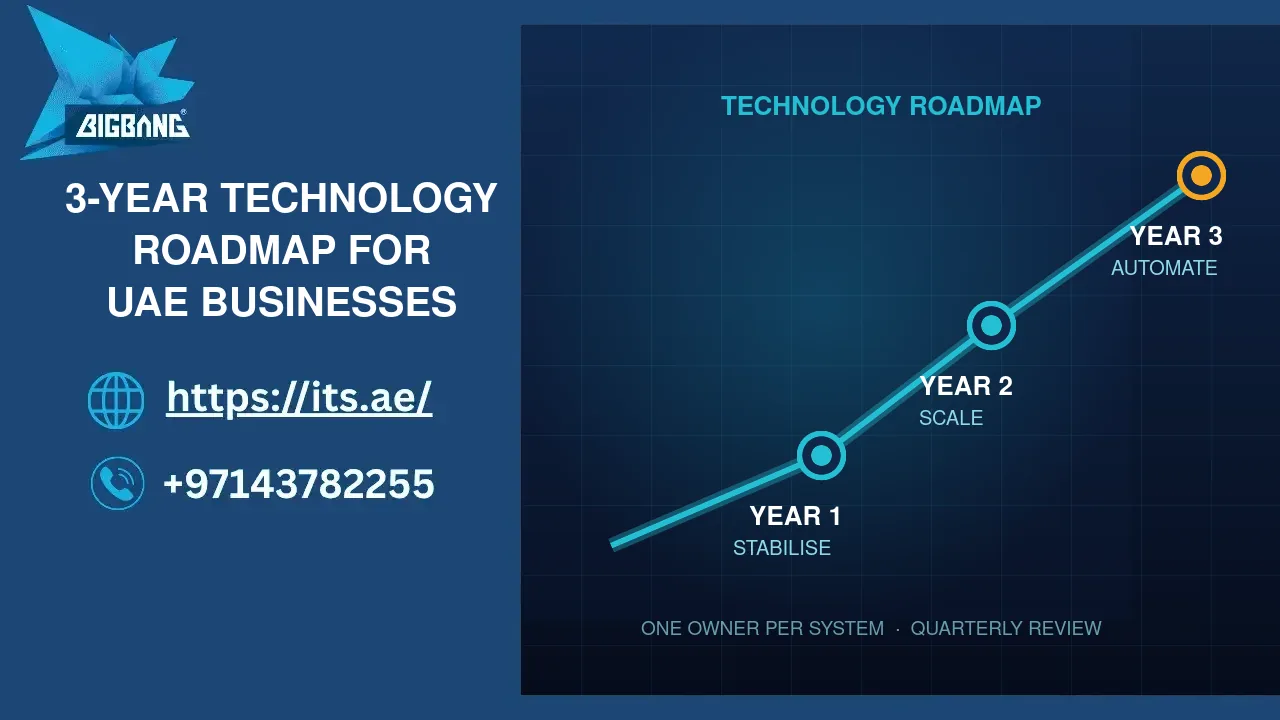
A three-year technology roadmap is a one-page plan that lists the systems a company will need over the next 36 months and the order in which they must be built. Each line gets an owner and a budget line. You build it in 3 passes. Year 1 stabilises the foundation: domain and DNS ownership, business email with SPF, DKIM and DMARC, tested backups, 2FA on the accounts that matter. Year 2 scales what growth stresses first: hosting, the phone system, a CRM. Year 3 automates: reporting, AI where it saves hours, e-invoicing readiness. The order matters more than the products. We write these with clients in one afternoon, with the owner and the finance head in the room.
Why Growth Breaks IT First
Growth breaks the cheapest thing first, and the cheapest thing is almost always technology bought for the company you were, not the one you are becoming. We see the same 4 failures.
The shared hosting plan that ran a 5-page brochure site times out in the online store’s first busy week, because hundreds of other websites share the server. The PBX in the cupboard cannot add a second branch without a second PBX and an engineer visit. Email works, but nobody can log in to the registrar or the DNS, because the account belongs to a former employee or agency. And backups exist in the sense that a box was ticked years ago, but nobody has restored a file from them.
None of these is a technology problem at first. Each is an ownership problem that grew into one. That is why the roadmap starts with ownership, not purchases.
Year 1 — Stabilise
The first year is not exciting, and it should not be expensive. 5 items cover it:
- Own the domain and the DNS. The registrar account, the DNS zone and the renewal invoice should be in the company’s name, on a company mailbox, with 2 people able to log in. If you cannot say where your DNS is hosted, start here.
- Business email with authentication. SPF, DKIM and DMARC records published on your domain so receiving servers can verify the sender. Microsoft’s documentation on email authentication explains how mail without these 3 records ends up rejected or in spam.
- Backups you have restored from. A backup that has never been restored is a hope. The UK’s National Cyber Security Centre makes backing up your data one of the 5 steps in its guide for small organisations. It also says a backup drive should not stay connected to the computer it protects. Restore once, time it, write the time down. The schedule we use is in our website backup and recovery plan.
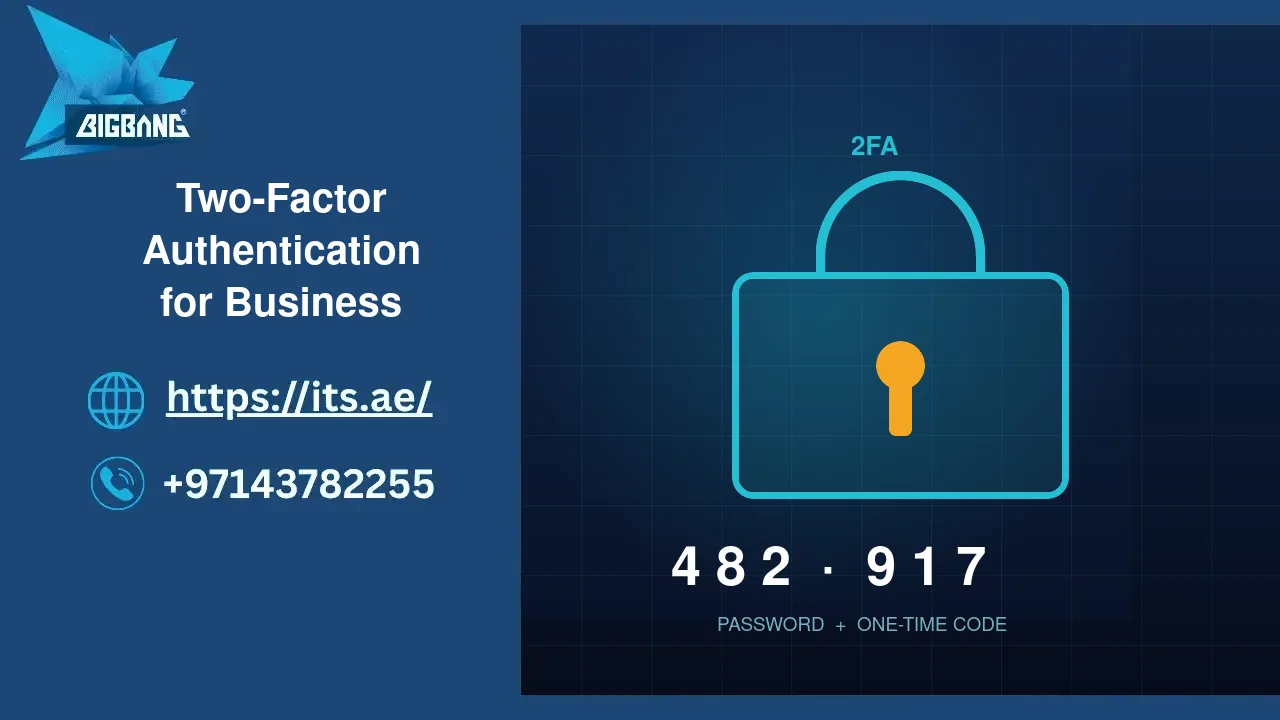
- 2FA on the accounts that matter. Email, the domain registrar, the hosting panel, the bank portal. CISA’s guidance is plain: with multifactor authentication turned on, a stolen password alone is not enough to get into the account.
- One maintenance owner. A named person, inside or outside the company, responsible for updates, renewals, monitoring and the restore test. Not a committee, and not whoever is free. For most companies of this size that is a maintenance contract.
If Year 1 is done properly, the company can lose a laptop, an employee or a hosting provider without losing the business. That is the test.
Year 2 — Scale
Year 2 is where growth shows up in the technology. We scale one layer at a time, in the order the business is straining.
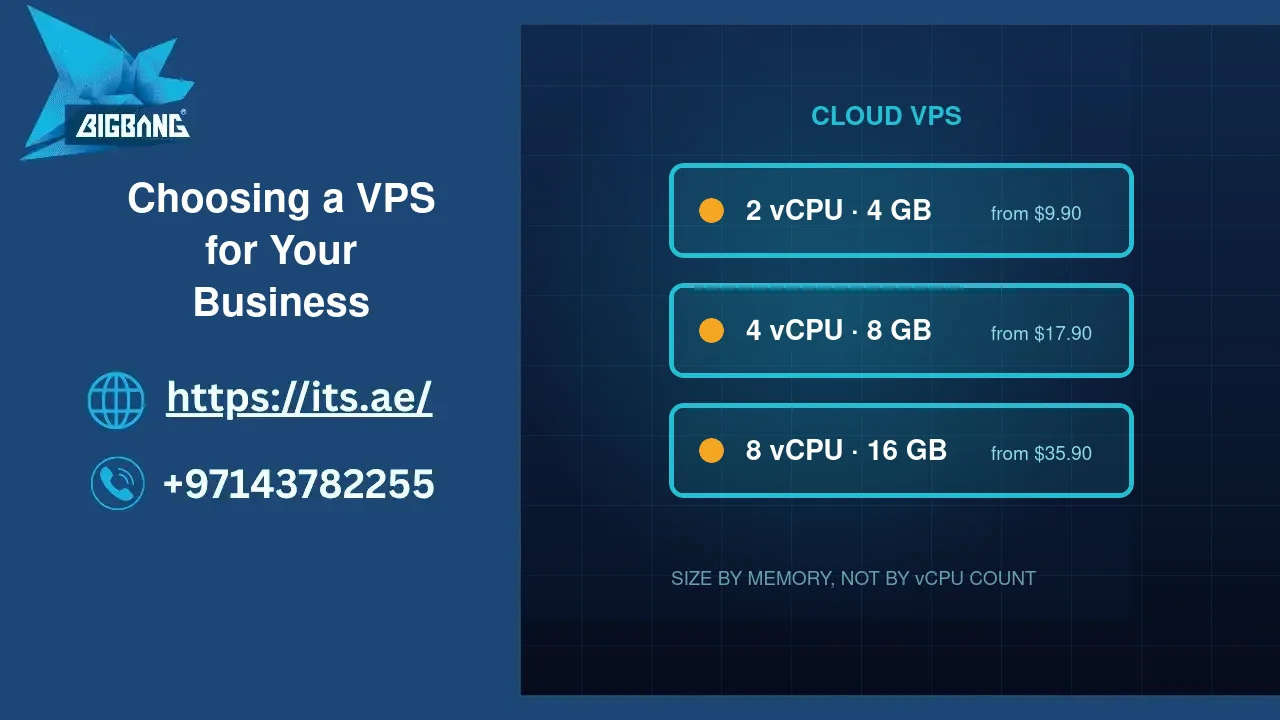
Hosting sized for the load. The path is shared hosting, then a VPS, then a dedicated server. Move when the site needs more memory than the shared plan can give it at peak, or when it runs a booking system, a large store or a customer portal. The most common mistake we see is buying by CPU count when the constraint is memory. Our guide to choosing a VPS for a UAE business gives the sizes and the prices.
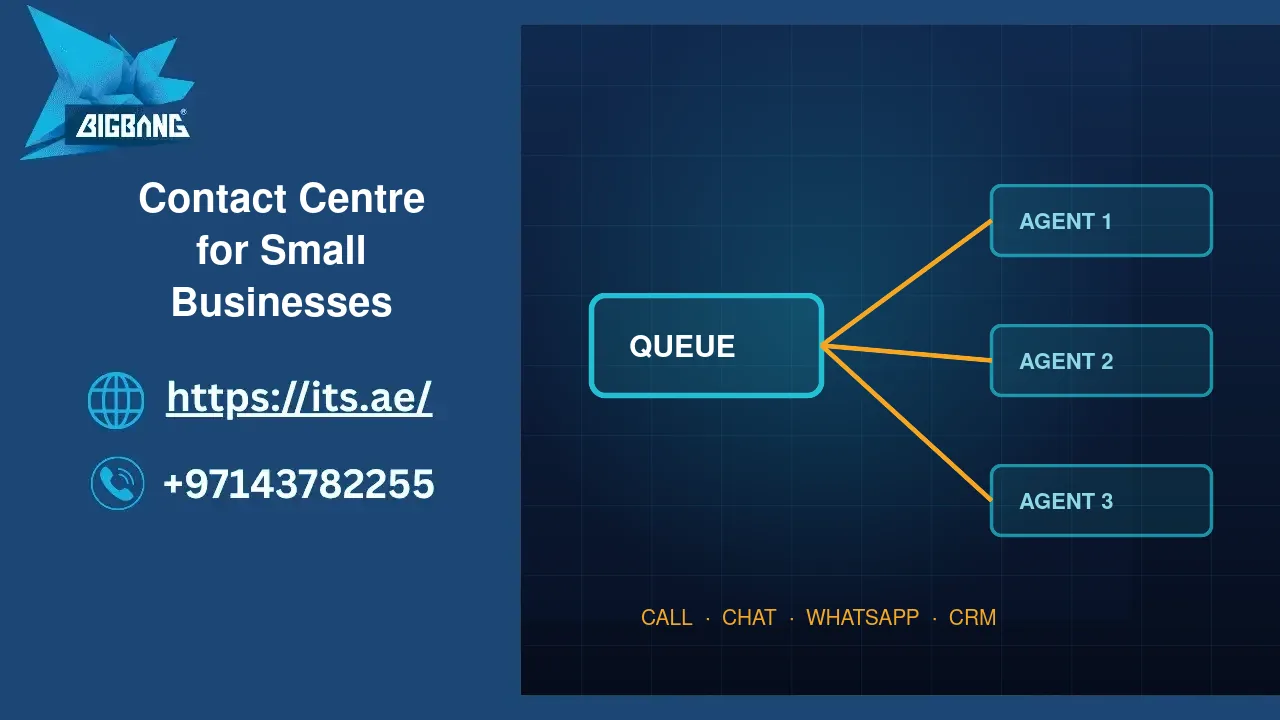
A phone system that follows the team. A second branch or a hybrid schedule is where the desk PBX stops. A software PBX such as 3CX runs the desk phone, the laptop app and the mobile app as one extension. It adds a branch without new hardware and puts calls, chat and WhatsApp into one queue. In the UAE the calls still terminate through the licensed operators, and the server is hosted here. If customers call you more than you call them, start with our article on a contact centre for a small business.
A CRM the phone and the email feed. A CRM bought before the phone and email are connected to it becomes a spreadsheet with a login page. Connect it so calls are logged, emails attach to the customer record and the pipeline is visible to the owner without asking anyone.
An ERP only when the spreadsheets break. Wait for 2 signs together: the same data is typed into 2 places, and the owner cannot get a number (stock, margin, receivables) without a phone call. For companies moving goods, a logistics ERP that ties shipments, warehouse and invoicing together is usually the first serious system. It goes on the Year 1 foundation, or it fails on it.
Year 3 — Automate and Decide with Data
By Year 3 the systems exist and the data is in them. The work is to use it.
AI where it saves a person’s hours. Not everywhere. The cases that pay back in a small company are specific: drafting replies to routine emails, summarising calls and tickets, extracting fields from supplier invoices, first-line answers on the website. Our AI solutions page lists what we build, and our guide to Claude AI services covers where to start and what to measure.
Dashboards from the ERP and CRM. Once the Year 2 systems hold a year of data, the owner should see 5 to 8 numbers weekly without asking: cash, receivables, pipeline, orders, stock, open tickets. They come from the systems, not from a person compiling them.
E-invoicing readiness. The UAE’s e-invoicing programme, run by the Ministry of Finance, requires invoices to be issued as structured data through an accredited service provider; PDFs and scanned copies do not count. The rollout is phased and reaches smaller businesses in 2027; the dates are in UAE e-invoicing deadlines. An invoicing system chosen in Year 2 should already be able to connect.
Security and data-protection review. The UAE’s federal personal data protection law sets obligations on how customer data is collected, stored and shared. A yearly review of who can access what, where it is hosted and what is retained is the minimum. The practical part is in our article on the UAE data protection law and your website.
How to Lead It
The roadmap is a management tool, not an IT document. 5 habits make it work, and they cost the owner almost no time.
One owner per system. Every line on the roadmap has one name next to it. They need not be technical; they need to know who to call. Shared ownership is no ownership.
A quarterly 30-minute technology review. Owner, finance head and the maintenance owner, 4 times a year. The agenda is 3 questions: what broke, what is next, and what has changed in the business that changes the roadmap.
A budget line instead of emergencies. Most of the roadmap is now a subscription: hosting, licences, email, maintenance. That is operating expense, and it belongs in the budget as a monthly line the finance head can see. Capital expense is the exception: phones, network hardware, a server you own. Treat the 2 differently and the emergencies stop, because the spending was already planned. The rule for choosing between them is in our article CapEx or OpEx? How a UAE business should pay for its technology.
A rule for buy versus build. Buy anything that every other company also needs. Build only what makes your company different, after the bought parts are in place. A custom system on a shared plan with no backups is the most expensive thing we get called to rescue.
What to ask your IT provider for in writing. 4 things: who owns each account and credential, what the backup schedule is and when it was last restored, what the response time is when something is down, and what it costs to leave. A provider who will not put those in writing has answered the question.
| Decision | Who owns it | Review cadence | Warning sign |
|---|---|---|---|
| Domain, DNS and renewals | Finance head | Annual, before renewal | Renewal email goes to someone who has left |
| Email and authentication | Maintenance owner | Quarterly | Customers say your mail lands in spam |
| Backups and restore test | Maintenance owner | Monthly check, annual restore | Nobody knows when the last restore was |
| Hosting size | Maintenance owner | Quarterly, before any campaign | Site slows at the busiest hour |
| Phone system | Sales head | Annual, before any new branch | Staff give customers personal mobiles |
| CRM and ERP | Owner | Quarterly | The same data is typed twice |
| Access and 2FA | Maintenance owner | Quarterly, and on every leaver | A former employee can still log in |
| Technology budget | Finance head | Quarterly | An IT purchase that was not budgeted |
Three Examples from Our Work
A trading company and a second branch. The company ran on a legacy PBX that could not add a second branch without duplicating the hardware. We moved them to 3CX hosted in the UAE. The new branch and the mobile app came on the same licence, and extensions followed staff between the office and home without forwarding rules. The roadmap entry was one line: a phone system that adds a branch without an engineer visit.
A logistics company on spreadsheets and WhatsApp. Operations ran on shared spreadsheets and driver updates by WhatsApp, and the owner asked for an ERP first. The roadmap put email and backups before it, because the ERP would have failed on that foundation. Unauthenticated email meant customer notifications would bounce, and an untested backup meant one bad day could erase the operation. The logistics ERP replaced the spreadsheets in the second phase, on a base that had been fixed.
A services company whose website slowed down. The website sat on a shared plan that was fine until the online booking system was added, after which it slowed at the busiest hours. We moved it to a VPS sized by memory rather than CPU count, because memory was the constraint we measured. The migration ran in parallel with the old site and was switched over with no downtime. Their roadmap now reviews hosting size every quarter.
Frequently Asked Questions
What is a three-year technology roadmap?
A short written plan of the systems a company will need over the next 36 months, in the order they must be built, with an owner and a budget line for each. For a company of 5 to 50 staff it fits on one page and is reviewed every quarter, not rewritten.
Why start with email and backups instead of the systems the business is asking for?
Because every later system depends on them. A CRM sends email; an ERP holds data that must be backed up; a phone system logs to the CRM. If the foundation is not owned, authenticated and recoverable, the new system inherits those weaknesses, and fixing them under a live ERP costs more.
How much should a UAE company of this size budget for technology?
We do not give a number, because it depends on whether you sell online, how many branches you run and what you already own. What we do say is that most of it is now a monthly operating cost, that it belongs in the budget as a visible line, and that a quarterly review stops emergency spending.
Do we need an IT provider to write the roadmap, or can we do it ourselves?
You can write the first draft yourself in an afternoon using the 3-year structure in this article. A provider helps with sizing: which hosting tier, which phone licence, whether the spreadsheets have really broken. Ask for the roadmap in writing, with named owners, as part of a maintenance contract rather than a separate sale.
Sources
- UAE Ministry of Finance — eInvoicing programme (accessed 2026-09-16)
- Microsoft Learn — Email authentication in Microsoft 365 (SPF, DKIM, DMARC) (accessed 2026-09-16)
- RFC Editor — RFC 7489: Domain-based Message Authentication, Reporting, and Conformance (DMARC) (accessed 2026-09-16)
- CISA — Turn On Multifactor Authentication (accessed 2026-09-16)
- UK National Cyber Security Centre — Small organisations guide to cyber security (accessed 2026-09-16)
- NIST — SP 800-34 Rev. 1: Contingency Planning Guide for Federal Information Systems (accessed 2026-09-16)
- UAE Government Portal (u.ae) — Data protection laws (accessed 2026-09-16)
- TDRA — Frequently Asked Questions (VoIP and licensed operators) (accessed 2026-09-16)
Where We Are
BIGBANG ITS has planned and run technology for UAE businesses since 2003, headquartered at the Sharjah Research, Technology and Innovation Park with a branch in Business Bay, Dubai. Support runs 24/7 and the office is open Saturday to Thursday, 09:00–18:00 Gulf time. For a roadmap sized to your company, contact us or call +971 4 378 2255.
Talk to us directly — we usually reply within minutes during business hours.