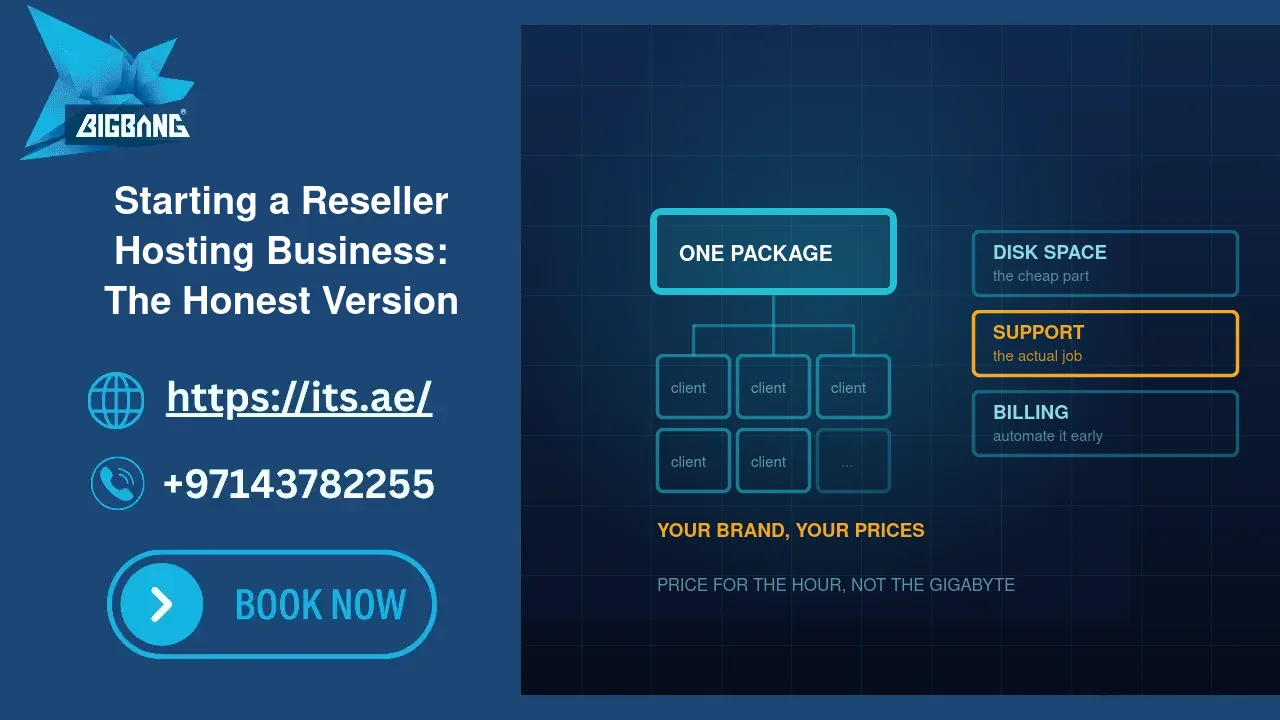
Reseller hosting is sold with a familiar pitch: buy a package, resell it under your own brand, collect recurring revenue. The pitch is not wrong, but it leaves out the part that decides whether the business works — you are not selling disk space, you are selling support. The margin on the hosting is small. The work is answering the phone when a client’s email stops arriving on a Sunday morning.
This guide is written for the people who actually do well at this: web designers, agencies, IT consultants and freelancers who already have clients and are currently sending them elsewhere for hosting. It covers what reseller hosting is, the real economics, what you have to be ready to do, and how to start without over-committing.
Quick Answer
Reseller hosting means renting a block of server resources with the tools to split it into individual accounts you sell under your own brand. Your provider runs the infrastructure; you own the customer relationship, set the prices, and handle first-line support. It works well when you already have clients — designers and agencies especially, because hosting turns one-off project fees into recurring revenue and stops clients disappearing to a cheap host that then breaks the site you built. It works badly as a standalone business competing on price. Expect to start for a few hundred dirhams a month, and expect support to be the real workload.
What You Are Actually Buying
A reseller account gives you a slice of a server plus the control panel to divide it. In practice that means:
A quota to distribute. A fixed amount of storage and bandwidth that you split across as many accounts as you like, in whatever sizes you choose.
WHM, or an equivalent panel. The tool for creating accounts, defining your own hosting packages, suspending non-payers, and moving accounts between packages. Each of your clients gets their own cPanel and never sees yours.
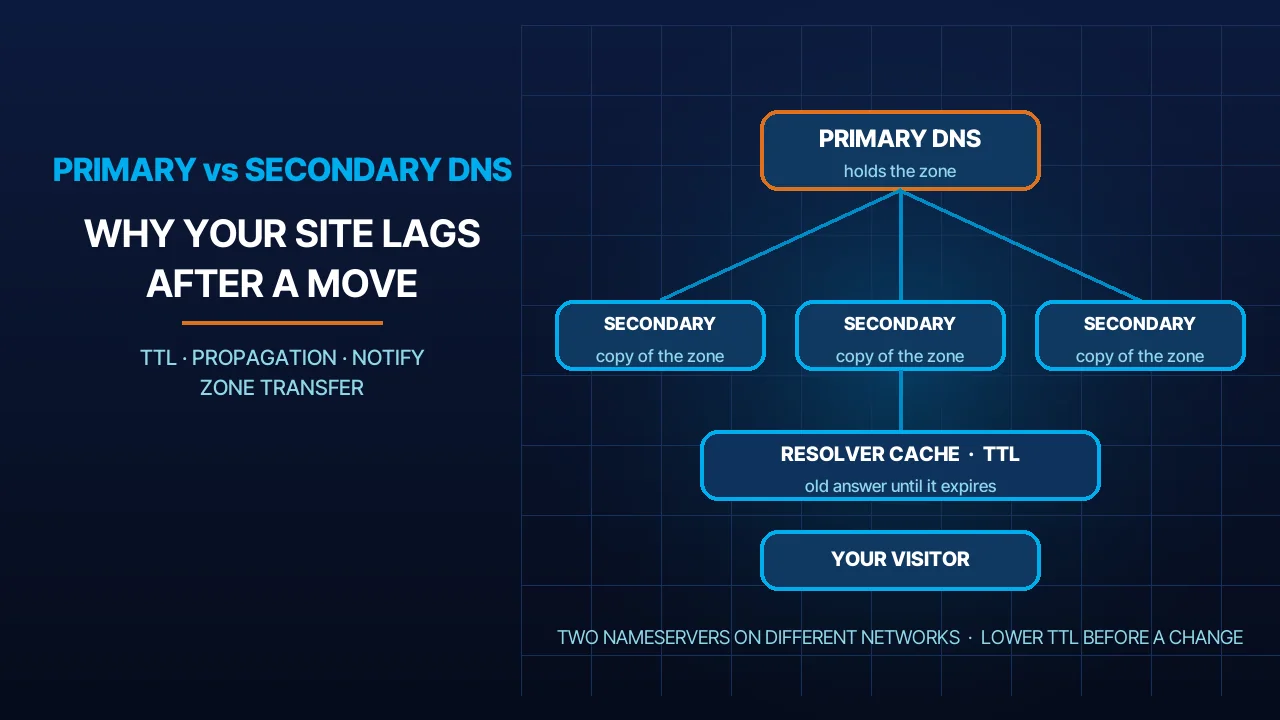
White labelling. Your brand on the control panel, your nameservers (ns1.yourbrand.com), your name on the emails the system sends. Done properly, a client has no way of knowing whose infrastructure it is.
No server administration. Your provider handles the hardware, the operating system, security patching, backups and uptime. This is the central trade: you give up control of the server and gain not having to be a systems administrator at 3am.
What you do not get is root access or the ability to install server-level software. If a client needs something unusual at the system level, a reseller account cannot deliver it — that is when the conversation moves to a VPS or a dedicated server.
The Economics, Honestly
Take a typical reseller package. You pay a fixed monthly fee and you can comfortably fit twenty to forty small business sites on it. If you charge each client a modest annual hosting fee, the arithmetic works out well — the package costs the same whether you have five clients on it or thirty-five, so every account after break-even is close to pure margin.
That is the attractive half. The other half:
You inherit the support. Your client will not call the datacentre. They will call you, and they will not distinguish between “the server is down” and “I forgot my password” and “my email is going to spam because I have no SPF record“. You are the first line for all of it.
Billing is a real job. Renewals, reminders, failed cards, suspensions, reactivations. At five clients you can track it in a spreadsheet. At thirty you cannot, and you will need automated billing.
Migrations take time. Every new client arrives from somewhere else. Moving a site is usually straightforward and occasionally a full day of untangling somebody else’s mess.
You carry the reputation risk. If your provider has an outage, your clients experience it as your outage. This is the single strongest argument for choosing a provider on reliability rather than price.
The honest summary: reseller hosting is an excellent add-on to an existing client business and a difficult standalone business. If you already build websites, it is close to free money. If you plan to acquire hosting customers from scratch on price alone, you are competing with companies whose per-unit cost you cannot match.
Who It Works For
Web designers and developers. The strongest case. You build a site, you host it, and you keep the relationship instead of handing the client to a host who will break your work and blame you. Recurring revenue also smooths out the feast-and-famine of project billing.
Agencies. Same logic at scale, with the added benefit of controlling the environment your work runs in — no more debugging a site on a host that disables the functions you need.
IT consultants and MSPs. Hosting fits naturally beside the support contracts you already sell.
Anyone managing several of their own sites. A reseller package is often cheaper than several separate hosting plans, and gives far better tooling.
What to Look For in a Provider
You are dependent on this choice in a way that is hard to reverse, so weigh it properly.
Reliability over price. Your clients judge you on it, and the difference between good and cheap hosting is a few dirhams a month per account. Do not save that at the cost of your reputation.
Server location. For clients in the UAE, a regional server measurably improves speed and matters for anyone with data-residency concerns.
Real support, in your language, at your hours. When you escalate, you need a human who answers. Test this before you commit — send a pre-sales question at an inconvenient hour and see what happens.
Genuine white labelling. Private nameservers, your branding in the panel, no provider references in system emails.
Backups you can restore yourself. Confirm they exist, confirm how far back they go, and confirm you can restore a single account without a support ticket.
Room to grow. Check the upgrade path to a bigger package, a VPS, or a dedicated server, and whether migrating between them is your problem or theirs.
Current software. Recent PHP versions, a modern web server, a real security layer. You cannot patch what you do not control, so this is entirely on your provider.
How to Actually Start
1. Start with the clients you already have. Do not build a hosting brand and go looking for customers. Take the sites you built or maintain, move them one at a time, and let the business grow from there. Before the first invoice, check that your trade licence activity list covers hosting or IT services.
2. Buy the smallest package that fits. You can upgrade in minutes. Starting large to “leave room” just costs money while you learn.
3. Set up your nameservers and branding first. Before the first client, so nobody ever sees the provider’s name.
4. Define two or three packages, not eight. Small, medium, large. More options make the decision harder, not easier, and you will spend your life explaining the difference.
5. Price for the support, not the disk. Your cost is the hour you spend on the phone, not the gigabyte. Price accordingly, and be clear in writing about what is included — “we host your site” and “we fix your site whenever it breaks” are different products.
6. Migrate one site as a test. Preferably your own. Learn where the friction is before doing it to a paying client.
7. Automate billing before you need to. The moment it feels slightly tedious, it is already past time.
8. Write down what you do not do. Content updates, design changes, plugin conflicts on a site somebody else built. Without a written boundary, hosting quietly becomes unpaid maintenance.
Reseller, VPS, or Dedicated?
Reseller when you host many small sites and do not want to administer a server. Lowest cost, lowest control.
VPS when you need root access, custom software, or one client’s site is big enough to deserve isolation. You become responsible for the operating system — factor in either your time or a managed plan.
Dedicated when scale, compliance, or performance requires the whole machine.
Most people start with reseller and stay there far longer than they expect, which is the correct outcome. Move up when a specific need forces it, not because it sounds more professional.
Frequently Asked Questions
Do I need a trade licence to sell reseller hosting in the UAE?
Yes. Invoicing clients for hosting is a commercial activity and needs a licence that covers IT or web services, on the mainland or in a free zone. Most designers already hold one that fits. Check that your activity list covers hosting resale before the first invoice, and remember VAT registration becomes mandatory once taxable turnover passes AED 375,000.
How many websites fit on one reseller package?
It depends on the package’s disk and bandwidth quota and on how heavy each site is, not on a fixed account limit. A typical package comfortably carries twenty to forty small business sites; a busy WooCommerce store can consume the resources of ten brochure sites. Start small, watch usage in WHM, and upgrade when it climbs.
What happens to my clients if I stop reselling?
Their accounts stay on the provider’s server, so nothing goes offline. You can hand them to the provider directly, sell the customer list to another reseller, or migrate them elsewhere with a cPanel backup per account. Put that scenario in your client contract from day one so the handover is a formality rather than a crisis.
Sources
- cPanel Documentation — WHM: Edit Reseller Nameservers and Privileges (accessed 2026-09-15)
- cPanel Documentation — WHM: Add a Package (accessed 2026-09-15)
- WHMCS Documentation — Automation Settings (accessed 2026-09-15)
- The UAE Government portal (u.ae) — Data protection laws (Personal Data Protection Law) (accessed 2026-09-15)
- PHP.net — Supported Versions (accessed 2026-09-15)
- UAE Federal Tax Authority — Registration for VAT (accessed 2026-09-15)
Where We Fit
BIGBANG ITS runs a reseller programme on infrastructure in the UAE — white-labelled, with private nameservers, current PHP, LiteSpeed, security and tested off-server backups included rather than sold as extras. We also answer the phone, which is the part that determines whether your clients stay yours.
If you are already building or maintaining sites and sending the hosting somewhere else, that is revenue you are handing away along with control of your own work. Talk to us and we will size a package against the number of sites you actually have.
Talk to us directly — we usually reply within minutes during business hours.