Most UAE businesses have filed this under “something the accountant will deal with.” That is the expensive misreading. E-invoicing is not a change to how you file returns — it is a change to how your systems issue invoices, in a structured format, through an approved third party, in real time. Your accountant cannot deliver that. Your software has to.
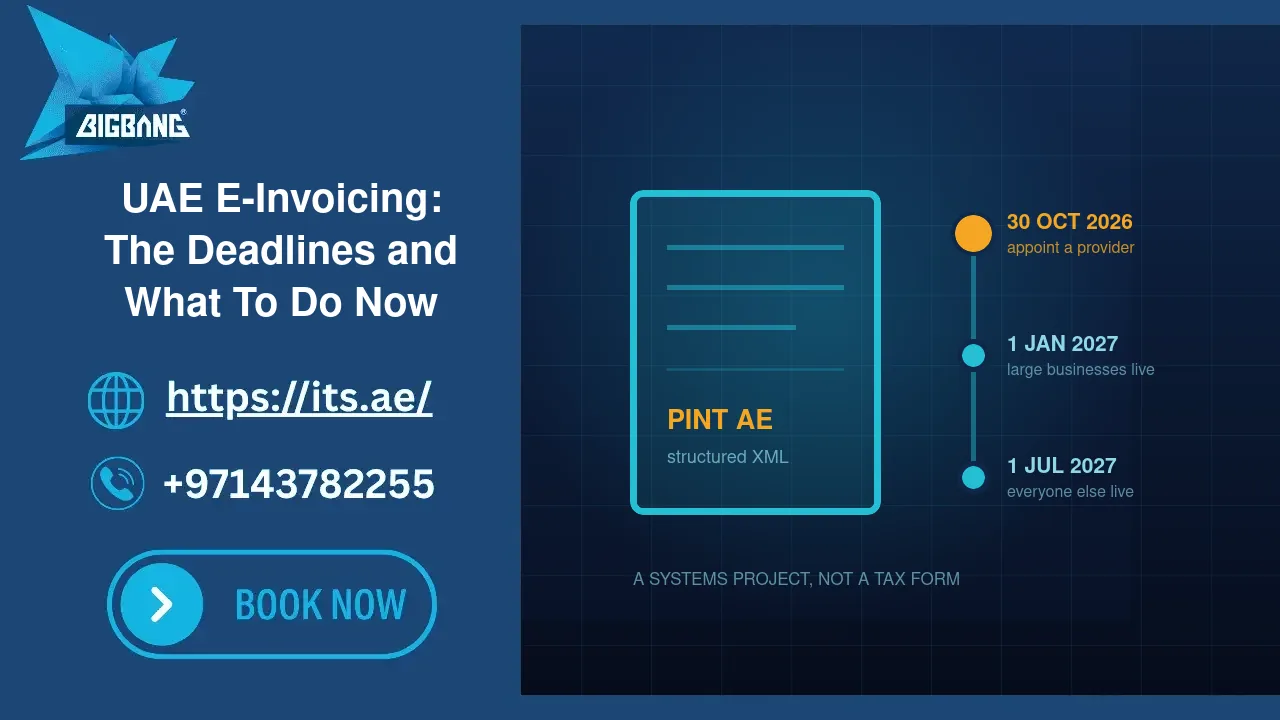
The first hard deadline is fixed: businesses with revenue of AED 50 million or more must have appointed an Accredited Service Provider by 30 October 2026. Everyone else follows within a year. This article sets out the timeline, what actually changes technically, and what to do now — from the systems side rather than the tax side.
This is systems and readiness guidance, not tax or legal advice. Confirm how the rules apply to your specific entity, revenue and sector with a qualified tax advisor.
Quick Answer
The UAE is introducing mandatory e-invoicing on a Peppol-based five-corner DCTCE model (Decentralised Continuous Transaction Control and Exchange): invoices must be issued as structured XML in the PINT AE format and exchanged through a Ministry-Accredited Service Provider (ASP), with tax data reported to the Federal Tax Authority. The rollout is phased. Large businesses (revenue ≥ AED 50m) must appoint an ASP by 30 October 2026 and go live 1 January 2027. Smaller businesses appoint by 31 March 2027 and go live 1 July 2027. Government entities follow from 1 October 2027. It applies to any person conducting business in the UAE, whether VAT-registered or not, subject to exclusions, and non-compliance carries administrative penalties set by Cabinet Decision No. 106 of 2025: AED 5,000 for each month of delay in appointing an ASP or implementing the system, and AED 100 per invoice not issued through it, capped at AED 5,000 per month.
The Timeline
The Ministry of Finance extended the Phase 1 ASP appointment deadline from 31 July 2026 to 30 October 2026, following market feedback asking for more technical options and competitive pricing. Read that extension correctly: the go-live date did not move. Phase 1 still begins 1 January 2027. You were given more time to choose a provider, not more time to be ready.
Pilot — from 1 July 2026. Invited businesses began piloting, with voluntary participation open to others.
Phase 1 — revenue of AED 50 million or more. Appoint an ASP by 30 October 2026. Mandatory issuance from 1 January 2027.
Phase 2 — revenue below AED 50 million. Appoint an ASP by 31 March 2027. Mandatory issuance from 1 July 2027.
Phase 3 — government entities. Appoint an ASP by 31 March 2027, the same date as Phase 2, with mandatory issuance from 1 October 2027 (Ministerial Decision No. 244 of 2025, Article 5).
If you are in Phase 2, count the months between today and 1 July 2027. The number sounds comfortable and is not, for reasons the next sections explain.
What Actually Changes
The word “e-invoicing” misleads people, because most businesses believe they already do it. They email PDF invoices. That is not e-invoicing in the regulatory sense, and the difference is the entire point.
A PDF is a picture of an invoice. A person reads it and types the data into another system. Under the new framework an invoice is a structured XML document conforming to the PINT AE schema — machine-readable, with every field defined, validated automatically, and rejected if it does not conform.
You no longer send invoices directly to your customer. In the Peppol model your accredited provider transmits the invoice to your customer’s accredited provider, which delivers it to your customer. Tax-relevant data is reported to the Federal Tax Authority as part of the same flow. You send to your ASP; the network does the rest.
Validation happens before delivery, not after. Today an invoice with a wrong trade licence number or a missing field still reaches the customer, and someone sorts it out later. Under the new model a non-conforming invoice is rejected at the gateway. It does not arrive at all.
That last point is the one that catches businesses. Data quality problems you have tolerated for years — an inconsistent customer name, a missing tax registration number, a unit of measure nobody standardised — stop being untidiness and start being failed invoices.
Why “The Accountant Will Handle It” Is Wrong
E-invoicing is a systems project wearing a tax costume. The work is:
Your invoicing system must produce compliant structured output. If you invoice from accounting software, the vendor needs to support PINT AE — ask them now, in writing, with a date. If you invoice from an ERP, the mapping between your fields and the schema’s required fields is a project. If you invoice from Excel or Word, you need different software, and that is a bigger decision than a compliance checkbox.
Your master data has to be clean. Customer legal names exactly as registered. Tax registration numbers present and correct. Standardised product codes and units. This is the single most underestimated part, and the one that cannot be done in the last month, because it requires going back to customers for information you never collected.
Your systems have to connect to an ASP. An integration — an API connection, credentials, error handling, a defined behaviour when the network is unreachable. Somebody has to own what happens when an invoice is rejected at 4pm on the last day of the month.
Your people need a new process. What happens to a rejected invoice. Who fixes it. How credit notes work. What you do about the customer who insists on receiving a PDF as well.
None of that is your accountant’s job. It is your systems, your data and your operations.
Choosing an Accredited Service Provider
The ASP is the gateway between your systems and the network, and it is the decision the 30 October deadline is actually about. Practical criteria:
Accreditation status. Confirm the provider is accredited by the Ministry of Finance, and confirm it against the official list rather than the provider’s own marketing.
Integration with what you already run. A provider with a proven connector for your specific accounting package or ERP will cost far less to implement than one requiring custom development. Ask for a reference customer running your exact software.
Volume-based pricing, understood in full. Per-document pricing looks small until you multiply it by your annual invoice count. Ask what happens when you exceed a tier, and whether rejected and re-sent documents are billed twice.
Error handling you can live with. How are rejections surfaced? Does someone get an alert, or does an invoice sit failed in a queue nobody looks at? This is the operational difference between a system that works and one that quietly loses revenue.
Archiving. Where invoices are stored, in what format, for how long, and how you get them out if you change provider.
What to Do in the Next Ninety Days
Regardless of your phase, this sequence is the same and the early steps cost almost nothing:
1. Establish which phase you are in. Revenue of AED 50 million or more puts you in Phase 1 with a 30 October 2026 ASP deadline and a 1 January 2027 go-live. Confirm the revenue definition with your advisor rather than assuming.
2. Ask your software vendor the direct question. “Will this product support PINT AE e-invoicing through an accredited provider, and on what date?” A vague answer is itself an answer, and it means you should be looking at alternatives now rather than in six months.
3. Audit your customer master data. Export your customer list and check: legal name, tax registration number, address, contact. Count the gaps. That number is your project timeline, because filling it means contacting customers.
4. Inventory every place an invoice is issued from. Most businesses find more than one — the accounting system, plus a spreadsheet in sales, plus a separate tool in one branch. Every one of them is in scope.
5. Shortlist ASPs and get pricing. Two or three, with your actual annual volume, and ask each for a reference customer on your software.
6. Decide who owns this internally. A named person, not a committee. Projects that fail here fail because nobody was responsible until the deadline was six weeks away.
The Opportunity Nobody Mentions
Compliance projects are usually pure cost. This one is unusual, because the prerequisites for e-invoicing are the same prerequisites for automating everything downstream of invoicing.
Once your invoice data is structured and machine-readable, matching invoices to purchase orders becomes automatic. Chasing overdue payments becomes a report rather than an afternoon. The monthly reconciliation somebody does by hand becomes a scheduled job. Businesses that treat this as a systems modernisation get those benefits; businesses that treat it as a form to fill in pay for the work and get none of them.
The other half of that opportunity is defensive: clean, structured, complete invoice data is exactly what makes an audit uneventful.
Frequently Asked Questions
Does UAE e-invoicing apply to small businesses that are not VAT-registered?
Yes, in principle. Ministerial Decision No. 243 of 2025 applies the system to any person conducting business in the UAE for every business transaction, not only to VAT registrants, with listed exclusions such as certain financial services and sovereign government activity. Business-to-consumer transactions are out of scope for now, until the Minister sets a date.
What are the penalties for missing the UAE e-invoicing deadlines?
Cabinet Decision No. 106 of 2025 sets AED 5,000 for each month that a business has not appointed an Accredited Service Provider or implemented the system on time. Invoices or credit notes not issued through the system cost AED 100 each, capped at AED 5,000 per month, and failing to report a system failure costs AED 1,000 per day.
Is a PDF invoice sent by email an e-invoice under the UAE rules?
No. The Ministry of Finance says unstructured formats such as PDF, Word, images, scans and email are not e-invoices. A compliant invoice is structured data in the PINT AE format, exchanged through your Accredited Service Provider and reported to the Federal Tax Authority. A PDF copy can still go to customers who want one, but it has no standing.
Sources
- UAE Ministry of Finance — eInvoicing programme portal (accessed 2026-09-15)
- UAE Ministry of Finance — Ministerial Decision No. 244 of 2025 on the Implementation of the Electronic Invoicing System (PDF) (accessed 2026-09-15)
- UAE Ministry of Finance — Ministerial Decision No. 66 of 2026 amending Decision No. 244 of 2025 (ASP deadline moved to 30 October 2026) (PDF) (accessed 2026-09-15)
- UAE Ministry of Finance — Ministerial Decision No. 243 of 2025 on the Electronic Invoicing System (scope and exclusions) (PDF) (accessed 2026-09-15)
- UAE Ministry of Finance — Cabinet Decision No. 106 of 2025 on violations and administrative penalties for the Electronic Invoicing System (PDF) (accessed 2026-09-15)
- UAE Ministry of Finance — UAE eInvoicing Programme introduction, 30 June 2026 (PDF) (accessed 2026-09-15)
- UAE Ministry of Finance — eInvoicing Accredited Service Providers (official list) (accessed 2026-09-15)
- UAE Federal Tax Authority — UAE e-Invoicing (accessed 2026-09-15)
- OpenPeppol — PINT AE Billing specification (United Arab Emirates) (accessed 2026-09-15)
Where We Fit
BIGBANG ITS is an IT company, not a tax advisor, and the tax questions belong with your accountant. What we handle is the layer the mandate actually lands on: the systems that issue your invoices, the data inside them, and the integrations between your software and an accredited provider.
If your invoicing runs on something that will not produce structured output — a spreadsheet, an ageing system nobody supports, or four different tools that disagree with each other — the honest answer is that the deadline is a software decision, and it is better made now with time than at the deadline with none. Talk to us and we will look at what you actually run and tell you what it needs.
Talk to us directly — we usually reply within minutes during business hours.