Many company VPNs in the UAE were set up when remote work meant one manager opening the accounting server from home. Today staff sign in from laptops, phones and home Wi-Fi, and most of their software lives in the cloud. Owners ask us whether to keep the VPN, replace it with zero-trust access, or run both. The VPN vs zero trust choice is less about a product than about what you check before you let someone in.
Quick Answer
Keep the VPN for the few systems that need network-level access, turn on multi-factor authentication (MFA) for every account first, and move everyday apps to zero-trust access, where each request is checked per user, per device and per app. In the UAE, the TDRA states that companies may use VPN technology to reach their internal networks. NIST SP 800-207, published in August 2020, defines zero trust as granting no implicit trust based on network location alone, and expects most organisations to run both models side by side. Our network security and two-factor authentication services cover both sides.
What a VPN Protects, and What It Does Not
A VPN (virtual private network) builds an encrypted tunnel from a staff device to your office network.
What it protects. Traffic between the laptop and the office cannot be read on hotel, café or home Wi-Fi. Systems that should never face the internet, such as a file server or an on-premises accounting system, stay reachable only through the tunnel.
What it does not protect:
- A stolen password. If the VPN accepts a username and password alone, whoever holds them is inside your network.
- An unhealthy device. A basic VPN setup checks who is connecting, not whether the laptop is patched, encrypted or already infected.
- Movement inside the network. NIST notes that once attackers are past the perimeter, their lateral movement is unhindered.
- Cloud apps. Microsoft 365, Google Workspace and your CRM are reached directly over the internet. NIST says a remote worker should not need a VPN link back to the company network to use services hosted by a public cloud provider, such as email.
On 18 June 2024, CISA, the FBI and partner agencies in New Zealand and Canada published joint guidance on network access. It urges business owners of all sizes to move toward approaches such as zero trust, and explains the risks of traditional remote access and VPN deployment. A VPN alone is no longer the whole answer.
What UAE Rules Say About VPN Use
Is a company VPN allowed in the UAE at all? The regulator has answered in writing.
- Company use is allowed. The TDRA’s Internet Guidelines page states that companies, institutions and banks are allowed to use VPN technology to access their internal networks through the internet.
- Misuse is what the law targets. In a statement dated 31 July 2016, the regulator (then called the TRA) said no regulation prevents that business use, and that business users can be held accountable if the technology is misused. It described the offence in the law then in force as using a false or third-party IP address in order to commit a crime or prevent its discovery.
- Filter-bypass services are not allowed. The same guidelines, written for cloud and hosting providers operating from the UAE, say that hosting VPN connections and services which serve UAE-based users and let them bypass ISP filtering is strictly not allowed. The TDRA’s list of prohibited content also includes proxy servers and VPN services that mainly give access to prohibited content.
Our reading for an SME: a VPN that connects your staff to your own office network sits on the allowed side. The TDRA pages give no such permission for getting around filtering, so we advise clients to rule that out in a written acceptable-use policy covering the company VPN and consumer VPN apps on work devices. This is a summary of what the regulator publishes, not legal advice. The TDRA notes that its English list of prohibited categories is not an official translation; the Arabic text is the legal reference.
VPN vs Zero Trust: What Zero-Trust Access Adds
Zero trust is not a product. NIST describes it as a set of principles: no user or device is trusted because of where it sits on the network, and each session with a resource is authenticated and authorised first. That adds 3 checks a VPN does not make on its own.
- Per user. Every sign-in is tied to a named identity. NIST expects MFA for access to some or all company resources.
- Per device. The security state of the device is part of the decision. Under NIST’s tenets, a device that is unmanaged or has known vulnerabilities can be treated differently, up to being refused.
- Per app. Access is granted to one resource for one session, and does not carry over to another. A compromised account reaches its assigned apps, not the whole network.
The tools come from vendors many SMEs already use. Microsoft calls Entra Conditional Access its Zero Trust policy engine: if-then rules that read signals such as user or group, IP location, device and application, and can require MFA or a device marked as compliant before granting access. It requires Entra ID P1 licences, and Microsoft says Microsoft 365 Business Premium customers can also use it. Google’s equivalent is its BeyondCorp model, which shifts access control from the network perimeter to individual users and their devices. Google offers it to other organisations through Chrome Enterprise Premium.
CISA’s Zero Trust Maturity Model, version 2.0 of April 2023, is a useful map: 5 pillars (Identity, Devices, Networks, Applications and Workloads, Data) and 3 stages that advance from a Traditional starting point to Initial, Advanced and Optimal. It was written for US federal agencies, but the pillars work as a checklist for a 50-person company.
| Question | VPN | Zero-trust access |
|---|---|---|
| What is checked? | Usually the user’s login, at connection time | User, device state and the app requested, per session |
| What can the user reach? | Whatever the network allows | Only the apps assigned to that user |
| Best fit | On-premises servers, older desktop software, office-to-office links | Cloud and web apps, contractors, personal devices |
| Main weak point | One stolen login can open the network | Needs an accurate list of users and devices |
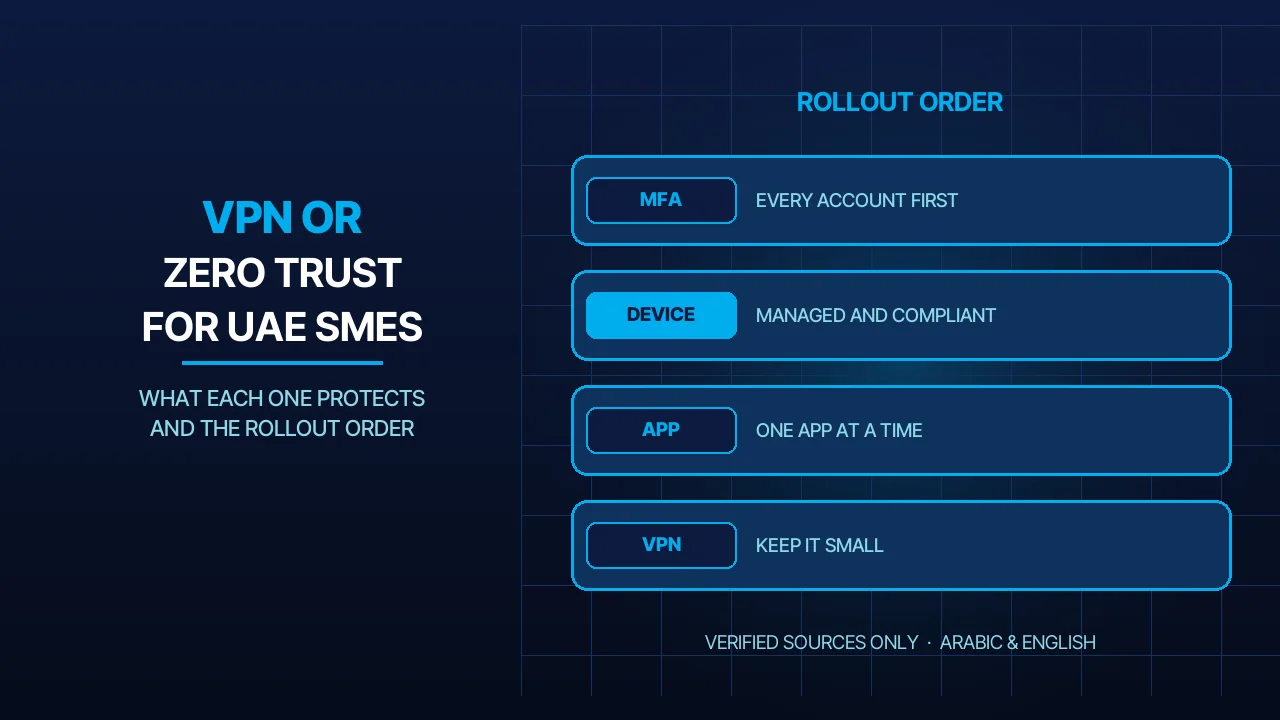
The Rollout Order: MFA First
When we set this up for a client, the order matters more than the product.
- MFA on every account, including the VPN login. Microsoft states that more than 99.9% of common identity-related attacks are stopped by MFA together with blocking legacy authentication, and it provides both as security defaults at no extra cost. In CISA’s model, MFA marks the Initial stage of the Identity pillar and phishing-resistant MFA the Advanced stage. Our guides to two-factor authentication for business and passkeys for a UAE company compare the methods.
- List users, devices and apps. NIST says a survey of assets, users, data flows and workflows must come first. For an SME this is a spreadsheet of people, devices and systems.
- Bring devices under management. Encrypt disks, enforce updates and screen locks, and make sure you can wipe a lost laptop. Only then does a “compliant device required” rule mean anything.
- Move one app at a time. NIST describes migrating one business process at a time, and names those that use cloud resources or serve remote workers as good first candidates. Start with email and files.
- Shrink the VPN. Limit it to the systems that still need it and to the named users who need them, and review its logs.
When Running Both Makes Sense
For most SMEs the honest answer is both, for a while. NIST expects the same: most enterprises will keep operating in a hybrid of zero trust and perimeter-based security for an indefinite period.
Keep the VPN for an on-premises file or accounting server, desktop software that cannot sit behind a web sign-in, links between 2 offices, and administrator access to servers. Put MFA on it and restrict who can use it.
Use zero-trust access for email, files, CRM and other cloud or web apps, contractors who need 1 system only, and staff on personal phones.
By size, our rule of thumb:
- 5–20 staff, all cloud: often no VPN at all. MFA plus device and app rules in Microsoft 365 or Google Workspace cover it.
- 20–100 staff with an office server: both, with a small VPN for the server only.
- 100–300 staff: per-app access for most people, and a tightly limited VPN for the IT team.
Three Decisions to Make
- Who gets MFA, and by what date? The answer should be everyone, starting with administrators and finance. Our two-factor authentication service covers VPN, web and cloud apps.
- Which systems still need network-level access? List them by name. What remains sits behind a firewall and a restricted VPN, which our network security team sets up and maintains.
- What happens when a device is lost or an account is taken over? Decide who disables the account, who wipes the device, and where the clean copy of the data lives. That is where backup and a tested ransomware recovery plan come in.
Frequently Asked Questions
Is it legal for a UAE company to use a VPN?
The TDRA states that companies, institutions and banks are allowed to use VPN technology to access their internal networks through the internet. Its 2016 statement adds that business users can be held accountable for misuse. Getting around internet filtering is a different matter, so cover it in your acceptable-use policy.
Does zero trust replace the VPN completely?
Not usually, and not at once. NIST SP 800-207 expects most organisations to run zero trust and perimeter-based security side by side for an indefinite period. Cloud and web apps move to per-user, per-device checks first. A small, restricted VPN often remains for on-premises servers and administrator access.
What should a 20-person company do first?
Turn on MFA for every account, starting with administrators, finance and the VPN login. Then list your users, devices and apps, and bring laptops and phones under management. After that, require a compliant device for email and files. The VPN is the last thing to change, not the first.
Sources
- TDRA (Telecommunications and Digital Government Regulatory Authority), Internet Guidelines (accessed 2026-11-16)
- TDRA, Telecommunications Regulatory Authority issues statement on the use of VPN to clarify media reports, 31 July 2016 (accessed 2026-11-16)
- NIST, Special Publication 800-207: Zero Trust Architecture, August 2020 (accessed 2026-11-16)
- CISA, Zero Trust Maturity Model, Version 2.0, April 2023 (accessed 2026-11-16)
- CISA, Modern Approaches to Network Access Security, 18 June 2024 (accessed 2026-11-16)
- Microsoft Learn, What is Conditional Access? (accessed 2026-11-16)
- Microsoft Learn, Security defaults in Microsoft Entra ID (accessed 2026-11-16)
- Google Cloud, BeyondCorp: A new approach to enterprise security (accessed 2026-11-16)
Where We Are
BIGBANG ITS has planned and run technology for UAE businesses since 2003, headquartered at the Sharjah Research, Technology and Innovation Park with a branch in Business Bay, Dubai. Support runs 24/7 and the office is open Saturday to Thursday, 09:00–18:00 Gulf time. If you want remote access for your team that is checked per user and per device, contact us or message us on WhatsApp.
Talk to us directly — we usually reply within minutes during business hours.