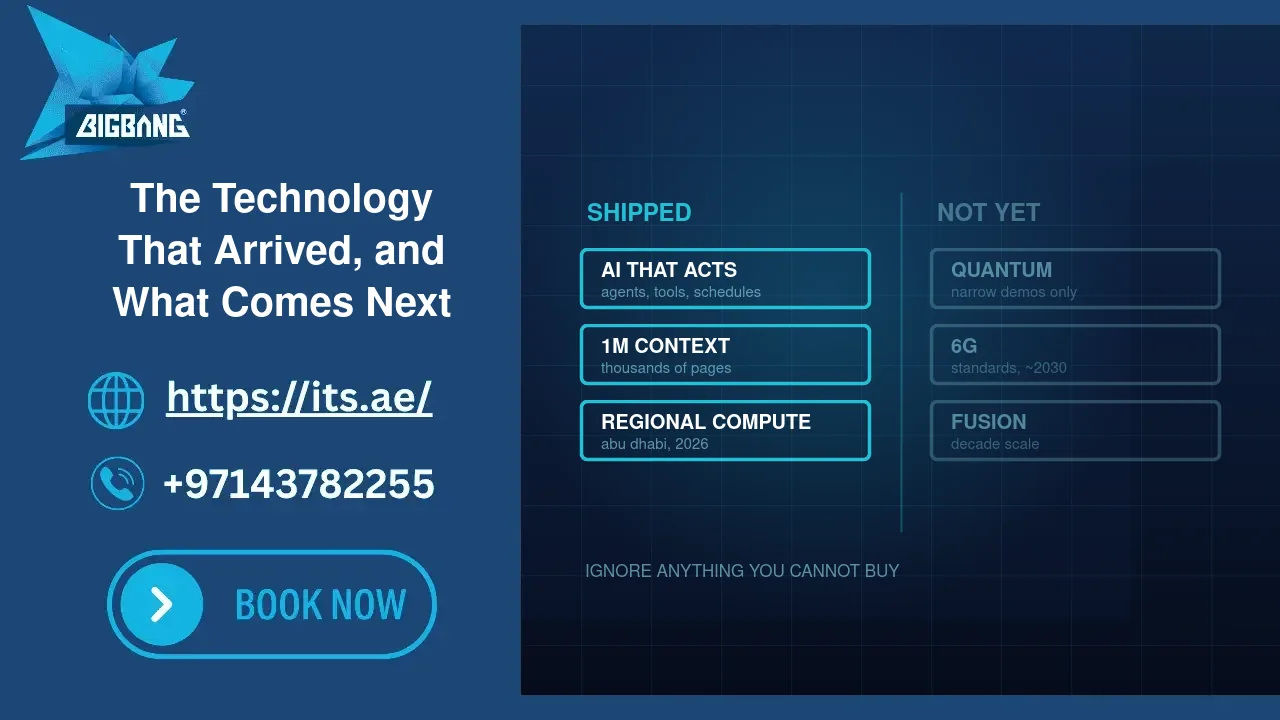
Every year produces a list of technologies that are about to change everything, and every year most of them do not. The useful exercise is not predicting the future; it is separating what has actually shipped from what is being promised, because those two things demand completely different responses from a business. One deserves a plan this quarter. The other deserves a bookmark.
This article does that separation. What has genuinely arrived and is in production use today, what is real but several years earlier in its life than the headlines suggest, what the next few years plausibly hold, and — the part that matters most for a business in the Emirates — what any of it should change about what you do on Monday.
Quick Answer
The technology that has actually landed is AI that acts rather than answers: models that use tools, run multi-step tasks and complete work instead of just describing it. Everything else in the current news cycle is earlier than it sounds. Quantum computing is real research with narrow demonstrations and no general business application yet. Humanoid robots are in a handful of factories doing narrow tasks, not entering workplaces generally. 6G is standards work; there is nothing to buy. Fusion remains a decade-scale project. The single highest-return move available to most businesses is unglamorous: apply today’s AI to one repetitive, document-heavy process and measure the result.
What Actually Arrived
AI that does work, not AI that answers questions
This is the real shift, and it happened faster than most people adjusted to. The change is from a model that produces text to a system that completes a task: it reads your files, calls your systems, runs steps, checks its own output, and keeps going until the job is done or it needs a decision from a person.
Three capabilities made that possible, and all three are ordinary and available now rather than experimental. Models can hold enormous amounts of context — on the order of a million tokens, well over a thousand pages, in a single request — so “read all of this and tell me what’s inconsistent” is a real instruction. They can use tools, meaning they can call your systems rather than just describe them. And they can run for extended periods, hosted and scheduled, so an agent can run every night without anyone starting it.
The business consequence is a change in what is worth automating. Previously, automation paid off on high-volume, perfectly structured processes — everything else cost more to automate than it cost to do by hand. Now the messy, low-volume, judgement-adjacent work is in range: the invoices that arrive in eleven different formats, the correspondence that needs to exist in two languages, the weekly report somebody assembles from four systems by hand.
The infrastructure being built to run it
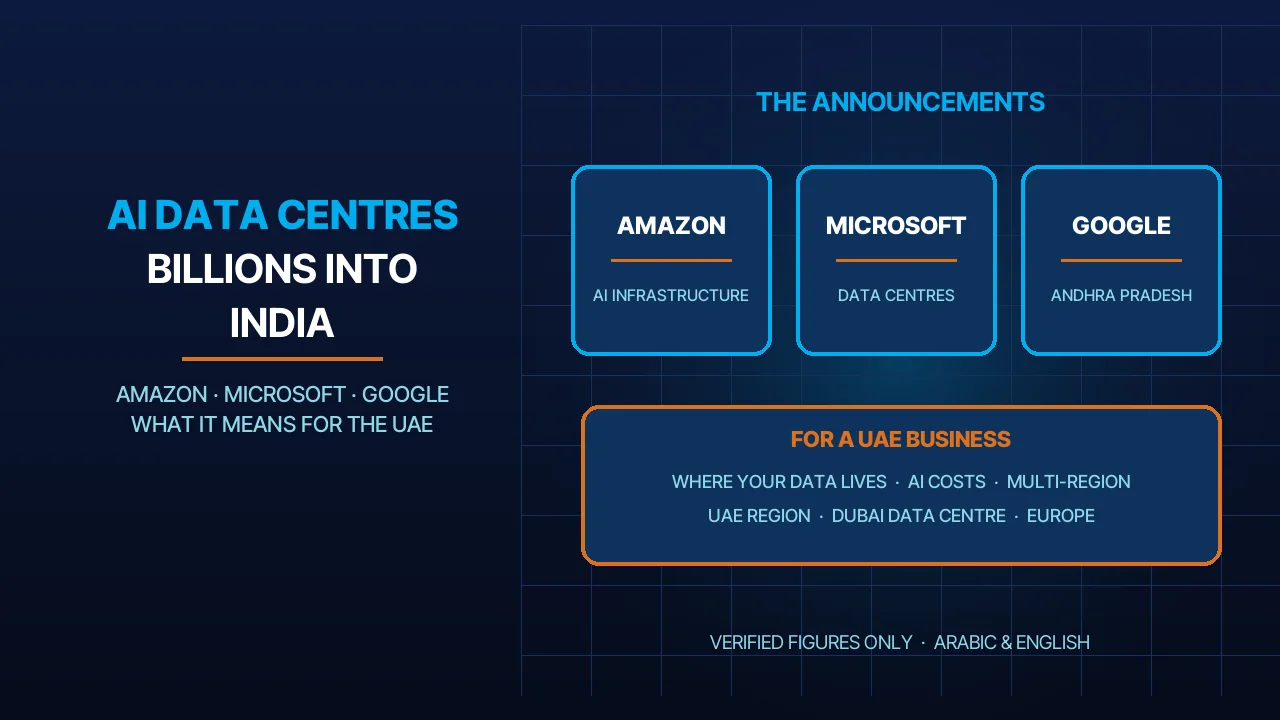
The less-discussed half of the AI story is physical, and the Emirates is one of its centres. Stargate UAE — announced in 2025 as a partnership between G42, OpenAI, Oracle, NVIDIA, Cisco and SoftBank — targets a gigawatt of AI compute capacity in Abu Dhabi. Its first 200-megawatt phase, equipped with roughly 100,000 of NVIDIA’s latest-generation chips, is on course to go live in 2026, within the 5-gigawatt UAE–U.S. AI Campus that G42 describes as the largest such deployment outside the United States. Microsoft has committed a further $7.9 billion in the UAE for 2026 to 2029, and its partnership with G42 adds another 200 megawatts of data centre capacity through Khazna Data Centers.
This matters beyond national prestige. Compute located regionally means lower latency, and more importantly it means AI workloads can run under local data-residency arrangements — the single most common blocker we encounter when a UAE business with regulated data wants to use AI at all.
Robots, in the narrow places they actually work
Humanoid robots have moved from demonstration videos into a small number of real industrial deployments — BMW is piloting wheeled humanoid units in production at its Leipzig plant, and Tesla says its Optimus units are performing repetitive tasks in its own factories, primarily to gather training data.
Read that precisely. These are narrow, repetitive, heavily-supervised roles in controlled environments, deployed by enormous manufacturers with enormous engineering budgets. It is a genuine milestone and it is not a product you can buy for your warehouse. The realistic timeline for general commercial availability is years, not quarters.
Real, But Earlier Than It Sounds
Quantum computing
Quantum computing is serious science with serious money behind it, and multiple governments treat it as strategic infrastructure. There are periodic claims of quantum machines outperforming classical ones on specific problems, and those claims are typically contested and always narrow.
What has not happened is a quantum computer doing anything a business needs. There is no quantum application for accounting, logistics, customer data or any ordinary commercial workload, and there will not be one soon.
There is exactly one quantum-related item that belongs on a business agenda today, and it is defensive: post-quantum cryptography. The concern is “harvest now, decrypt later” — encrypted data captured today could be decrypted by a sufficiently capable future machine. If your business holds data that must stay confidential for ten or twenty years, the migration to quantum-resistant encryption standards is worth understanding now. For everyone else, this is a vendor problem: your browsers, servers and VPNs will migrate, and you will follow.
6G
6G is standards development. There is no equipment, no spectrum allocation in most markets, and nothing to procure. Commercial deployment is expected around 2030. Anyone selling you 6G readiness today is selling you 5G with a different label.
Fusion and next-generation energy
Fusion has produced genuine scientific milestones and attracted serious private investment. It remains a decade-scale proposition for grid electricity. The energy technologies that will actually affect your operating costs in the next five years are unexciting and already deployed: cheaper solar, better grid-scale batteries, and — relevant to anyone running infrastructure — substantially more efficient data centre cooling and power design.
Autonomous vehicles
Genuinely working, in specific, mapped, permitted urban areas including several in this region. Still expanding city by city, regulator by regulator. Real, and geographically narrow.
What the Next Few Years Plausibly Hold
Forecasting beyond about three years is entertainment. Within that horizon, a few things follow from what is already visible:
Agents become ordinary infrastructure. The pattern of a scheduled agent that reads systems, does work and reports exceptions will become as unremarkable as a scheduled report is now. Businesses that have their data accessible will adopt it easily; businesses whose information lives in spreadsheets on individual laptops will not.
The interface changes more than the systems. Rather than replacing your accounting or CRM software, AI increasingly sits in front of it — you ask a question in your own language and something translates that into the queries and actions the system understands. This is why connection standards matter more than model benchmarks for most businesses.
The cost of a competent digital operation keeps falling. A small business can now produce bilingual content, respond to customers around the clock, and analyse its own data at a quality that required a department five years ago. The competitive advantage is shifting from having the capability to actually applying it.
Regulation catches up. Data protection, AI governance and disclosure obligations are tightening across the region. Businesses that built on well-documented, properly-consented data will find this routine. Others will not.
Verification becomes a real problem. Synthetic images, audio and video are now cheap and convincing. Practical consequences are already here: voice-based approval processes are no longer safe, and “I recognised their voice on the phone” is no longer evidence of anything. Businesses that authorise payments over the phone should change that process now, not eventually.
What This Should Change on Monday
Stripped of the vocabulary, here is the short list:
Pick one process and automate it properly. Repetitive, document-heavy, currently done by a person who has better things to do. Measure the time it takes before and after. One finished project teaches you more than a year of strategy discussion.
Get your data reachable. Almost every AI project stalls in the same place: the information is in someone’s inbox, a shared drive nobody has organised, or a system with no way to query it. This work is boring, it has to happen anyway, and it is worth doing whether or not the AI project proceeds.
Fix your verification processes. Any process where an instruction over a phone call or an email can move money or grant access needs a second channel. This is the cheapest risk reduction available right now.
Update your security posture for the new baseline. Attackers use the same tools you do. Phishing is now well-written, in fluent Arabic and English, and personalised. The defence is not better spam filters; it is two-factor authentication, least-privilege access and processes that do not depend on a person spotting a bad email.
Ignore anything you cannot buy. If a technology has no product, no price and no reference deployment, it is not a decision you need to make this year.
The Regional Position
The UAE has made a deliberate bet on being an AI infrastructure hub rather than a consumer of one, and the national digital economy strategy aims to double the digital economy’s contribution to GDP by 2032. For businesses here that produces a set of practical advantages that are easy to overlook: regional compute capacity, growing data-residency options, a regulatory environment that is engaging with AI rather than waiting, and a market where clients expect digital competence as a baseline rather than a differentiator.
The gap, in our experience, is not ambition or access. It is that many businesses are trying to reach the frontier while their fundamentals are unfinished — an unpatched website, business email that fails authentication, backups nobody has restored, a phone system that cannot route a call properly. Those things are not exciting, and they are the floor everything else stands on.
Frequently Asked Questions
What is agentic AI, and how is it different from a chatbot?
Agentic AI completes tasks instead of returning text: it reads your files, calls other systems, runs multi-step work and checks its own output, asking a person only when a decision is needed. A chatbot answers and leaves the doing to you. The catch is that an agent is only as useful as the data it can reach.
Should a UAE business do anything about quantum computing now?
Not operationally: no quantum computer runs any commercial workload today. The one item worth attention is post-quantum cryptography, because NIST finalised its first standards in August 2024 and browser, server and VPN vendors are migrating. If you hold data that must stay confidential for a decade or more, ask each supplier for its migration timeline.
Which AI project should a small business start with?
One repetitive, document-heavy process that a person currently does by hand, such as invoice intake or a weekly report assembled from several systems. Automate it properly and measure the time it takes before and after. Sort out data access first, since most projects stall when information lives in inboxes or unorganised shared drives.
Sources
- Anthropic Claude Platform Docs — Context windows (up to 1M tokens) (accessed 2026-09-15)
- G42 — Global Tech Alliance Launches Stargate UAE (May 2025) (accessed 2026-09-15)
- G42 via PR Newswire — G42 Provides Update on Construction of Stargate UAE AI Infrastructure Cluster (October 2025) (accessed 2026-09-15)
- Reuters via Yahoo Finance — Microsoft, G42 announce 200 MW data centre capacity expansion in the UAE (November 2025) (accessed 2026-09-15)
- BMW Group PressClub — BMW Group to deploy humanoid robots in production in Germany for the first time (Plant Leipzig pilot, 2026) (accessed 2026-09-15)
- NIST — NIST Releases First 3 Finalized Post-Quantum Encryption Standards (13 August 2024) (accessed 2026-09-15)
- CISA — Post-Quantum Cryptography Initiative (accessed 2026-09-15)
- Nokia — Charting the path to 6G (3GPP Release 21, first commercial deployments expected 2029–2030) (accessed 2026-09-15)
- Lawrence Livermore National Laboratory — Lawrence Livermore National Laboratory achieves fusion ignition (December 2022) (accessed 2026-09-15)
- WeRide (investor relations) — WeRide and Uber Launch Fully Driverless Robotaxi Fare-Charging Operations in Dubai (31 March 2026) (accessed 2026-09-15)
- Dubai Media Office — RTA Launches Pilot Autonomous Robotaxi Service in Collaboration with WeRide and Uber (December 2025) (accessed 2026-09-15)
- FBI IC3 — PSA: Criminals Use Generative Artificial Intelligence to Facilitate Financial Fraud (3 December 2024) (accessed 2026-09-15)
- u.ae (UAE Government) — Digital Economy Strategy (double the digital economy’s GDP contribution from 9.7% to 19.4% within 10 years) (accessed 2026-09-15)
Where We Fit
BIGBANG ITS builds and runs that floor for businesses across the UAE — hosting, domains, business email, cloud telephony, websites and security — and increasingly the layer above it, connecting AI to the systems a business already runs. Our position on all of this is consistent: start with what is proven, measure it, and add the frontier only where it does something a simpler tool cannot.
If you want a straight assessment of where your technology actually stands and what would make the biggest difference, talk to us. We will tell you if the answer is that you do not need us.
Talk to us directly — we usually reply within minutes during business hours.