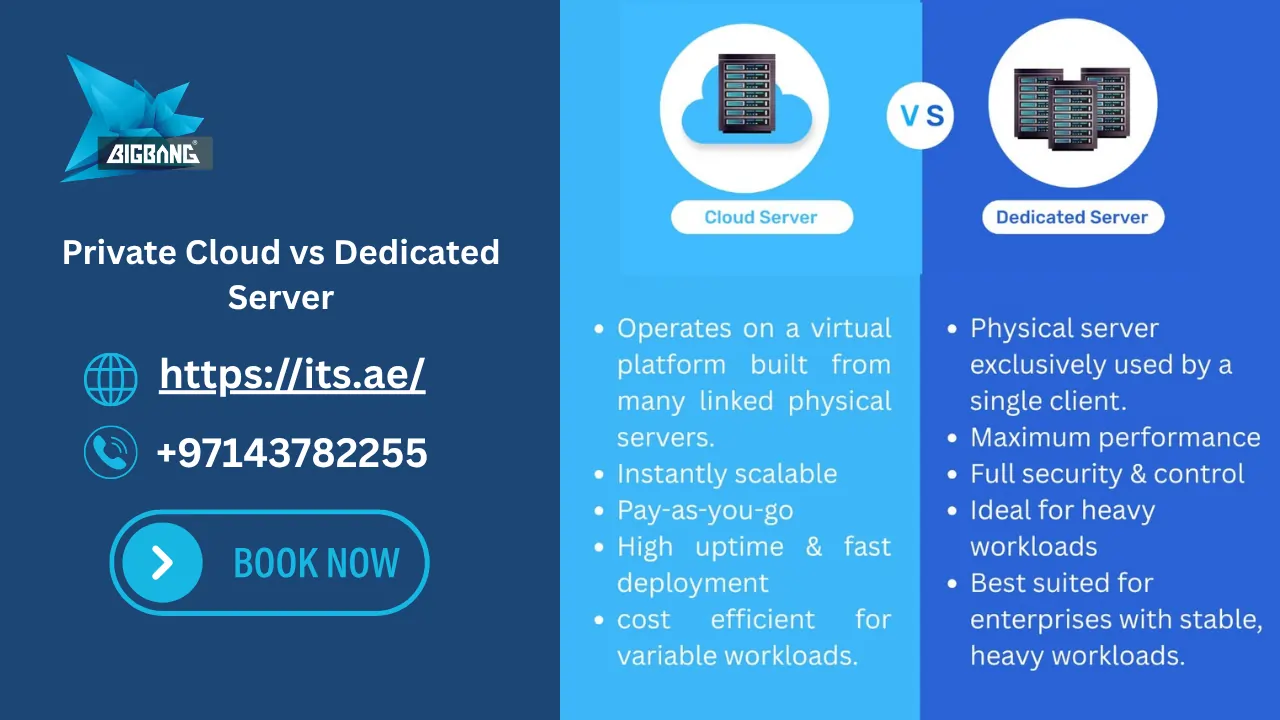
Choosing between a private cloud vs dedicated server is a key infrastructure decision for growing businesses. While both offer dedicated computing resources, they differ in scalability, management, and performance.
This guide provides a clear comparison to help UAE businesses and IT teams choose the right solution based on workload, compliance needs, and long-term cost efficiency.
What Is a Server?
When evaluating private cloud vs dedicated server hosting, you are essentially choosing between two different ways to deploy and manage server resources — either through virtualized cloud infrastructure or through physical bare-metal hardware dedicated exclusively to your organization.
For growing businesses, choosing the wrong infrastructure can lead to higher operational costs, slower deployments, and scalability bottlenecks that directly affect revenue and customer experience.

What Is a Private Cloud Server?
A private cloud is an isolated computing environment built exclusively for a single organization. NIST SP 800-145 defines it as cloud infrastructure provisioned for exclusive use by a single organization, which may be owned, managed and operated by that organization, a third party or a combination of them, and may exist on or off premises, so a hosted private cloud is still a private cloud. Unlike public cloud (where resources are shared across thousands of customers), a private cloud gives your business dedicated infrastructure — with the flexibility and automation of cloud technology.
Private cloud environments are typically built on virtualization platforms such as VMware, OpenStack, or Proxmox (an open-source server virtualization platform) — providing dynamic resource allocation across a pool of dedicated hardware.
How Private Cloud Works: Virtualization Explained Simply
In a private cloud, physical servers are virtualized — meaning one physical machine can host multiple virtual machines (VMs), each with its own allocated CPU, RAM, and storage. These VMs can be created, resized, or removed in minutes, giving businesses cloud-like agility without sharing infrastructure with external parties.
Hosted Private Cloud vs On-Premise Private Cloud
There are two main deployment models for private cloud:
- Hosted Private Cloud: The infrastructure is owned and managed by a third-party provider (like ITS) and located in a secure data center. You control the virtual environment; the provider handles hardware, maintenance, and uptime.
- On-Premise Private Cloud (private cloud vs on premise): The infrastructure is physically located in your own facility. You maintain full control — but also bear the full cost of hardware, maintenance, power, and staffing.
For most UAE businesses, hosted private cloud offers the best balance of control, compliance, and cost efficiency.
Private Cloud vs Dedicated Cloud: Are They the Same?
This is one of the most common points of confusion when researching dedicated cloud vs private cloud. Here is the key distinction:
- A private cloud is any isolated cloud environment dedicated to one organization — hardware may be managed by a provider.
- A dedicated cloud is a specific type of private cloud where the customer has full control over the underlying hardware specs and configuration.
In simple terms: all dedicated clouds are private clouds — but not all private clouds are dedicated clouds.
What Is a Dedicated Server?
A dedicated server is a physical machine — also called a bare-metal server — leased or purchased exclusively by one organization. In our store, dedicated servers are rented monthly; the listed plans are hosted in Europe, and a server in our Dubai data centre is configured and quoted on request. There is no virtualization layer. You get 100% of the server’s CPU, RAM, storage, and bandwidth — with no resource sharing and no “noisy neighbor” effects.
How a Dedicated Server Works: Bare-Metal Explained
When you rent a dedicated server, you receive access to a single physical machine in a data center. Your applications run directly on the hardware, which delivers the highest possible performance for compute-intensive workloads such as high-traffic databases, AI/ML processing, gaming servers, and financial trading platforms.
Managed vs Unmanaged Dedicated Servers
- Unmanaged Dedicated Server: You have full root access and are responsible for all configuration, security, updates, and maintenance. Requires strong internal IT expertise.
- Managed Dedicated Server: The provider handles OS updates, security patching, monitoring, and support. Ideal for businesses without a dedicated in-house server team.
Private Cloud vs Dedicated Server: Key Differences
When comparing private server vs cloud infrastructure, five factors matter most:
Performance and Speed
Dedicated servers typically deliver slightly higher raw performance because applications run directly on the hardware — no virtualization overhead. For workloads requiring maximum sustained compute power (AI/ML, rendering, HPC), dedicated servers hold an edge.
Private cloud performance is high and consistent, especially with modern hypervisors — the gap with bare-metal has narrowed significantly. For most enterprise applications, private cloud delivers more than sufficient performance.
Scalability: Which Scales Faster?
This is the biggest practical difference in the private cloud vs dedicated server debate:
- Private Cloud: Scale resources up or down in minutes — add CPU, RAM, or storage without purchasing new hardware. Ideal for variable workloads and growing businesses.
- Dedicated Server: Scaling requires procuring, configuring, and deploying additional physical hardware — a process that can take days or weeks.
Private cloud is ideal for businesses needing rapid scalability, while dedicated servers suit stable, high-performance workloads.
Security and Data Protection
Both private cloud and dedicated servers offer strong security, but through different architectures. When evaluating private server vs cloud security, consider your threat model:
- Dedicated Server: Physical isolation means no other company’s workloads share your hardware. The offline element of dedicated infrastructure protects against certain network-based attacks — but makes the system more vulnerable to physical risks (disasters, hardware failure).
- Private Cloud: Logical isolation via virtualization. Managed private cloud environments include automated security patching, DDoS protection, firewalls, and audit logging — often exceeding the security posture of unmanaged dedicated hardware.
Control and Customization
- Dedicated Server: Full control over hardware selection, operating system, software stack, and network configuration. Best for highly specialized workloads.
- Private Cloud: Control over the virtual environment — OS, software, network settings. Hardware is managed by the provider. Less hardware-level control, but faster provisioning and less operational overhead.
Management and Maintenance
- Dedicated Server: In-house team is responsible for OS patches, security updates, hardware monitoring, and failure response — unless a managed service is purchased.
- Private Cloud: Provider manages physical infrastructure. Your team focuses on applications and workloads, not hardware maintenance.
Private Cloud vs Dedicated Server: Quick Comparison Table
| Feature | Private Cloud | Dedicated Server |
| Infrastructure | Virtualized (VMware, OpenStack) | Physical bare-metal hardware |
| Scalability | High — scale resources instantly | Limited — requires new hardware |
| Performance | High — pooled resources | Highest — no virtualization layer |
| Security | Isolated environment + managed | Physical isolation, full control |
| Management | Managed by provider (3rd party) | Self-managed or managed add-on |
| Compliance (UAE) | GDPR, ISO 27001, DIFC-ready | Full control over data residency |
| Cost Model | Monthly subscription (OpEx) | Fixed monthly fee (OpEx/CapEx) |
| Setup Time | Fast (hours) | Slower (days/custom build) |
| Best For | Enterprises, multi-app, compliance | High-traffic, compute-intensive apps |
Not sure which option fits your business?
Speak with a cloud infrastructure expert to evaluate whether private cloud or dedicated servers better suit your performance, security, and compliance requirements.
Private Cloud vs Dedicated Server: Which Is More Secure?
Security is the top concern for businesses evaluating both options — especially in regulated industries. The answer depends on your threat profile and compliance requirements.
Data Isolation in Private Cloud
Private cloud environments provide logical isolation — your workloads are separated from other tenants at the hypervisor level. Managed private cloud solutions include centralized security management, intrusion detection, automated threat response, and full audit trails — making compliance reporting significantly easier.
Physical Security Advantages of Dedicated Servers
Because a dedicated server is a single physical machine, there is no risk of cross-tenant data leakage at the hardware level. For highly sensitive data — such as financial transaction records or classified government data — the physical isolation of a dedicated server can be a regulatory requirement.
Compliance Requirements: GDPR, ISO 27001, and UAE Regulations
For businesses operating in the UAE, compliance is non-negotiable. Both infrastructure types can support compliance, but in different ways:
- Private Cloud: Easier to achieve and demonstrate compliance (ISO 27001, PCI DSS, GDPR) through provider-managed audit tools, encryption at rest/transit, and centralized policy enforcement. Well-suited for DIFC and ADGM-regulated entities.
- Dedicated Server: Requires the business to implement and maintain compliance controls independently — powerful for organizations with strong in-house security teams and highly specific regulatory requirements.
UAE businesses subject to data residency requirements should confirm that their chosen solution hosts data within UAE borders — a capability that both ITS private cloud and dedicated server solutions support.
Use Cases: When to Choose Private Cloud
Private cloud is the right choice when flexibility, scalability, and managed compliance matter more than raw bare-metal performance:
Enterprise Applications and Multi-Workload Environments
Organizations running multiple applications simultaneously — ERP systems, CRM platforms, internal portals, and databases — benefit from private cloud’s ability to allocate resources dynamically between workloads without provisioning separate physical servers for each.
Financial Services and Healthcare in the UAE
Industries subject to strict data regulations — banking, insurance, healthcare, legal services — increasingly prefer private cloud because it combines dedicated infrastructure with built-in compliance tooling. Automated audit logs, encryption, and access controls reduce the compliance burden significantly.
Many organizations searching for web hosting services for financial marketing platforms prioritize private cloud environments because of their compliance capabilities, encryption controls, and audit readiness.
Businesses Requiring Rapid Scaling
If your business experiences seasonal traffic spikes, is launching new products, or is growing rapidly, a private cloud allows you to scale resources in hours, not weeks. This agility is impossible with physical dedicated hardware alone.
Use Cases: When to Choose a Dedicated Server
Dedicated servers remain the best choice when raw performance, full hardware control, and long-term cost predictability are the primary drivers:
High-Traffic Websites and E-commerce Platforms
E-commerce platforms processing thousands of concurrent transactions require consistent, high-throughput performance. Dedicated servers deliver this without the virtualization overhead of cloud environments — making them ideal for platforms where milliseconds of latency directly impact conversion rates.
Businesses evaluating top enterprise hosting for high traffic sites often choose dedicated infrastructure for consistent performance under heavy workloads.
Gaming Servers and Compute-Intensive Workloads
Real-time gaming applications, rendering pipelines, big data processing, and AI/ML inference workloads benefit from the full compute power of bare-metal hardware. Dedicated servers allow direct access to GPU resources and custom hardware configurations not possible in virtualized environments.
Businesses That Need Full Hardware Control
Organizations with specific hardware requirements — proprietary software licenses tied to physical servers, specialized networking equipment, or custom BIOS configurations — require the hardware control that only a dedicated server provides.
Choosing the right infrastructure at this stage can significantly impact your performance, scalability, and long-term operational cost. If you’re unsure, a quick consultation can help clarify the best path forward.
How to Choose Between Private Cloud and Dedicated Server
Questions to Ask Before Deciding
- Does your workload require maximum bare-metal performance, or will virtualized performance suffice?
- How variable is your resource demand — do you experience traffic spikes or seasonal peaks?
- Do you have an internal IT team capable of managing server hardware and security independently?
- Are you subject to UAE data regulations (DIFC, ADGM, healthcare, finance) that require documented compliance?
- How quickly do you need to scale — hours or weeks?
Businesses comparing private cloud and dedicated infrastructure should also understand how to select a web hosting company based on scalability, security, compliance, and long-term operational support.
ITS supports UAE enterprises with enterprise-grade hosting solutions, including managed private cloud, dedicated servers, hybrid infrastructure, and migration services — all backed by local data center presence and SLA-driven support.
Choose Private Cloud If…
- You run multiple applications or services simultaneously
- Your business is growing and requires flexible, rapid scaling
- You need built-in compliance and managed security (UAE financial/healthcare sector)
- You want predictable OpEx costs without hardware management responsibilities
- You need disaster recovery and high availability across multiple availability zones
Choose Dedicated Server If…
- Your workload is consistently high and compute-intensive with predictable resource demands
- You need the absolute highest performance for gaming, rendering, or real-time data processing
- You require full hardware control and custom infrastructure configurations
- Your in-house IT team can manage server security, patches, and maintenance
- You need physical hardware isolation for highly sensitive data with no virtualization layer
What About VPS vs Cloud vs Dedicated? Understanding the Full Spectrum
When businesses search for VPS vs cloud vs dedicated comparisons, they’re typically trying to understand the full hosting spectrum. Here’s where each option fits:
- VPS (Virtual Private Server): Entry-level virtualized hosting. Shares physical hardware with other tenants (see our VPS hosting plans, which come with full root access and a browser console). Best for small businesses, developers, and test environments. Lower cost, less performance.
- Private Cloud: Mid-to-enterprise level. Dedicated virtualized infrastructure for one organization. Best balance of flexibility, security, and scalability for growing businesses.
- Dedicated Server: Enterprise and performance-focused. Full physical hardware for one organization. Maximum performance and control.
For businesses in the UAE that have outgrown VPS but are weighing the next step — the private cloud vs dedicated server decision is the defining infrastructure choice for sustainable growth.
Businesses running content-heavy WordPress platforms may also evaluate the best web hosting in UAE for WordPress before deciding whether to move toward private cloud or dedicated infrastructure.
What About Cost?
Private cloud vs dedicated server cost and private cloud vs dedicated server pricing are among the most searched questions in this space. While both options are priced differently based on resources, provider, and management level, a full cost breakdown is beyond the scope of this technical comparison article.
For detailed monthly pricing estimates, cost predictability analysis, and a UAE-specific cost comparison, see our full guide: Cloud vs Dedicated Server Cost
Private Cloud and Dedicated Servers in the UAE: What Businesses Should Know
Data Sovereignty and Local Hosting Regulations
UAE businesses — particularly those in financial services, healthcare, and government — may be subject to sector-specific data residency rules set by their regulators. Hosting private cloud or dedicated server infrastructure within UAE data centers (Dubai and Abu Dhabi) is the usual way to meet such rules, but confirm the exact requirement with your regulator. Cloud solutions hosted outside the UAE may create compliance risks under local data protection regulations. At federal level the baseline is the Personal Data Protection Law (Federal Decree-Law No. 45 of 2021, in force since 2 January 2022), which sets the requirements for cross-border transfer and sharing of personal data; our guide to the UAE data protection law and your website walks through what that means for a hosted site.
UAE Enterprises Are Moving to Private Cloud
Across the UAE, enterprise businesses are accelerating their migration from traditional dedicated infrastructure toward private cloud. The reasons are consistent: faster scaling to support the ‘We the UAE 2031’ vision and its digital transformation goals, reduced IT operational burden, built-in compliance tooling for regulated industries, and the ability to deploy new services in hours rather than weeks.
At the same time, dedicated servers remain a strategic component for high-performance workloads, financial trading platforms, and mission-critical databases where bare-metal performance is non-negotiable.
How ITS Delivers Both Solutions in the Middle East
ITS (its.ae) is a certified technology partner across the Middle East, providing both private cloud and dedicated server solutions tailored to UAE business requirements. Whether you need the flexibility of managed private cloud infrastructure or the raw performance of bare-metal dedicated servers, ITS delivers enterprise-grade solutions backed by local support, UAE data center presence, and deep regional expertise.
ITS solutions include: fully managed private cloud environments, dedicated server hosting in UAE data centers, hybrid cloud architectures, and migration support for businesses transitioning between hosting models.
Final Thoughts
The choice between private cloud and dedicated servers depends on your workload, performance needs, and compliance requirements — not on which technology is better overall.
Private cloud is ideal for flexibility and scalability, while dedicated servers are best for maximum performance and full hardware control. Many UAE enterprises also adopt a hybrid approach to balance both models.
If you’re unsure which option fits your business, ITS experts can help you evaluate your infrastructure needs and recommend the right solution.
Get a free consultation with ITS today.
Sources
- NIST — SP 800-145, The NIST Definition of Cloud Computing (four deployment models; private cloud: exclusive use by a single organization, on or off premises, operated by the organization or a third party) (accessed 2026-10-12)
- Proxmox — Proxmox Virtual Environment: open-source server virtualization platform (accessed 2026-10-12)
- PCI Security Standards Council — PCI DSS (accessed 2026-10-12)
- UAE Government portal (u.ae) — Data protection laws: Federal Decree-Law No. 45 of 2021 Regarding the Protection of Personal Data, in force 2 January 2022, cross-border transfer requirements (accessed 2026-10-12)
- UAE Government portal (u.ae) — ‘We the UAE 2031’ vision (accessed 2026-10-12)
FAQs
Which is better, VPS or cloud hosting?
Cloud hosting is generally better for scalability, reliability, and performance because it distributes resources across multiple servers. VPS hosting is more affordable but limited in scalability and resources, making it suitable for small to medium websites.
What are the 4 types of hosting?
The four main types of web hosting are:
- Shared Hosting
- VPS Hosting (Virtual Private Server)
- Dedicated Server Hosting
- Cloud Hosting (including private cloud solutions)
Each type differs in performance, scalability, control, and cost.
Which is better, VPS or dedicated server?
A dedicated server is better for performance, security, and full hardware control, making it ideal for high-traffic and resource-intensive applications. VPS hosting is more budget-friendly but shares underlying hardware resources, which can limit performance.
What is the difference between VPS and cloud functions?
VPS is a virtual machine with fixed allocated resources (CPU, RAM, storage), while cloud functions are serverless and run only when triggered, scaling automatically. VPS is better for always-on applications, while cloud functions are better for event-driven, lightweight workloads.
Talk to us directly — we usually reply within minutes during business hours.