For fifteen years, the practical answer to “can we do business in Syria” was no — not because of the merits of any particular deal, but because the compliance risk fell on anyone who touched it, wherever in the world they were. That answer has changed. Over roughly twenty months the United States dismantled most of its Syria sanctions architecture, ending with the repeal of the Caesar Act in December 2025 and the removal of Syria’s State Sponsor of Terrorism designation in August 2026. A market of more than twenty million people that was closed to normal commerce is now, in most respects, open.
What follows is what actually changed, which service sectors are opening first, and — from the position of an IT company in the UAE that fields these questions weekly — what a business practically needs in place to operate there. It ends with the part most enthusiastic coverage leaves out: what has not been lifted.
This is commercial orientation, not legal or sanctions advice. Sanctions compliance is fact-specific and the details still matter enormously. Before transacting, take advice from qualified counsel and run your own screening.
Quick Answer
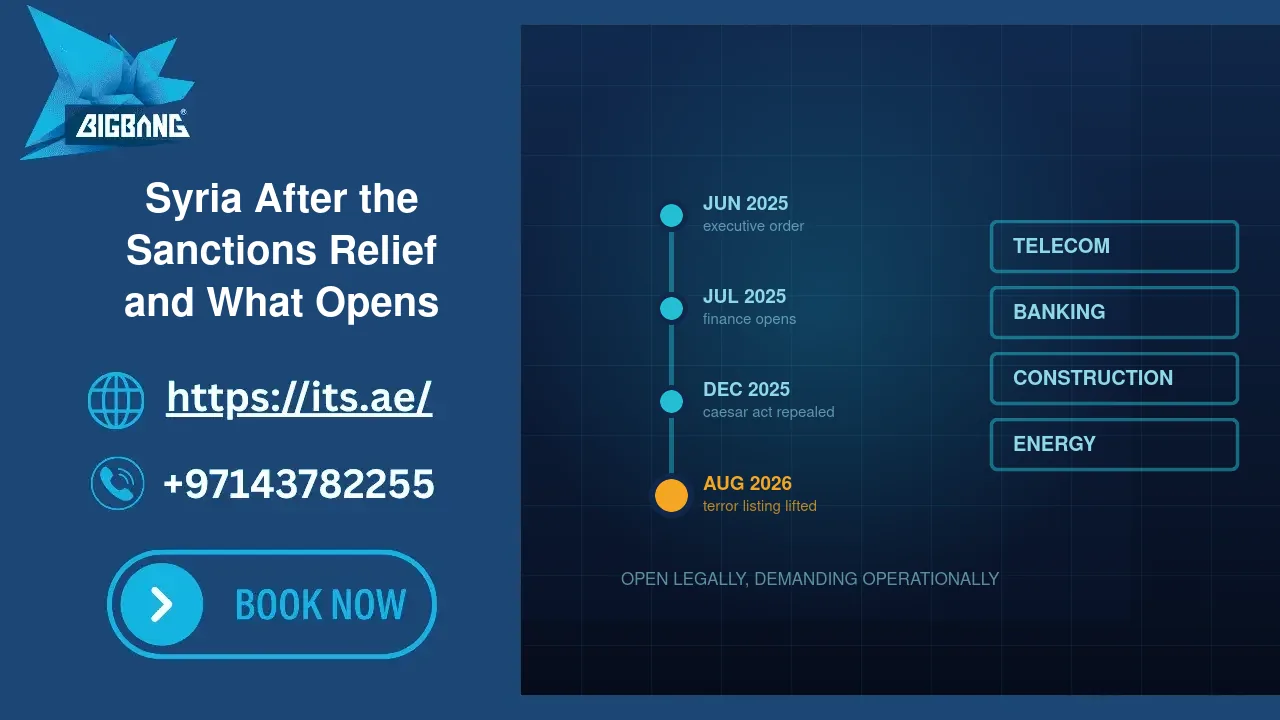
US sanctions on Syria were removed in stages: general licences in early 2025, Executive Order 14312 in June 2025, authorisation for financial services and correspondent banking from 1 July 2025, repeal of the Caesar Act on 18 December 2025, and rescission of the State Sponsor of Terrorism designation effective 24 August 2026. The immediate effects are that non-US companies no longer face secondary sanctions for legitimate Syrian business, and that money can move: the Central Bank of Syria has reconnected to SWIFT and international card acceptance has begun. The sectors moving first are telecoms, banking and fintech, construction and property, and energy. Individual designations remain in force — the country is open, specific people are not, and screening every counterparty is still mandatory.
What Actually Changed, and When
The sequence matters, because different obligations fell away at different points and a lot of commentary blurs them together.
January and May 2025 — General Licences 24 and 25. The first broad authorisations, permitting transactions that had been prohibited outright.
June 2025 — Executive Order 14312. Directed US agencies to unwind the sanctions and export-control programme applied to Syria.
1 July 2025 — financial services opened. From this date US persons were no longer prohibited from providing financial services to Syria, processing payments involving Syrian financial institutions on behalf of third-country banks, or establishing correspondent banking relationships. This is the change that made everything else practical: without payment channels, permission to trade is theoretical.
18 December 2025 — the Caesar Act repealed. Repealed through the annual defence bill. The Caesar Act was the piece that reached beyond US jurisdiction: it threatened foreign persons with mandatory US sanctions for dealing with Syria’s government, construction, energy and infrastructure sectors. Its repeal is why a UAE, Turkish or European company can now engage without fearing exposure in the US financial system.
24 August 2026 — State Sponsor of Terrorism designation rescinded. Following notification to Congress in July and the statutory 45-day review. Syria is no longer subject to the Terrorism List Governments Sanctions Regulations. Hay’at Tahrir al-Sham was simultaneously removed from the SDN list.
The Sectors Opening First
Telecommunications
The clearest activity, and the sector with the largest visible numbers. Syria was formally readmitted to the GSMA on 30 July 2025, ending a long exclusion from the global mobile industry body. In March 2026 the Ministry of Communications and Information Technology launched an international tender for a new mobile licence to replace MTN Syria’s, as MTN negotiated an orderly exit. Zain won that licence for $747 million, with a 25-year term (20 years plus an optional five-year extension) and a 75 per cent stake alongside Syria’s sovereign wealth fund, and has announced plans for around $800 million of 5G and AI network investment.
The context for those numbers is that roughly half of Syria’s infrastructure, including its communication networks, is reported destroyed or inoperable after more than a decade of war and digital embargo. This is not an upgrade cycle; it is a rebuild. Everything downstream of connectivity — cloud services, payments, e-commerce, remote work — is gated on it.
Banking and fintech
The Central Bank of Syria has reconnected to SWIFT and reopened an account at the Federal Reserve Bank of New York, and is working to establish correspondent relationships with banks abroad, starting with Turkey. QNB became the first foreign bank to enable international card acceptance, meaning Syrian merchants can process Visa and Mastercard transactions for the first time in over a decade.
The honest characterisation is that the market has reopened faster than the sector has rebuilt. Correspondent banking coverage is thin, cash still dominates, and the domestic banking system is small relative to the economy it now has to serve. That gap is precisely why fintech firms are moving early: payments, remittances and merchant acquiring are underserved in a way that rarely happens in a market of this size.
Construction, property and infrastructure
The largest headline commitments are here. Emaar founder Mohamed Alabbar has spoken of investing as much as $18 billion in Syria. Saudi Arabia announced a package in February 2026 spanning energy, aviation, property and telecoms, alongside agreements on telecommunications infrastructure and digital connectivity.
Energy
Consistently named among the most promising sectors, and one of the specific areas the Caesar Act repeal unblocked for foreign participants.
What a Business Actually Needs to Operate
This is where the coverage gets thin, because it is unglamorous. Whether you are opening an office, serving Syrian clients from the UAE, or supporting a partner on the ground, the operational checklist is the same one that applies in any recovering market — with a few local specifics.
Connectivity you do not depend on. Assume unreliable local bandwidth and plan around it. Systems that require a constant connection to a local office will fail. Systems hosted outside the country, reachable from anywhere, and usable on a phone will not.
Host outside the country. For the foreseeable future, business-critical systems belong in a stable, well-connected jurisdiction — the UAE being the obvious one for regional operations — with users reaching them over the internet. Local hosting infrastructure is part of the rebuild, not a current option.
A domain and email identity that survives scrutiny. Counterparties and banks will scrutinise a new Syrian-market entity harder than they would scrutinise a new entity anywhere else. A proper domain, authenticated business email (SPF, DKIM and DMARC configured correctly), and a real website are not marketing; they are the difference between your invoices arriving and your invoices landing in a spam folder during a compliance review.
Telephony that is not tied to a local line. A cloud phone system gives you numbers, call routing and recording independent of local infrastructure, and lets a team in Dubai and a team in Damascus operate as one. Call recording matters more than usual here, because documentation is part of your compliance posture.
Documentation discipline from day one. Every counterparty screened and the screening recorded. Every payment with a clear, evidenced purpose. Contracts that say what the money is for. Not because anyone assumes bad faith, but because banks entering this market are cautious by necessity, and the business that can produce its file immediately clears in days while the one that cannot waits months.
Bilingual everything. Arabic and English, properly — not machine-translated Arabic. This is a market where the quality of your Arabic is read as a signal about the seriousness of your operation.
What Has Not Been Lifted
This section matters more than the rest of the article, because the most expensive mistake available right now is assuming that “sanctions lifted” means “no sanctions”.
Individual designations remain. A number of individuals who held formal positions in HTS or its predecessor organisations remain on the SDN list under separate authorities. Bashar al-Assad and other figures remain designated. Country-level relief does not touch person-level designations.
Screening is still mandatory. Every counterparty, beneficial owner, director and payee. The obligation did not go away; what changed is that a clean screening result is now a route to doing business rather than a dead end.
Other jurisdictions have their own regimes. US relief is not EU or UK relief. If your business or your banking touches those jurisdictions, their rules apply independently and on their own timetable.
Export controls are separate from sanctions. Specific goods and technologies carry their own licensing requirements regardless of the sanctions position.
Banks apply their own risk appetite. A transaction being legal does not oblige any bank to process it. Expect enhanced due diligence, and expect it to take time.
The practical posture is straightforward: treat Syria as a market that is legally open and operationally demanding. Do the screening properly, document everything, and take real advice on your specific transactions.
The Regional Angle
For UAE-based businesses this is not a distant story. The UAE is among the most visible sources of capital and commercial interest in Syria’s reopening, the commercial and logistics links are old and well established, and there is a large, well-connected Syrian business community across the Emirates that has spent fifteen years unable to trade with home.
The realistic near-term pattern is not companies relocating to Damascus. It is UAE-registered businesses serving the Syrian market from here — trading, consulting, technology, logistics and professional services delivered from Dubai to clients and partners on the ground. That structure keeps banking, contracts and infrastructure in a jurisdiction that works, which is exactly what the current stage of the rebuild calls for.
Frequently Asked Questions
Are US sanctions on Syria fully lifted?
Country-level sanctions are gone: the comprehensive programme ended on 1 July 2025 under Executive Order 14312, the Caesar Act was repealed on 18 December 2025, and the State Sponsor of Terrorism designation was rescinded on 24 August 2026. Person-level designations remain, including Bashar al-Assad and his associates, so screening every counterparty is still mandatory.
Can a UAE company legally do business in Syria today?
In most cases yes, provided no counterparty appears on the US SDN list or on EU or UK lists and no controlled goods are involved. The EU lifted its economic sanctions in May 2025; the UK keeps a separate regime you must check independently. Banks apply their own risk appetite, so expect enhanced due diligence and take legal advice.
Can money be transferred to and from Syria now?
Yes, with limits. The Central Bank of Syria resumed SWIFT messaging in November 2025, reactivated its account at the Federal Reserve Bank of New York in March 2026, and international Visa and Mastercard transactions began through QNB in 2026. Correspondent banking coverage is still thin, so transfers take longer and need clear documentation of purpose.
Sources
- OFAC (U.S. Treasury) — Recent Actions 2025-01-06: Issuance of Syria General License 24 (accessed 2026-09-15)
- OFAC (U.S. Treasury) — Recent Actions 2025-05-23: Issuance of Syria General License 25 (accessed 2026-09-15)
- U.S. Department of the Treasury — Treasury Issues Immediate Sanctions Relief for Syria (23 May 2025) (accessed 2026-09-15)
- Federal Register — Executive Order 14312, Providing for the Revocation of Syria Sanctions (30 June 2025) (accessed 2026-09-15)
- OFAC (U.S. Treasury) — Recent Actions 2025-06-30: Revocation of Syria Sanctions; Syria FAQs (accessed 2026-09-15)
- OFAC (U.S. Treasury) — Syria Sanctions FAQs (accessed 2026-09-15)
- GovInfo — Public Law 119-60, National Defense Authorization Act for Fiscal Year 2026 (approved 18 December 2025; repeals the Caesar Act) (accessed 2026-09-15)
- OFAC (U.S. Treasury) — Recent Actions 2026-08-24: Removal of Syria’s designation as a State Sponsor of Terrorism and associated list updates (accessed 2026-09-15)
- OFAC (U.S. Treasury) — Promoting Accountability for Assad and Regional Stabilization Sanctions (PAARSS) (accessed 2026-09-15)
- European Commission — Commission welcomes lifting of EU economic sanctions on Syria (28 May 2025) (accessed 2026-09-15)
- GOV.UK — UK sanctions on Syria (collection) (accessed 2026-09-15)
- World Bank — Syria overview (accessed 2026-09-15)
- World Bank — Syria’s Post-Conflict Reconstruction Costs Estimated at $216 billion (21 October 2025) (accessed 2026-09-15)
- SANA — Syria launches international tender for 20-year mobile network license (March 2026) (accessed 2026-09-15)
- Telecompaper — Zain Group wins license to take over MTN Syria network for USD 747 mln (accessed 2026-09-15)
- Telco Magazine — Syria Rejoins GSMA: Telecoms Rebuild Eyes 5G, MTN, Syriatel (accessed 2026-09-15)
- SANA — Syria’s Central Bank resumes SWIFT operations after 14-year halt (accessed 2026-09-15)
- Al-Monitor / Reuters — Syria sends first Swift message to New York Fed, central bank governor says (November 2025) (accessed 2026-09-15)
- Electronic Payments International — Visa, Mastercard process first global payments in Syria (accessed 2026-09-15)
- The National — Emaar founder Alabbar plans to invest up to $18 billion in Syria (12 May 2026) (accessed 2026-09-15)
- Saudi Press Agency — Saudi Arabia, Syria Sign Major Investment Agreements Under Presidential Patronage (February 2026) (accessed 2026-09-15)
- The National — Syria’s US terror delisting opens door to foreign investment (25 August 2026) (accessed 2026-09-15)
Where We Fit
BIGBANG ITS is an IT company in Dubai, not a sanctions advisor, and we will not pretend otherwise. What we do handle is the layer underneath a cross-border operation: domains and business email that authenticate properly, hosting in the UAE for systems that need to stay reachable, cloud telephony that ties distributed teams together, and bilingual websites that read as though a native speaker wrote them — because one did.
If you are building toward the Syrian market and want the technical and communications side handled by people who work in both languages and both time zones, talk to us.
Talk to us directly — we usually reply within minutes during business hours.