When a UAE company asks what a mobile app costs, it usually gets a single number with no explanation behind it. That number hides three cost layers: the build, the store fees, and the cost of keeping the app working after launch. We have 13 mobile app projects in our portfolio, and every quote we write is built from those three layers. This guide sets out the cost structure of a mobile app in the UAE in 2026, with the fees Apple and Google publish themselves, so you can budget before you ask anyone for a price.
Quick Answer
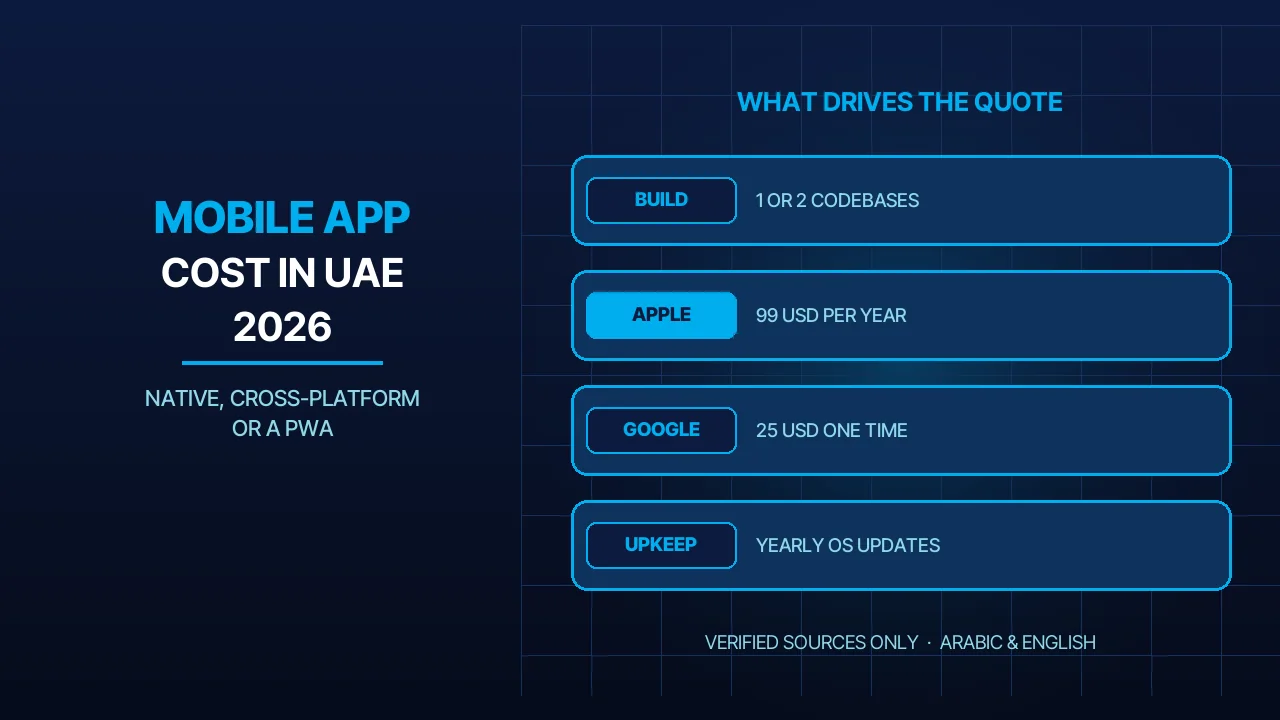
A mobile app has three cost layers: the build, the store fees and the yearly running costs. The build depends on the approach. A native app means 2 codebases, a cross-platform app means 1 codebase shipped to both stores, and a PWA is 1 web codebase with no store at all. The store fees are fixed and public: the Apple Developer Program costs 99 USD per membership year and Google Play charges a 25 USD one-time registration fee. Store commission applies to digital goods and services sold in the app, not to physical goods or services. We do not publish a price list for mobile app development; every app is quoted per project after scoping.
The Three Ways to Build an App, and What Each Does to the Quote
Native. A native app is written separately for each platform, typically in Swift for iPhone and Kotlin for Android. You pay for 2 codebases, 2 rounds of testing and 2 sets of updates for the life of the app. Native fits apps whose value depends on the device itself: heavy camera or sensor work, complex animation, or integration with hardware.
Cross-platform. Frameworks such as Flutter or React Native let one team write the app once and ship it to both stores. Flutter’s own documentation describes it as a way to build multiplatform apps from a single codebase. One codebase means one build effort and one maintenance line, which suits most business apps, such as ordering, booking, delivery and loyalty apps. You still need both store accounts, and both stores still review the app.
PWA. A progressive web app is a website that behaves like an app. MDN describes it as something that runs on multiple platforms from a single codebase, can be installed on the device and can operate while offline. There is no store account, no store review and no store commission, because the customer installs it from the browser. If you already have a good website, a PWA is the smallest step up from it, and it shares most of the work with your business website budget.
| Point | Native | Cross-platform | PWA |
|---|---|---|---|
| Codebases | 2 (iOS and Android) | 1 for both stores | 1 web codebase |
| Distribution | App Store and Google Play | App Store and Google Play | Your own website, installed from the browser |
| Store fees | 99 USD per year (Apple) and 25 USD once (Google) | 99 USD per year (Apple) and 25 USD once (Google) | None |
| Push notifications | Yes, on both platforms | Yes, on both platforms | On iPhone only after the user adds the app to the Home Screen, from iOS 16.4 |
| Offline use | Yes | Yes | Possible, if it is built for it |
| When it fits | Device-heavy features, highest polish | Most business apps on a single budget | Content, catalogues, bookings and internal tools |
The Fees Apple and Google Publish
Store accounts. Apple states that the Apple Developer Program is 99 USD per membership year, and that prices may vary by region and are listed in local currency during enrolment. Google Play asks for a 25 USD one-time registration fee. These are the only fixed store costs.
Commission on digital sales. Apple’s membership page says the commission on digital goods and services sold through the App Store is 30%, or 15% if you are enrolled in the App Store Small Business Program, and 15% for qualifying subscriptions. Apple adds that different rates may apply in some regions. Google’s service fee page sets the rate by where the paying user is. For users outside Australia, the European Economic Area, Japan, the United Kingdom and the United States it lists, until its updated fees are rolled out globally, 15% on the first 1 million USD a developer earns each year for developers enrolled in the 15% service fee tier, 30% on earnings above that, and 15% on automatically renewing subscriptions. A different table has applied to users in those 5 markets since 2026, so read both if you sell abroad.
Physical goods and services are different. Apple’s guideline 3.1.3(e) says that if your app sells physical goods or services consumed outside the app, you must use purchase methods other than in-app purchase, such as Apple Pay or card entry. Google’s Payments policy says Google Play’s billing system must not be used for physical goods or physical services. So a shop, a restaurant, a clinic or a delivery company pays no store commission on its orders. It pays its payment gateway instead, and we compare those in our guide to payment gateways in the UAE.
Digital content must use the store’s billing. Apple’s guideline 3.1.1 says features opened inside the app, such as subscriptions and premium content, must use in-app purchase. Google’s Payments policy requires Google Play’s billing system for in-app features, digital content and digital goods, apart from the exceptions it lists. If your app sells courses, memberships or media, put the commission into your business plan from day one.
What Store Review and iPhone Rules Mean for a PWA
A wrapped website is not an app. Apple’s guideline 4.2 says an app should include features, content and UI that elevate it beyond a repackaged website. If the plan is to put your site inside a shell and submit it, budget for the risk of rejection, or choose a PWA and skip the store.
A PWA on iPhone has limits you should know. WebKit, the engine behind Safari, added Web Push for Home Screen web apps in iOS and iPadOS 16.4. The same page sets the conditions: the user must first add the web app to the Home Screen from the Share menu, and the app may ask for notification permission only in response to a direct user action such as tapping a subscribe button. WebKit also states you do not need to be a member of the Apple Developer Program to use Web Push. In practice a PWA suits staff tools and returning customers more than winning new ones.
The Running Costs People Forget
Yearly OS updates. An app is never finished. Google’s target API level requirement states that from 31 August 2026 new apps and app updates must target Android 16 (API level 36) or higher, and existing apps must target Android 15 (API level 35) or higher to remain available to new users on newer devices. Put a yearly maintenance line in the budget, and ask every supplier to price it.
Backend and hosting. Almost every app talks to a server: accounts, orders, notifications, an admin panel. That server has a monthly cost and needs backups and security updates. A properly sized VPS is usually enough to start, and it can grow with usage.
Store accounts in the company’s name. Apple requires an organisation to be a legal entity and to have a D-U-N-S Number, a nine-digit identifier assigned by Dun & Bradstreet, plus a publicly available website on a domain associated with the organisation. Apple also says the organisation’s name is displayed as the seller name on the App Store. Google Play offers personal and organisation accounts. Open both accounts in your company’s name and invite the developer as a user. An app published under the developer’s account is controlled by whoever holds that account.
Arabic and right-to-left layout. A UAE app normally needs Arabic and English. Arabic is not only translation: the whole layout mirrors, and mixed Arabic and Latin text needs testing on real devices. Say in the brief whether Arabic is in the first release. Good UI/UX design settles this before any code is written.
What to Put in a Request for Quotation
Quotes are comparable only when every supplier prices the same thing. Fix these points before you ask us or anyone else:
- Approach: native, cross-platform or PWA, and which framework.
- Platforms and languages: iPhone, Android or both; Arabic and English from the first release or not.
- Screens and roles: a list of screens, and who uses the app (customer, driver, staff, admin).
- What is sold: physical goods or services through a payment gateway, or digital content through store billing.
- Integrations: payment gateway, SMS or WhatsApp, maps, your accounting or stock system, and an existing website or store. If you run an online shop, read whether your online store needs a mobile app first.
- Backend: who builds the admin panel and the API, where it is hosted, and who pays the hosting.
- Ownership: source code handed over, store accounts in your company’s name, and design files included.
- After launch: the warranty period, the yearly maintenance price and what it covers, including the yearly OS-update work.
Three decisions matter most: the approach, what you sell through the app, and who owns the accounts and the code.
Frequently Asked Questions
How much do Apple and Google charge to publish an app?
Apple lists the Apple Developer Program at 99 USD per membership year, with prices that may vary by region. Google Play charges a 25 USD one-time registration fee. These are account fees only. Commission is separate and applies to digital goods and services sold inside the app, not to physical goods or services.
Do the stores take a commission on orders for physical products?
No. Apple’s guideline 3.1.3(e) requires purchase methods other than in-app purchase for physical goods or services consumed outside the app, and Google’s Payments policy says Google Play’s billing system must not be used for them. A shop or delivery app pays its payment gateway, not the store.
Can a PWA replace a store app on iPhone?
Sometimes. From iOS and iPadOS 16.4 a web app added to the Home Screen can send push notifications after the user grants permission. The user must install it from the Share menu, and it is not listed in the App Store. It suits staff tools and returning customers more than winning new ones.
Sources
- Apple Developer Program: Become a member (accessed 2026-11-26)
- Apple Developer Program: Membership Details (accessed 2026-11-26)
- Apple: App Review Guidelines (accessed 2026-11-26)
- Play Console Help: Get started with Play Console (accessed 2026-11-26)
- Play Console Help: Service fees (accessed 2026-11-26)
- Play Console Help: Payments policy (accessed 2026-11-26)
- Android Developers: Meet Google Play’s target API level requirement (accessed 2026-11-26)
- WebKit: Web Push for Web Apps on iOS and iPadOS (accessed 2026-11-26)
- MDN Web Docs: Progressive web apps (accessed 2026-11-26)
- Flutter documentation (accessed 2026-11-26)
Where We Are
BIGBANG ITS has planned and run technology for UAE businesses since 2003, headquartered at the Sharjah Research, Technology and Innovation Park with a branch in Business Bay, Dubai. Support runs 24/7 and the office is open Saturday to Thursday, 09:00–18:00 Gulf time. To scope an app and get a written quotation, contact us or message us on WhatsApp.
Talk to us directly — we usually reply within minutes during business hours.